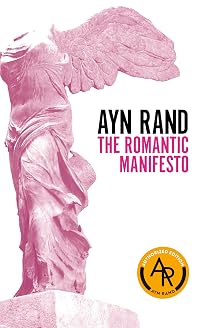
The Romantic Manifesto: A Philosophy of Literature (second revised edition, 1975)
by Ayn Rand 
On This Page
Description
In this beautifully written and brilliantly reasoned collection of essays, Ayn Rand throws new light on the nature of art and its purpose in human life. Once again, Rand demonstrates her bold originality and her refusal to let conventional ideas define her sense of the truth. Rand eloquently asserts that one cannot create art without infusing it with one's own value judgments and personal philosophy-even an attempt to withhold moral overtones only results in a deterministic or naturalistic show more message. Because the moral influence of art is inescapable, she argues, art should always strive to elevate the human spirit. The Romantic Manifesto takes its place beside The Fountainhead and Atlas Shrugged as one of the most important achievements of our time. show lessTags
Recommendations







Member Reviews
I know a lot of people sneer at Ayn Rand and her admirers. But one would think the one thing they'd acknowledge is that she was a writer who knew how to tell a story. *thinks of reviews she's seen.* OK, maybe not. But even if I'm not an uncritical devotee, I for one do love her style, do, with some reservations, love her novels. And I think the core of her argument here is absolutely true--you can't write fiction without revealing your philosophy and values--even if you try. Ayn Rand is the one who above all made me aware of that. I don't care if you're talking about Dostoevsky's Crime and Punishment or Mercedes Lackey's fantasy books about talking horses--I can tell you a lot about the values and worldview of the authors only from show more reading their fiction--ditto about even the most trite work in pulp romance. That doesn't mean I agree with all Rand's evaluations. Sometimes I think she argued backward to validate her own idiosyncratic tastes, and certainly there are plenty of works of "naturalism" I prefer over works of "romanticism" (I personally found Hugo's Ninety-Three, which I read on her recommendation, overwrought.)
But Rand gets at something basic though: that in a lot of the books we love--that what we look for is our values reflected back at us. That's what resonates, in both low and high literature. And we look for, crave for, heroes. And the lack of them is what makes so many modern works arid to me. I think that's why I, and many others, love science fiction and fantasy so much--they're the last refuge of the hero. show less
But Rand gets at something basic though: that in a lot of the books we love--that what we look for is our values reflected back at us. That's what resonates, in both low and high literature. And we look for, crave for, heroes. And the lack of them is what makes so many modern works arid to me. I think that's why I, and many others, love science fiction and fantasy so much--they're the last refuge of the hero. show less
Lucid to the point of being cartoonish. Her an analysis of style and the elements of literature are worthy of reading again though. I know it's sneered at by contemporary critics. I think her ideas have a lot of merit. If you don't buy them completely, they still would influence any thinking person's approach to interpreting art.
Though I don't agree with her opinions of caging art in boxes of social goals. The Romantic Manifesto is a good read only for the way Ayn Rand puts her points forward... To agree or to disagree with her opinion is a different matter altogether.
What makes good literature? How does an author create a heroic character? What is the difference between "romantic" and "naturalist" literature? Ayn Rand asks these questions and answers them in her usual succinct, enlightening style.
After reading The Romantic Manifesto, you will have a better understanding of why Rand wrote her novels the way she did. You can also apply her analysis to other novels, and perhaps come to consciously appreciate the "romantic" elements in other literature.
I found it a very stimulating view of looking at literature and writing and general. And, already respecting Rand's works, I now have a deeper understanding of both her philosophy, Objectivism, and her writing style. I would highly recommend it for Rand show more fans, literature enthusiasts, and philosophers alike. show less
After reading The Romantic Manifesto, you will have a better understanding of why Rand wrote her novels the way she did. You can also apply her analysis to other novels, and perhaps come to consciously appreciate the "romantic" elements in other literature.
I found it a very stimulating view of looking at literature and writing and general. And, already respecting Rand's works, I now have a deeper understanding of both her philosophy, Objectivism, and her writing style. I would highly recommend it for Rand show more fans, literature enthusiasts, and philosophers alike. show less
Explains Ayn Rand's views on art, which of course are in sync with her philosophy, Objectivism. Since I am long out of my Rand phase (age 20), I wouldn't read it again.
In this tiny book, Ayn Rand presents to her audience rational esthetics. This is different from her more famous books (Atlas Shrugged and The Fountainhead) but even in those there is philosophy. I would only read this after I had read her other books because this can be somewhat difficult to understand for people who are not students of any kind of philosophy. But if you are a fan of Ayn Rand, I suggest you get your hands on this.
Ayn Rand's writings are a breath of fresh air. She was a luminary and her works are a testament to the heroic nature of the human spirit.
Members
- Recently Added By
Lists

Books Read in 2015
3,299 works; 129 members
Author Information

181+ Works 76,790 Members
Ayn Rand, 1905 - 1982 Novelist and philosopher Ayn Rand was born Alice Rosenbaum on February 2, 1905 in St. Petersburg, Russia. She graduated with highest honors in history from the University of Petrograd in 1924, and she came to the United States in 1926 with dreams of becoming a screenwriter. In 1929, she married actor Charles "Frank" O'Connor. show more After arriving in Hollywood, Rand was spotted by Cecil B. DeMille standing at the gate of his studio and gave her a job as an extra in King of Kings. She also worked as a script reader and a wardrobe girl and, in 1932, she sold Red Pawn to Universal Studios. In the 1950's, she returned to New York City where she hosted a Saturday night group she called "the collective." It was also during this time that Rand received a fan letter from a young man, Nathaniel Branden. She was impressed with his letter, and she wrote him back. Her correspondence with him eventually led to an affair that lasted over a decade. He became her chief spokesperson and codified the principles of her novels into a strict philosophical system (objectivism) and founded an institute bearing his name. Their affair ended in 1968 when Branden got involved with another one of Rand's disciples. According to Rand, people are inherently selfish and act only out of personal interest making a selfish act, a rational one. It is from this belief that her characters play out their lives. Rand's first novel was "We the Living" (1936) and was followed by "Anthem" (1938), "The Fountainhead" (1943), and "Atlas Shrugged" (1957). All four of her novels made the top ten of the controversial list of the 100 Best Novels of the 20th Century. On March 6, 1982, Ayn Rand died in her New York City apartment. (Bowker Author Biography) show less
Ayn Rand has a Legacy Library. Legacy libraries are the personal libraries of famous readers, entered by LibraryThing members from the Legacy Libraries group.
Work Relationships
Is an expanded version of
Common Knowledge
- Canonical title
- The Romantic Manifesto: A Philosophy of Literature (second revised edition, 1975) (second revised edition, 1975)
- Original publication date
- 1975
- First words
- (Introduction): The dictionary definition of "manifesto" is: "a public declaration of intentions, opinions, objectives or motives, as one issued by a government, sovereign, or organization."
The position of art in the scale of human knowledge is, perhaps, the most eloquent symptom of the gulf between man's progress in the physical sciences and his stagnation (or, today, his retrogression) in the humanities. - Last words
- (Click to show. Warning: May contain spoilers.)Then he pushed the blank paper aside and reached for the Times' "Help Wanted" ads.
- Disambiguation notice
- Please distinguish this second revised edition of Ayn Rand's The Romantic Manifesto: A Philosophy of Literature (1975) from the original edition (1969). This edition includes the essay "Art and Cognition." Thank you.
Classifications
Statistics
- Members
- 991
- Popularity
- 26,595
- Reviews
- 11
- Rating
- (3.86)
- Languages
- 5 — English, German, Korean, Russian, Spanish
- Media
- Paper, Audiobook, Ebook
- ISBNs
- 24
- UPCs
- 1
- ASINs
- 9