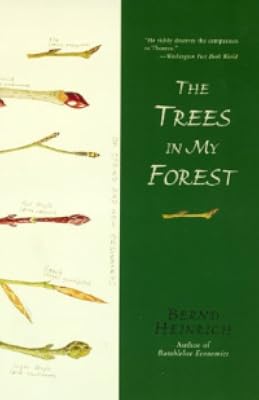
The Trees in My Forest
by Bernd Heinrich
On This Page
Description
In a book destined to become a classic, biologist and acclaimed nature writer Bernd Heinrich takes listeners on an eye-opening journey through the hidden life of a forest. A lifetime observer of the natural world shares his vast knowledge and reflections on the trees of the Northeast woodlands and the rhythms of their seasons, from the DNA contained in an apple seed to the great branches beyond reach.Tags
Recommendations













Member Recommendations
Member Reviews
Looking back, I see that I highlighted a surprising number of sections in this book. It is an exemplary nature book: informative (but avoiding mind-numbing academic data dumps) and evocative of the writer's personality.
He approaches his forest with an inquisitive nature. He wonders why the world is the way it is, and then makes guesses. These are clearly labelled as "maybe...", but this is where the above cautions come in. Sometimes he experiments to see what would happen, for example if he nipped the top bud & 0-all side buds of a pine would a side bud become a single extension of the trunk or would there be multiple trunks. Sometimes he gives up on his experiments, sometimes they are a failure (such as when he cut down trees shading an old abandoned orchard & caused the apple trees to die). These are not scientific experiments, but something I might do, out of curiosity. That makes this book approachable.
His main focus is on diversity--a variety of show more tree species to fit the variety of landscape habitats (hill vs river bottomlands vs old fields) which in turn support a variety of animal and insect life. "habitat complexity...what makes it a forest" (p. 16). He helps us appreciate the importance of insects for pollination, for bird food.
The watercolor illustrations of leaf, bud, and fruit of his trees and shrubs are a beautiful addition, along w/the pencil sketches of individual trees.
I was cautioned about the science in this book by a botanist friend (NOT the previous reviewer--that makes 2 cautions!) but read it anyway. For example, he makes a case for the shape of spruce trees, with downward sloping branches, being related to shedding snow, yet my friend claims it has been "proven" that a stronger influence is sloping branches expose more leaf (needle) surface to sunlight needed for photosynthesis because of the low angle of the sun in northern latitudes. Heinrich does state "several selective pressures may act similarly and simultaneously, so that it is difficult to tease apart their individual contribution to evolution" (p. 64), so both explanations may be pertinent. I do agree that his simplistic view, repeated a few times, that "the land will select the best one [seedling]" (p. 14) gives an inaccurate impression. Browsers, disease, and climate are other selective pressures not connected to soil & topography. Yet his point, that native trees are better adapted to a specific location than imported ones, is appropriate, as is the point that we humans do not know everything required to make a sustainable system.
I did enjoy the prose of many chapters, but some had too many facts (cellular structure of wood, plant reproduction, chemical defenses) that reminded me of the Plant Physiology course I took.
The parts I most appreciated were his mentions of how specific species require specific trees, e.g. Sapsuckers can carve out nest holes in trees that are already softened by fungi, or Swallowtail butterflies needing Black Cherry.. Also enjoyed his perspective on sustainability and the role of forest management. He opened my eyes to the greenwashing of large lumber companies that promote their tree-planting as a positive (we're all taught as children that the world needs more trees, right?) when actually they've herbicided their clearcut areas to prevent growth of the natural habitat so they can plant their monoculture of profitable species.
His Appendix A is a thought-provoking introduction to forest management for a small landowner that meanders into a maudlin plea for biodiversity. Soon I'll read One Family's Forest by Alan Haney (who was a Professor of Forestry) , to compare their approaches. show less
His main focus is on diversity--a variety of show more tree species to fit the variety of landscape habitats (hill vs river bottomlands vs old fields) which in turn support a variety of animal and insect life. "habitat complexity...what makes it a forest" (p. 16). He helps us appreciate the importance of insects for pollination, for bird food.
The watercolor illustrations of leaf, bud, and fruit of his trees and shrubs are a beautiful addition, along w/the pencil sketches of individual trees.
I was cautioned about the science in this book by a botanist friend (NOT the previous reviewer--that makes 2 cautions!) but read it anyway. For example, he makes a case for the shape of spruce trees, with downward sloping branches, being related to shedding snow, yet my friend claims it has been "proven" that a stronger influence is sloping branches expose more leaf (needle) surface to sunlight needed for photosynthesis because of the low angle of the sun in northern latitudes. Heinrich does state "several selective pressures may act similarly and simultaneously, so that it is difficult to tease apart their individual contribution to evolution" (p. 64), so both explanations may be pertinent. I do agree that his simplistic view, repeated a few times, that "the land will select the best one [seedling]" (p. 14) gives an inaccurate impression. Browsers, disease, and climate are other selective pressures not connected to soil & topography. Yet his point, that native trees are better adapted to a specific location than imported ones, is appropriate, as is the point that we humans do not know everything required to make a sustainable system.
I did enjoy the prose of many chapters, but some had too many facts (cellular structure of wood, plant reproduction, chemical defenses) that reminded me of the Plant Physiology course I took.
The parts I most appreciated were his mentions of how specific species require specific trees, e.g. Sapsuckers can carve out nest holes in trees that are already softened by fungi, or Swallowtail butterflies needing Black Cherry.. Also enjoyed his perspective on sustainability and the role of forest management. He opened my eyes to the greenwashing of large lumber companies that promote their tree-planting as a positive (we're all taught as children that the world needs more trees, right?) when actually they've herbicided their clearcut areas to prevent growth of the natural habitat so they can plant their monoculture of profitable species.
His Appendix A is a thought-provoking introduction to forest management for a small landowner that meanders into a maudlin plea for biodiversity. Soon I'll read One Family's Forest by Alan Haney (who was a Professor of Forestry) , to compare their approaches. show less
This book started out well, with prose reminiscent of Aldo Leopold. By the end of the first chapter, I was asking myself, how many mistakes can I put up with before I abort? Finally got the answer: 7. Too many mistakes for the short length of time I'd been reading. This is a good example of why people writing outside their own specialty should be extra careful that they understand the topic, maybe even taking the extreme step of asking someone who IS in that specialty to review the work. I am horrified that an animal behaviorist has such a simplistic, and inaccurate, view of plant science. As a botanist, I tell you - avoid this one. Don't be drawn in by the well-written prose.
This book is still very pertinent after almost 30 years. Heinrich as always is a brilliant, yet simple, easily understood, scientist. I think his afterward is one of the best, most concise conservation essays ever written.
Good condition. Writing inside front cover in pen. Minor shelf wear.
Ratings
Members
- Recently Added By
Lists

Recommended Nature Writing
346 works; 180 members
Author Information

24+ Works 6,337 Members
Bernd Heinrich is an acclaimed scientist and the author of numerous books, including the best-selling Winter World, Mind of the Raven, and Why We Run. He writes for numerous periodicals, including the New York Times, the Los Angeles Times, Scientific American, Outside, and Audubon. Among Heinrich's many honors is the 2013 PEN New England Award for show more nonfiction, for Life Everlasting. show less
Common Knowledge
- Canonical title
- The Trees in My Forest
- Original publication date
- 1997
- People/Characters
- Bernd Heinrich
- Important places
- Maine, USA
- Epigraph
- We travel the Milky Way together, trees and men.
---John Muir - First words
- Having been partly arboreal since the age of eight, I learned early on that trees contain birds' nests, safety, grand vistas, and apples.
- Quotations
- Deadwood inevitably accumulates in any organization, tree or otherwise, where there is competition for resources. (p. 45)
- Last words
- (Click to show. Warning: May contain spoilers.)Perhaps a seed from one of the apples we tossed today will germinate and grow, providing fruit for the grandchildren of that moose who visited this morning and for my newborn son when he is a teenager.
Classifications
Statistics
- Members
- 433
- Popularity
- 71,378
- Reviews
- 5
- Rating
- (4.16)
- Languages
- English, German, Polish
- Media
- Paper, Ebook
- ISBNs
- 9
- ASINs
- 2