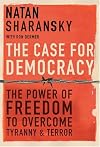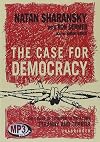
The Case For Democracy: The Power of Freedom to Overcome Tyranny and Terror
by Natan Sharansky, Ron Dermer
On This Page
Description
In this brilliantly analytical yet personal book, non-democratic societies are put under a microscope to reveal the mechanics of tyranny that sustain them. In exposing the inner workings of a "fear society;" the authors explain why democracy is not beyond any nation's reach, why it is essential for our security and why there is much that can be done to promote it around the world.Tags
Recommendations












































Member Reviews
I finally got around to reading Natan Sharansky's The Case for Democracy: The Power of Freedom to
Overcome Tyranny and Terror (2006). Sharansky's argument is that freedom is good for everyone. The more freedom, the more security. Everyone will be happy and peaceful. Dictatorships are bad for their people, and threats to peace. It is an argument that President George W. Bush repeated during the invasion of Iraq.
Sharansky's struggle for freedom began as a dissident in the Soviet society of fear, where after years of agitation he was labeled a spy, and sent to the gulag. After Ronald Reagan personally mentioned Sharansky in a conversation with Mikhail Gorbachev, the dissident was fattened up, released, and allowed to immigrate to Israel. show more Sharansky entered politics in his adoptive land, and formed a party whose objective was to assimilate the massive influx of Soviet emigres into Israeli Society. The party was so successful, that it lost its purpose. A powerful figure in Israeli politics, Sharansky was active in the negotiations with Yasser Arafat throughout the 1990s. He believes that peace in the Middle East is elusive because of the dictators hold such tremendous power over their fearful and subjected people. These regimes are propped up with a false ideology ruthlessly supported by state organized media, and maintained by a brutal oppression of civil rights and free thought. Sharansky sees the same pattern in Syria or the Palestinian Authority as he saw in the old Soviet Union. These authoritarian regimes are abetted by the foreign policy realists in the West. As an example, he recounts a conversation he had with former president Jimmy Carter. In discussing his experience advocating peace in the Middle East, Carter stated he had a good partnership with Syrian dictator Hafez Assad because he felt that he could always trust the dictator to keep his word. To Sharansky, this line of thinking lacked moral clarity. Even if one could take a dictator's word to the bank, it still did not change the fact that they crushed human freedom and degraded the humanity of their peoples. The entire book is an argument for idealism in foreign policy and against realism or relativism.
Historians will find interesting insights on US-Soviet Detente (he opposed it), Jimmy Carter, Ronald Reagan (he speaks highly of the Gipper), his arrival in Israel (he was shocked by the division he found within a democratic society), and the Middle East peace negotiations in the 1990s (he wanted to couple concessions with guarantees of more open, transparent government). Future historians will undoubtedly look to this book to gain an insights into early year of the Global War on Terror.
From my blog: http://gregshistoryblog.blogspot.com/2014/06/recent-read-natan-sharansky-case-fo... show less
Overcome Tyranny and Terror (2006). Sharansky's argument is that freedom is good for everyone. The more freedom, the more security. Everyone will be happy and peaceful. Dictatorships are bad for their people, and threats to peace. It is an argument that President George W. Bush repeated during the invasion of Iraq.
Sharansky's struggle for freedom began as a dissident in the Soviet society of fear, where after years of agitation he was labeled a spy, and sent to the gulag. After Ronald Reagan personally mentioned Sharansky in a conversation with Mikhail Gorbachev, the dissident was fattened up, released, and allowed to immigrate to Israel. show more Sharansky entered politics in his adoptive land, and formed a party whose objective was to assimilate the massive influx of Soviet emigres into Israeli Society. The party was so successful, that it lost its purpose. A powerful figure in Israeli politics, Sharansky was active in the negotiations with Yasser Arafat throughout the 1990s. He believes that peace in the Middle East is elusive because of the dictators hold such tremendous power over their fearful and subjected people. These regimes are propped up with a false ideology ruthlessly supported by state organized media, and maintained by a brutal oppression of civil rights and free thought. Sharansky sees the same pattern in Syria or the Palestinian Authority as he saw in the old Soviet Union. These authoritarian regimes are abetted by the foreign policy realists in the West. As an example, he recounts a conversation he had with former president Jimmy Carter. In discussing his experience advocating peace in the Middle East, Carter stated he had a good partnership with Syrian dictator Hafez Assad because he felt that he could always trust the dictator to keep his word. To Sharansky, this line of thinking lacked moral clarity. Even if one could take a dictator's word to the bank, it still did not change the fact that they crushed human freedom and degraded the humanity of their peoples. The entire book is an argument for idealism in foreign policy and against realism or relativism.
Historians will find interesting insights on US-Soviet Detente (he opposed it), Jimmy Carter, Ronald Reagan (he speaks highly of the Gipper), his arrival in Israel (he was shocked by the division he found within a democratic society), and the Middle East peace negotiations in the 1990s (he wanted to couple concessions with guarantees of more open, transparent government). Future historians will undoubtedly look to this book to gain an insights into early year of the Global War on Terror.
From my blog: http://gregshistoryblog.blogspot.com/2014/06/recent-read-natan-sharansky-case-fo... show less
This book was cited by The President as an influence on his decision to invade Iraq. (to bring another democracy into the middle east) I think it's worth the read, but I'm not so sure that he makes enough of a case for democracy as a pure virtue in itself to justify said action. Maybe we'll get lucky and history will be kinder than the current political climate. An important book regardless of your political views.
I bought this book after watching Mr. Sharansky on Meet the Press. A very good book. This is "supposedly" the book that Bush is basing is foreing policy on, but he must not have read the same book that I read. Sharansky is from Russian and is Jewish. He was a political dissident during the Soviet era and spent many years in prison. He sits on the Israeli cabinet. Basically Sharansky implores the Western governments to shum countries for their human rights abuses. He references how that we were tough on the Soviets and especially under Reagan and how that sped to its eventual collapse. The problem I see is that as a world we are too moved by comercial interests to do this. And there is the argument for using trade to issue in free market show more reforms which will in turn bring in democracy. I don't really buy into that and it is funny how we preach that policy in regards to China, but any other state which has their record of human rights abuses, we shun. show less
Who better to talk of this than Natan. He has lived both and knows that freedom is the only way to overcome tyranny and the tyrants that run them. No wonder the Left has so vilified this book. Truth hurts.
Ratings
Members
- Recently Added By
Author Information

6+ Works 1,044 Members
Natan Sharansky is currently the Chairman of the Adelson Institute for Strategic Studies in Jerusalem.
1 Work 520 Members
Some Editions
Awards and Honors
Distinctions
Classifications
- Genres
- Politics and Government, Nonfiction, General Nonfiction, Philosophy, History
- DDC/MDS
- 321.8 — Society, government, & culture Political science Systems of governments and states Democratic government [formerly : Republic]
- LCC
- JC423 .S495 — Political Science Political theory Political theory. The state. Theories of the state Forms of the state
- BISAC
Statistics
- Members
- 521
- Popularity
- 57,774
- Reviews
- 4
- Rating
- (4.08)
- Languages
- English, Spanish
- Media
- Paper, Audiobook, Ebook
- ISBNs
- 13
- ASINs
- 5