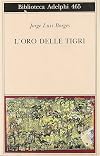
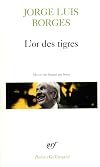
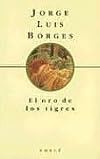
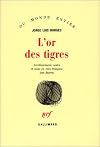
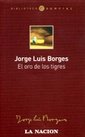
The Gold of the Tigers: Selected Later Poems
by Jorge Luis Borges
On This Page
Description
"Es el amor. Tendr ?que ocultarme o huir. Crecen los muros de su cr?cel, como en un sueno atroz. La hermosa mascara ha cambiado, pero como siempre es la n?ica.""It's love, I'll have to hide or flee, the walls of his prison grow, like in an atrocious dream, the beautiful mask has changed, but as always it's the only one."Tags
Recommendations












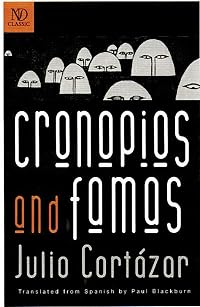


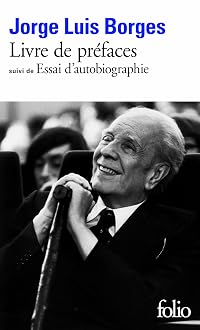




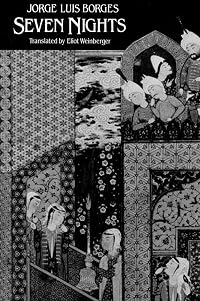

Member Recommendations
cometahalley Il sogno, la visione, l'affabulazione degna di un nuovo Omero. I temi più cari a Borges in una prosa lucida, fluida, potente.
Member Reviews
Hay libros que te eligen a ti, dicen, y a mí me parecía una cursilería. Este me eligió, estoy seguro. Nos necesitábamos el uno al otro. Eran los poemas y la lucidez de Borges lo que mi mente necesitaba justo ahora. Cuando las palabras y los versos van pasando por ti, casi a través de ti, y se sienten como el masaje o el baño que requerías sin saberlo, estás ante uno de esos libros que tuvieron que haberte elegido porque no pudo ser de otra manera. Y entonces no puedes hacer más que acomodarte y disfrutar. Siempre Borges. Hay que leerlo y releerlo. Es obra que no se agota nunca.
El título de este volumen une el drama personal, las entrevisiones del color amarillo de la ceguera, al tigre emblemático que cruza toda la obra de Jorge Luis
Borges. Esa combinación entre vida y literatura está acompañada por algunas innovaciones en su arte poética. El uso de formas orientales, los Tankas, y un tratamiento menos elusivo en los poemas de amor, como en el magnífico `El amenazado`, les otorgan a los versos un singular peso emotivo. Sus virtudes descansan en las enumeraciones y accidentes verbales y en la serena precisión para comunicar experiencias íntimas: el paso del tiempo, las vacilaciones, la esperanza, las lecturas, la ausencia de una voz deseada, la memoria y el olvido, los sueños, el cambiante rostro en show more los espejos.
El oro de los tigres, colección de poemas y textos breves en prosa escritos entre 1969 y 1972, es uno de los libros más delicados y directos de Borges. show less
Borges. Esa combinación entre vida y literatura está acompañada por algunas innovaciones en su arte poética. El uso de formas orientales, los Tankas, y un tratamiento menos elusivo en los poemas de amor, como en el magnífico `El amenazado`, les otorgan a los versos un singular peso emotivo. Sus virtudes descansan en las enumeraciones y accidentes verbales y en la serena precisión para comunicar experiencias íntimas: el paso del tiempo, las vacilaciones, la esperanza, las lecturas, la ausencia de una voz deseada, la memoria y el olvido, los sueños, el cambiante rostro en show more los espejos.
El oro de los tigres, colección de poemas y textos breves en prosa escritos entre 1969 y 1972, es uno de los libros más delicados y directos de Borges. show less
Jun 23, 2022Spanish
Borges est un immense écrivain et un poète monumental. Ce recueil regroupe plusieurs livrets de poèmes. L'or des tigres est le meilleur avec quelques poèmes bouleversant. Passion, ironie, réflexion sur soi, introspection et malgré tout l'age, la maladie, un potentiel amoureux intact. Il évoque l'amour de façon retenue sans lyrisme mais avec une justesse troublante. Il dissèque en quelques vers les révolutions induites par ce sentiment si beau et terrible. Je conseille le Menacé pour bien mesurer ce talent total.
Jul 8, 2016French
Pubblicato nel 1972, il volume ci offre il il volto di un Borges poeta. Nei versi la riflessione e i quesiti sulla morte, sull'identità e sul sogno si affrancano da ogni pudore e ritrosia e si svelano in tutta la semplicità con toni intimi di rimpianto per ciò che non si è vissuto o che si è perduto.
Feb 13, 2015Italian
Ratings
Members
- Recently Added By
Author Information

869+ Works 58,897 Members
Born in Buenos Aires, Argentina, in 1899, Jorge Borges was educated by an English governess and later studied in Europe. He returned to Buenos Aires in 1921, where he helped to found several avant-garde literary periodicals. In 1955, after the fall of Juan Peron, whom he vigorously opposed, he was appointed director of the Argentine National show more Library. With Samuel Beckett he was awarded the $10,000 International Publishers Prize in 1961, which helped to establish him as one of the most prominent writers in the world. Borges regularly taught and lectured throughout the United States and Europe. His ideas have been a profound influence on writers throughout the Western world and on the most recent developments in literary and critical theory. A prolific writer of essays, short stories, and plays, Borges's concerns are perhaps clearest in his stories. He regarded people's endeavors to understand an incomprehensible world as fiction; hence, his fiction is metaphysical and based on what he called an esthetics of the intellect. Some critics have called him a mystic of the intellect. Dreamtigers (1960) is considered a masterpiece. A central image in Borges's work is the labyrinth, a mental and poetic construct, that he considered a universe in miniature, which human beings build and therefore believe they control but which nevertheless traps them. In spite of Borges's belief that people cannot understand the chaotic world, he continually attempted to do so in his writing. Much of his work deals with people's efforts to find the center of the labyrinth, symbolic of achieving understanding of their place in a mysterious universe. In such later works as The Gold of the Tigers, Borges wrote of his lifelong descent into blindness and how it affected his perceptions of the world and himself as a writer. Borges died in Geneva in 1986. (Bowker Author Biography) show less
Series
Belongs to Publisher Series
Biblioteca esencial (13)
Work Relationships
Is contained in
Common Knowledge
- Canonical title*
- L'oro delle tigri
- Original title
- El oro de los tigres
- Original publication date
- 1972-07
*Some information comes from Common Knowledge in other languages. Click "Edit" for more information.
Classifications
Statistics
- Members
- 116
- Popularity
- 281,731
- Reviews
- 4
- Rating
- (3.83)
- Languages
- 5 — English, French, Italian, Spanish, Swedish
- Media
- Paper
- ISBNs
- 10
- ASINs
- 2