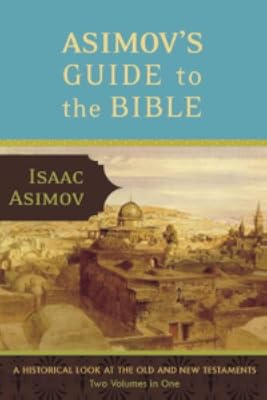
Asimov's Guide to the Bible: The Old and New Testaments
by Isaac Asimov
On This Page
Description
Attempts to illuminate the events of the Old and New Testaments by discussing actual historical, geographical, and biographical events.Tags
Recommendations


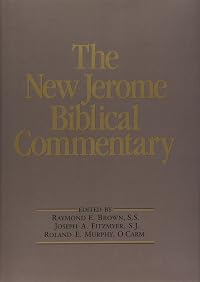
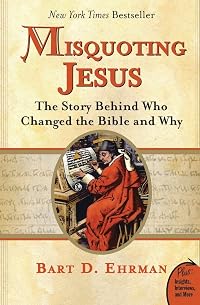


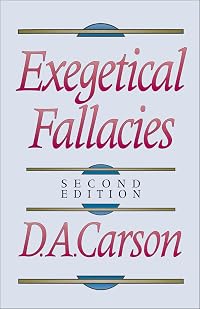
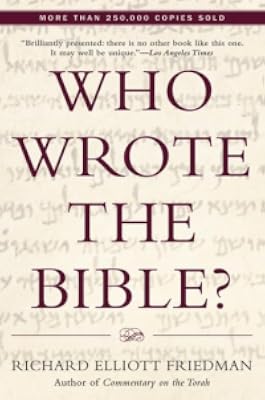










Member Recommendations
Member Reviews
I can't imagine any lay person understanding the Bible without having read this or something similar. Understanding historical context is essential. An enjoyable and easy read when taken chunks at a time. Indeed I would recommend this over the New Testament itself, and aside from the exquisite poetry, over the Old Testament as well. And you can learn a lot of Levantine history from this.
I had heard that Isaac Asimov was prolific, but I had not realized that he went into Biblical Study. Imagine my surprise when I saw a copy of this. I mean, it's Isaac Asimov, I have to see what he says about the Bible.
So Asimov goes through the Bible and discusses all of the major talking points. Have you ever wondered what a Sadducee was? So did I until I read this book. Where exactly is Jericho as related to Jerusalem? This book has multiple maps that show you just that. Along the way, we are treated to Secular History that has been verified by other records and not just the Bible. So that part alone makes it fascinating. I especially liked the parts that covered verifiable Jewish and Early Christian History. Those parts were show more excellent. The rest of the Bible seems to be made up of old Folk Legends and stories borrowed extensively during the Exile Period. For instance, there are numerous references to Marduk and Ishtar and other gods of the Babylonian Pantheon.
The Pentateuch and other parts make for pretty dry reading, but trying to estimate the relative dates and authors of certain books must be pretty hard. In any case, I really enjoyed this book. show less
So Asimov goes through the Bible and discusses all of the major talking points. Have you ever wondered what a Sadducee was? So did I until I read this book. Where exactly is Jericho as related to Jerusalem? This book has multiple maps that show you just that. Along the way, we are treated to Secular History that has been verified by other records and not just the Bible. So that part alone makes it fascinating. I especially liked the parts that covered verifiable Jewish and Early Christian History. Those parts were show more excellent. The rest of the Bible seems to be made up of old Folk Legends and stories borrowed extensively during the Exile Period. For instance, there are numerous references to Marduk and Ishtar and other gods of the Babylonian Pantheon.
The Pentateuch and other parts make for pretty dry reading, but trying to estimate the relative dates and authors of certain books must be pretty hard. In any case, I really enjoyed this book. show less
A good beginning introduction to the Bible, more focused on discussing the stories of the Bible than detailing all the scholarship, though there is a good bit of the scholarhip discussed. Asimov is always a good solid writer, and it is a pleasure to read him, as always.
A very good analysis of one of the most famous books in history from a rational, secular perspective, taking the time to correct events and fit the ones that existed within a more accurate historical chronology. Some information is slightly out of date due to recent archaeological discoveries, but there is still very much to be learned from here.
Asimov was a prolific writer, but as he admits, not a Bible scholar. He largely parrots the liberal view of the Bible advocated by form critics in the mid 20th century. This book can be a valuable synopsis of Bible history, but must be read with discernment or it will leave the reader with more confusion than understanding.
If you want a history of the information found in the bible, this is a great reference. If you are looking for a theological perspective however, Asimov doesn’t even try to go there. This book can explain where things are, why certain practices were done, and what the meanings behind some of the most important biblical events were. A good enough reference for understanding the bible in its historical context.
Although best known for his science fiction books and short stories and his factual science essays, Asimov was a polymath who dabbled in many areas. Although he was brought up in a Jewish family, as an adult he was a firm atheist, so he approaches the Bible as a historical novel, not as holy scripture. Asimov explains how the stories came to be written and attempts to sort out fact from fiction.
Although the book is somewhat dated, since there have been a number of advances in biblical scholarship since it was published, it provides a clear explanation of the Bible for anyone who is interested in the Bible's historical underpinnings.
Although the book is somewhat dated, since there have been a number of advances in biblical scholarship since it was published, it provides a clear explanation of the Bible for anyone who is interested in the Bible's historical underpinnings.
Members
- Recently Added By
Lists

Top Five Books of 2022
736 works; 272 members

Best Sellers / Popular 1968
237 works; 5 members
Author Information

2,405+ Works 294,447 Members
Isaac Asimov was born in Petrovichi, Russia, on January 2, 1920. His family emigrated to the United States in 1923 and settled in Brooklyn, New York, where they owned and operated a candy store. Asimov became a naturalized U.S. citizen at the age of eight. As a youngster he discovered his talent for writing, producing his first original fiction at show more the age of eleven. He went on to become one of the world's most prolific writers, publishing nearly 500 books in his lifetime. Asimov was not only a writer; he also was a biochemist and an educator. He studied chemistry at Columbia University, earning a B.S., M.A. and Ph.D. In 1951, Asimov accepted a position as an instructor of biochemistry at Boston University's School of Medicine even though he had no practical experience in the field. His exceptional intelligence enabled him to master new systems rapidly, and he soon became a successful and distinguished professor at Columbia and even co-authored a biochemistry textbook within a few years. Asimov won numerous awards and honors for his books and stories, and he is considered to be a leading writer of the Golden Age of science fiction. While he did not invent science fiction, he helped to legitimize it by adding the narrative structure that had been missing from the traditional science fiction books of the period. He also introduced several innovative concepts, including the thematic concern for technological progress and its impact on humanity. Asimov is probably best known for his Foundation series, which includes Foundation, Foundation and Empire, and Second Foundation. In 1966, this trilogy won the Hugo award for best all-time science fiction series. In 1983, Asimov wrote an additional Foundation novel, Foundation's Edge, which won the Hugo for best novel of that year. Asimov also wrote a series of robot books that included I, Robot, and eventually he tied the two series together. He won three additional Hugos, including one awarded posthumously for the best non-fiction book of 1995, I. Asimov. "Nightfall" was chosen the best science fiction story of all time by the Science Fiction Writers of America. In 1979, Asimov wrote his autobiography, In Memory Yet Green. He continued writing until just a few years before his death from heart and kidney failure on April 6, 1992. (Bowker Author Biography) show less
Some Editions
Work Relationships
Common Knowledge
- Canonical title
- Asimov's Guide to the Bible: The Old and New Testaments
- Original title
- Asimov's Guide to the Bible: The Old and New Testaments
- Original publication date
- 1971
- Original language
- English
Classifications
- Genres
- Religion & Spirituality, Nonfiction, History, General Nonfiction, Literature Studies and Criticism
- DDC/MDS
- 220.95 — Religion The Bible The Bible Geography, history, chronology, persons of Bible lands in Bible times History
- LCC
- BS635.2 .A8 — Philosophy, Psychology and Religion The Bible The Bible Works about the Bible
- BISAC
Statistics
- Members
- 1,297
- Popularity
- 18,838
- Reviews
- 12
- Rating
- (4.01)
- Languages
- English, Russian, Spanish
- Media
- Paper
- ISBNs
- 6
- ASINs
- 11