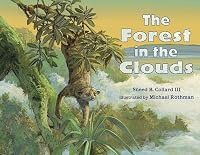
The Forest in the Clouds
by Sneed B. Collard III  , Michael Rothman (Illustrator)
On This Page
Description
Describes some of the exotic plants and animals that live in the cloud forest of Costa Rica, and discusses some environmental threats faced by this region.Tags
Recommendations



Member Reviews
The Forest in the Clouds Informational Nonfiction
Written by Sneed B. Collard, Illustrated by Michael Rothman (2000)
Although “The Forest in the Clouds” was an informational book aimed for children, I thought there were some flaws; therefore, I am only giving it a three star rating. The author and illustrator take the reader through a tour of the cloud forest. I thought the book was a little difficult to navigate through because there were no headings or sections. The best way to find what the page was about was to look at the pictures that matched the paragraphs. For example, the page where the animals were hiding from the rain was about the forest’s climate and the page with only birds on it was focused upon bird species. The show more pictures were also labeled which helps the reader follow what the author is talking about. Things such as a fig tree, brown hooded parrots, and wild avocado were labeled in the illustrations. I also appreciated how the author used specific numbers in “The Forest in the Clouds” to describe things such as the average height of trees or number of species. There was also a glossary at the end that included popular vocabulary used throughout the book such as: camouflage, migrants, nocturnal, nutrient, predator, trade wind, and tropical cloud forest. Overall, the book had well written content, but was difficult to navigate through and was a little lengthy for a children’s informational text. show less
Written by Sneed B. Collard, Illustrated by Michael Rothman (2000)
Although “The Forest in the Clouds” was an informational book aimed for children, I thought there were some flaws; therefore, I am only giving it a three star rating. The author and illustrator take the reader through a tour of the cloud forest. I thought the book was a little difficult to navigate through because there were no headings or sections. The best way to find what the page was about was to look at the pictures that matched the paragraphs. For example, the page where the animals were hiding from the rain was about the forest’s climate and the page with only birds on it was focused upon bird species. The show more pictures were also labeled which helps the reader follow what the author is talking about. Things such as a fig tree, brown hooded parrots, and wild avocado were labeled in the illustrations. I also appreciated how the author used specific numbers in “The Forest in the Clouds” to describe things such as the average height of trees or number of species. There was also a glossary at the end that included popular vocabulary used throughout the book such as: camouflage, migrants, nocturnal, nutrient, predator, trade wind, and tropical cloud forest. Overall, the book had well written content, but was difficult to navigate through and was a little lengthy for a children’s informational text. show less
This is an informational with beautiful graphics. It explains many of the different ways of life in the trees. It shows the birds and how they live, as well as many of the animals and plants that call the tree branches home. At the end they explain how many a specific species of frog was discovered in the 60's and has now completely disappeared. The disappearance of the frog shows just how fragile the jungle is, and yet still there is much happening to it.
This would count as an informational genre.
This I would read to older elementary students. For the younger students I would read pieces of the book if we were studying birds, plants, or animals in the jungle.
This would count as an informational genre.
This I would read to older elementary students. For the younger students I would read pieces of the book if we were studying birds, plants, or animals in the jungle.
This detailed journey through the Costa Rican cloud forests could be such a valuable tool to use during units on ecosystems or habitats. Each page is filled with colorful and labeled illustrations of the birds, plants, and wildlife in the forest along with story like text that explains the illustration.
How the animals survive and how the forrest is threatened. A very informative and very descriptive book to the reader as if you are there.
This book was enjoyable because of the hide-and-seek for the different type of animals within the pages. This was a very informative book with eye opening(literally) illustrations.
Genre: Informational
Age Appropriateness: Intermediate
Media:acrylic paint
Review: This book is a good example of an informational book because in the beginging it introduces you to what a tropical cloud forest is. Then throughout the book there are explanations of the plants, animals, and birds that live there. The book also talks about some of the environmental issues that are harming the rainforest. At the end of the book there are some addresses that you can donate money to to help save these rainforests. There is also a map of where the cloud forest in the book is located, Costa Rica. Throughout the pages of the book the illistrations all have plants and animal labled so you can see what each looks like that is being talked about.
Age Appropriateness: Intermediate
Media:acrylic paint
Review: This book is a good example of an informational book because in the beginging it introduces you to what a tropical cloud forest is. Then throughout the book there are explanations of the plants, animals, and birds that live there. The book also talks about some of the environmental issues that are harming the rainforest. At the end of the book there are some addresses that you can donate money to to help save these rainforests. There is also a map of where the cloud forest in the book is located, Costa Rica. Throughout the pages of the book the illistrations all have plants and animal labled so you can see what each looks like that is being talked about.
This book talks about the forests that lay on top of mountains in the clouds in Costa Rica. Throughout the book it talks about the different kinds of species you'll find there from birds, to animals, plants to insects. At the end of the book it begins to talk about endangered species such as the Golden Toads. This book is to raise awareness of the damage that pesticides could have on a number of different plants and animals even from far far away. This book was great for showing children what kind of animals are in the forests, on every page they illustrated and labeled different species.
Genre: Informational
1: I would introduce this book if we were talking about rain forests or animals that live in different places.
2: I would show more introduce this book also if we were doing a section on endangered species and some of the causes for them. show less
Genre: Informational
1: I would introduce this book if we were talking about rain forests or animals that live in different places.
2: I would show more introduce this book also if we were doing a section on endangered species and some of the causes for them. show less
Members
- Recently Added By
Lists

A Child's Book Tour of Central America ::: Costa Rica, Guatemala, Panama
39 works; 2 members

My Wishlist - Children's
185 works; 4 members

al.vick-wishlist-Children's
462 works; 3 members

Children's Books About Science and Math
461 works; 12 members

Science: Zoology
107 works; 1 member
Author Information

89 Works 4,247 Members
Sneed B. Collard III is a LibraryThing Author, an author who lists their personal library on LibraryThing.

Awards and Honors
Common Knowledge
- Important places
- Costa Rica
Classifications
Statistics
- Members
- 174
- Popularity
- 188,625
- Reviews
- 10
- Rating
- (4.07)
- Languages
- English
- Media
- Paper, Ebook
- ISBNs
- 4