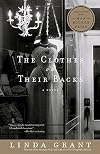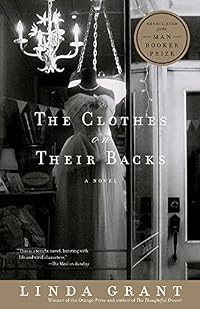
The Clothes on Their Backs
by Linda Grant
On This Page
Description
In a red brick mansion block off the Marylebone Road, Vivien, a sensitive, bookish girl grows up sealed off from both past and present by her timid refugee parents. Then one morning a glamorous uncle appears, dressed in a mohair suit, with a diamond watch on his wrist and a girl in a leopard-skin hat on his arm. Why is Uncle Sándor so violently unwelcome in her parents' home? This is a novel about survival - both banal and heroic - and a young woman who discovers the complications, even show more betrayals, that inevitably accompany the fierce desire to live. Set against the backdrop of a London from the 1950s to the present day, The Clothes on Their Backs is a wise and tender novel about the clothes we choose to wear, the personalities we dress ourselves in, and about how they define us all. show lessTags
Recommendations































Member Reviews
Vivien has grown up in a quiet backwater of London, with parents who desire nothing more out of life than to pass unnoticed. "A life that isn't peaceful is no life at all", her father says. One of the most vivid memories of her childhood is the appearance at their front door of a man who says he is her uncle - vivid not just for the way he was dressed (electric blue mohair suit, diamond watch) but because he caused her normally mouse-quiet father to scream, and shout, and swear, in a language she had never heard him speak before.
So when, in her early twenties, Vivien comes across Uncle Sándor again, she befriends him and starts to learn about her own history. The attraction for her is clear. I enjoyed listening to someone who was show more voluble, who didn't excrete small constipated pieces of information, under great pressure. Out it came, there was no stopping him, he was a man who loved to talk. But Sándor differs from her parents in another important way. They have chosen to survive by melting into the background. Sándor, on the other hand, has survived by being a hustler. He is defiantly proud of this - he has an appetite for life, and wants to live it to the full. But he also believes that it is, in the end, the only way to survive.
I didn't take the supplies, I took other people's supplies and I sold them and split the profits with them, so there was no coupon with my name on it, and this is why, at the end of the war, my mother still had an apartment. And now do you understand why your ideas about what is decent, and respect, and equality are for babies? A boy like that one downstairs, strong and stupid, is the kind who is most like the animal who suddenly lies down in the shafts of the cart and dies, for no reason, because his strength is exhausted. His strength is all he has. I'm not that type, and I hope you are not either.
I really like Linda Grant's writing, and have read all her novels. This one contains some of her best writing - I don't believe anyone could read the first chapter or two and then put the book back on the shelf. The subject seems a little less coherent than her other books, perhaps because Vivien is struggling for space with Sándor: the book is about her growing up as much as it is his life story, but he's such a bold personality that he sometimes takes over. And while Vivien's relationship with her mother is poignantly drawn, her father is little more than a cipher. There's also an element of unlikely contrivance in the story (Vivien and Sándor meet by chance - each recognises the other but both pretend not to). But there is still an enormous amount to like and enjoy in this novel, and I would highly recommend it. show less
So when, in her early twenties, Vivien comes across Uncle Sándor again, she befriends him and starts to learn about her own history. The attraction for her is clear. I enjoyed listening to someone who was show more voluble, who didn't excrete small constipated pieces of information, under great pressure. Out it came, there was no stopping him, he was a man who loved to talk. But Sándor differs from her parents in another important way. They have chosen to survive by melting into the background. Sándor, on the other hand, has survived by being a hustler. He is defiantly proud of this - he has an appetite for life, and wants to live it to the full. But he also believes that it is, in the end, the only way to survive.
I didn't take the supplies, I took other people's supplies and I sold them and split the profits with them, so there was no coupon with my name on it, and this is why, at the end of the war, my mother still had an apartment. And now do you understand why your ideas about what is decent, and respect, and equality are for babies? A boy like that one downstairs, strong and stupid, is the kind who is most like the animal who suddenly lies down in the shafts of the cart and dies, for no reason, because his strength is exhausted. His strength is all he has. I'm not that type, and I hope you are not either.
I really like Linda Grant's writing, and have read all her novels. This one contains some of her best writing - I don't believe anyone could read the first chapter or two and then put the book back on the shelf. The subject seems a little less coherent than her other books, perhaps because Vivien is struggling for space with Sándor: the book is about her growing up as much as it is his life story, but he's such a bold personality that he sometimes takes over. And while Vivien's relationship with her mother is poignantly drawn, her father is little more than a cipher. There's also an element of unlikely contrivance in the story (Vivien and Sándor meet by chance - each recognises the other but both pretend not to). But there is still an enormous amount to like and enjoy in this novel, and I would highly recommend it. show less
This book was a birthday present, and it's not a mystery why it was chosen for me. The story contains, among other things: slumlords, Jews, immigrants to the UK, the UK, and (as the name suggests) clothes. The giver probably over-estimates my interest in clothing and the acquisition of clothing, as many men do of many women, but it's a forgivable mistake.
My own interest in clothing is one of necessity, although not in the strictest sense of needing it to survive. I don't love clothing for its own sake, for the most part, but because it allows you to present an image of yourself. It's completely superficial and shouldn't matter, but it seems to. I revert to adolescent angst about what to wear to important events, and occasionally find show more myself half-naked in front of the bedroom mirror and unable to get dressed for work.
The author explores self-definition through clothing, through this idea that clothing can define you or, maybe, reflect you. Although I think this is meant to be the overarching theme of the book, I found it to be the least interesting or compelling aspect of the novel, even as I relate to it.
The stories in the book--of a family history that has been largely hidden from the narrator and of her early years as an adult--are far more interesting and compelling to me than the theme suggested by the title. The characters are vivid, the writing is very clean, and the stories told are genuinely interesting. show less
My own interest in clothing is one of necessity, although not in the strictest sense of needing it to survive. I don't love clothing for its own sake, for the most part, but because it allows you to present an image of yourself. It's completely superficial and shouldn't matter, but it seems to. I revert to adolescent angst about what to wear to important events, and occasionally find show more myself half-naked in front of the bedroom mirror and unable to get dressed for work.
The author explores self-definition through clothing, through this idea that clothing can define you or, maybe, reflect you. Although I think this is meant to be the overarching theme of the book, I found it to be the least interesting or compelling aspect of the novel, even as I relate to it.
The stories in the book--of a family history that has been largely hidden from the narrator and of her early years as an adult--are far more interesting and compelling to me than the theme suggested by the title. The characters are vivid, the writing is very clean, and the stories told are genuinely interesting. show less
I really loved this book with its sharp, incisive character studies & underlying exploration of how a wardrobe can reveal & conceal.
The main character, Vivien, embarks on a search for her family history by talking with her father's estranged brother, Sandor, once convicted of being a slum lord. Sandor is a complex character - a slum lord, a pimp, a survivor of slave labor camps during WWII, an escapee from communist Hungary. He is by turns "the face of evil" & the soul of human kindness. I loved all the complex dualities captured in his character.
Equally interesting is the underlying story of London in the '70's - punk music & the rise of the National Front. It's interesting to think about how frightening the skinhead movement must have show more been to those who had survived the first go-round with Fascism.
This book is well written & literary without being overly conscious of its craft. The story is well-told, the characters fully realized and multidimensional. & the clothes - the joys to be had in costuming & re-costuming & all of the ways that clothes express who we are or who we wish we could be. show less
The main character, Vivien, embarks on a search for her family history by talking with her father's estranged brother, Sandor, once convicted of being a slum lord. Sandor is a complex character - a slum lord, a pimp, a survivor of slave labor camps during WWII, an escapee from communist Hungary. He is by turns "the face of evil" & the soul of human kindness. I loved all the complex dualities captured in his character.
Equally interesting is the underlying story of London in the '70's - punk music & the rise of the National Front. It's interesting to think about how frightening the skinhead movement must have show more been to those who had survived the first go-round with Fascism.
This book is well written & literary without being overly conscious of its craft. The story is well-told, the characters fully realized and multidimensional. & the clothes - the joys to be had in costuming & re-costuming & all of the ways that clothes express who we are or who we wish we could be. show less
This book was mesmerizing. It caught my attention from the beginning and never let it go. Vivien had led a sheltered life in London as the daughter of Hungarian refugees who never talked about the past or where they came from, and rejected the only relative to ever show up at their door, her uncle Sandor, saying only that he was a very bad man. When Vivien is jobless and grieving after losing her husband on their honeymoon, she meets her uncle in a park and agrees to work for him, transcribing his life story into a book, but she doesn't tell him who she really is. And thus she learns about her own history, and all the things her parents would never tell her. The book reads like a mystery and a memoir and the characters are all show more fascinating and complex, and nothing is ever black and white. Highly recommended. show less
The Clothes on Their Backs is the Orange- and Booker-nominated book by Linda Grant - and it's certainly worthy of its accolades. Set in London during the 1970's, it's an enthralling look at family relationships, war and growing up in the shadow of family secrets.
Vivien Kovacs is the daughter of her reclusive, refugee parents, who emigrated from Hungary to London during World War II. Vivien's parents shielded her from life's experiences, including a complete avoidance of Vivien's uncle Sandor, who also lived in England after the war. Once Vivien graduated from college, she became more and more curious about her mysterious uncle, who had served time in prison for being a "slum lord." She finally got an opportunity to meet him and forged a show more relationship with her uncle, despite her father's wishes.
I can't say Vivien was the most likable character, but she was very believable. She was flawed and human, like her uncle. I was most intrigued, though, by Vivien's mother, Berta. She was a minor character in the book, but Grant left enough of a breadcrumb trail to make you wonder more about her. I think there was more there than met the eye.
The Clothes on Their Backs is a superb telling of the World War II refugee experience and the circumstances of family secrets. Most skeletons find their way out of the closet, and Vivien's family was no exception. Grant had me at Word One, and I devoured this novel, eager to learn more about Vivien and her family. I was slightly dissatisfied with the ending, especially the death of Uncle Sandor, but this is a small quibble. All in all, The Clothes on Their Backs was a readable and fascinating story about family relationships. show less
Vivien Kovacs is the daughter of her reclusive, refugee parents, who emigrated from Hungary to London during World War II. Vivien's parents shielded her from life's experiences, including a complete avoidance of Vivien's uncle Sandor, who also lived in England after the war. Once Vivien graduated from college, she became more and more curious about her mysterious uncle, who had served time in prison for being a "slum lord." She finally got an opportunity to meet him and forged a show more relationship with her uncle, despite her father's wishes.
I can't say Vivien was the most likable character, but she was very believable. She was flawed and human, like her uncle. I was most intrigued, though, by Vivien's mother, Berta. She was a minor character in the book, but Grant left enough of a breadcrumb trail to make you wonder more about her. I think there was more there than met the eye.
The Clothes on Their Backs is a superb telling of the World War II refugee experience and the circumstances of family secrets. Most skeletons find their way out of the closet, and Vivien's family was no exception. Grant had me at Word One, and I devoured this novel, eager to learn more about Vivien and her family. I was slightly dissatisfied with the ending, especially the death of Uncle Sandor, but this is a small quibble. All in all, The Clothes on Their Backs was a readable and fascinating story about family relationships. show less
I enjoyed this book ...up to a point. I found the narrative wandered a bit and I didn't care deeply about what happened to the central character, Vivien. Having said that, the characters were beautifully illustrated and there was a true insight in to 70s London ...both the good and bad times.
Fantastic story. This book follows a woman's life from her youth when she used clothes to define an identity she couldn't otherwise develop through her efforts to locate the past that was hidden from her by her parents. A great introspective work on what people find acceptable, why they might reject their relatives, and who they turn out to be themselves in the end.
The writing is lovely, spare yet with a style that touches on the emotions and turmoil of this woman at different life stages. And she does find herself in the end through some very interesting moves that force her parents to confront what they hid for so long.
The writing is lovely, spare yet with a style that touches on the emotions and turmoil of this woman at different life stages. And she does find herself in the end through some very interesting moves that force her parents to confront what they hid for so long.
Members
- Recently Added By
Lists

Booker Prize
491 works; 62 members

Man Booker Prize Longlist 2008
13 works; 2 members

Booker Prize Shortlist: Titles Not Yet Read
161 works; 4 members
Author Information

14+ Works 2,503 Members
Linda Grant is a novelist and journalist. She won the Orange Prize for Fiction in 2000 and the Lettre Ulysses Prize for the Art of Reportage in 2006. Her most recent novel, The Clothes on Their Back, was shortlisted for the Man Booker Prize in 2008. She writes for The Guardian, the Telegraph, and Vogue.
Awards and Honors
Awards
Common Knowledge
- Canonical title
- The Clothes on Their Backs
- Original title
- The Clothes on Their Backs
- Original publication date
- 2008
- Important places
- London, England, UK; Hungary
- Epigraph
- But this is the soul
Prepared for you, these garments that glow
In the dark and burn as fierce as coal.
George Szirtes, from 'Dressing' - Dedication
- To George Szirtes and Clarissa Upchurch
- First words
- This morning, for the first time in many years, I passed the shop on Seymour Street.
- Last words
- (Click to show. Warning: May contain spoilers.)Our vulnerability suddenly touched me, all our terrible, moving weaknesses contained in a jacket, a skirt, a pair of shoes.
- Blurbers
- Michael Korda
Classifications
Statistics
- Members
- 704
- Popularity
- 40,222
- Reviews
- 30
- Rating
- (3.44)
- Languages
- 5 — Dutch, English, French, Lithuanian, Spanish
- Media
- Paper, Ebook
- ISBNs
- 23
- ASINs
- 4