A Special Providence
by Richard Yates
On This Page
Description
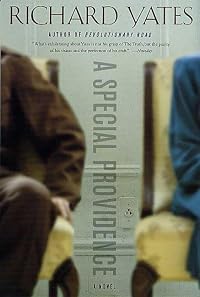
Robert Prentice has spent all his life attempting to escape his mother's stifling presence. His mother, Alice, for her part, struggles with her own demons as she attempts to realize her dreams of prosperity and success as a sculptor. As Robert goes off to fight in Europe, hoping to become his own man, Richard Yates portrays a soldier in the depths of war striving to live up to his heroic ideals. With haunting clarity, Yates crafts an unforgettable portrait of two people who cannot help but show more hope for more even as life challenges them both. show lessTags
Recommendations
















Member Reviews
A Special Providence is a little different from Richard Yates' other novels, in that it is set in wartime and a large proportion of the book is about the experiences of a young soldier, Bobby. The other part of the novel is the story of Bobby’s mother, Alice, back when Bobby was a child, describing their unstable and disaster-prone life together mainly from Alice’s point of view.
The prologue sets up the complicated relationship between the mother and son by describing a fraught meeting between them when Bobby is on leave from the army, before he is sent overseas. Because Bobby is an only child and has grown up without any contact with his father, he and his mother are very close. To anyone who’s read many Yates novels, it is very show more noticeable that all the mothers have similar characters, and Alice seems to fit straight away into the usual mould: self-dramatising, unable to stop talking about herself, prone to hysteria. The typical Yates-style mother has artistic ambitions and longs for a more glamorous life, spent with other artistic and ‘interesting’ people she considers worthy of her. This usually leads to endless attempts at social climbing, as well as vast extravagance and money problems. Anyway, it is immediately clear that Alice is of this type, and that Bobby feels a massive resentment towards her and is very critical of her delusions about herself. Nevertheless, it’s not that simple, because they both depend on each other, and there is part of Bobby that genuinely admires how his mother has battled through life and how during her very ordinary childhood, she ‘somehow developed a passion for art, and for elegance, and for the great distant world of New York’.
Alice is not the utterly terrible mother figure that so often appears in Richard Yates’ books; she has far more sympathetic character traits, such as her determination and her commitment to her artwork. I did find myself liking her at times and rejoicing in her occasional moments of success, while knowing (because obviously this is a Richard Yates novel!) that they couldn’t last very long and there would be disappointment round the corner. I very much enjoyed the parts of the book dealing with Bobby’s childhood. I was drawn in by Alice’s relationship with her boyfriend, and her disastrous move, encouraged by an artistic and ‘interesting’ couple she meets, to a decadent country estate like something by F. Scott Fitzgerald. Like most Richard Yates books, summarising the plot doesn’t show what is fascinating about his books: the characters, their relationships and conflicts, and his observations of their inner lives and interactions with eachother.
Bobby begins life in the army as an awkward, nervous eighteen-year-old and enters battle confused about what he is meant to be doing and desperate for acceptance, social status and the chance to act heroically. He is sent to France and Germany, and spends most of his time trying to survive battles set among the deserted houses of occupied villages. I felt as if, even in these dangerous situations, this novel was very much about self-consciousness, and the way in which people imagine they are perceived by others. The behaviour of Bobby and some of the other soldiers is influenced by war movies and their ideals of how a heroic soldier should behave. As Bobby grows up though, he starts to hate this fraudulence. Alice also shows this kind of self-consciousness; for example, when she goes on a romantic date at a sidewalk cafe,’she kept hoping someone she knew would walk past and see them there: she even hoped for strangers to notice them and to wonder, enviously, who they were’.
One thing I really like about Richard Yates’ novels is how his characters are always projecting themselves into the future, imagining themselves behaving well in front of someone they wish to impress or delivering a perfectly withering speech to someone who has made them angry, which I always find funny and believable. I think his novels are concerned with daydreamers and people who want their lives to have some kind of beauty or elegance. Things never work out exactly as they hope, and in the moments when people realise they have been fantasising or deluding themselves, they feel completely embarrassed. I think the contrast between ideal and reality is part of what drives his novels.
The idea of providence becomes quite ironic in the midst of a chaotic battle in which any soldier can die, by chance or because of someone else’s pointless mistake. As well as the importance of chance and luck in the book, there is also the epigraph from W.H. Auden: ‘We are lived by powers we pretend to understand’. I can see how this relates to the story of soldiers taking part in a war that’s beyond their control, but it also reminds me of other Yates characters, especially Emily from The Easter Parade and her words near the end of the novel, ‘I’m almost fifty years old and I’ve never understood anything in my whole life’. This expression of incomprehension and mystery in life is one reason I admire Richard Yates' books. [2011] show less
The prologue sets up the complicated relationship between the mother and son by describing a fraught meeting between them when Bobby is on leave from the army, before he is sent overseas. Because Bobby is an only child and has grown up without any contact with his father, he and his mother are very close. To anyone who’s read many Yates novels, it is very show more noticeable that all the mothers have similar characters, and Alice seems to fit straight away into the usual mould: self-dramatising, unable to stop talking about herself, prone to hysteria. The typical Yates-style mother has artistic ambitions and longs for a more glamorous life, spent with other artistic and ‘interesting’ people she considers worthy of her. This usually leads to endless attempts at social climbing, as well as vast extravagance and money problems. Anyway, it is immediately clear that Alice is of this type, and that Bobby feels a massive resentment towards her and is very critical of her delusions about herself. Nevertheless, it’s not that simple, because they both depend on each other, and there is part of Bobby that genuinely admires how his mother has battled through life and how during her very ordinary childhood, she ‘somehow developed a passion for art, and for elegance, and for the great distant world of New York’.
Alice is not the utterly terrible mother figure that so often appears in Richard Yates’ books; she has far more sympathetic character traits, such as her determination and her commitment to her artwork. I did find myself liking her at times and rejoicing in her occasional moments of success, while knowing (because obviously this is a Richard Yates novel!) that they couldn’t last very long and there would be disappointment round the corner. I very much enjoyed the parts of the book dealing with Bobby’s childhood. I was drawn in by Alice’s relationship with her boyfriend, and her disastrous move, encouraged by an artistic and ‘interesting’ couple she meets, to a decadent country estate like something by F. Scott Fitzgerald. Like most Richard Yates books, summarising the plot doesn’t show what is fascinating about his books: the characters, their relationships and conflicts, and his observations of their inner lives and interactions with eachother.
Bobby begins life in the army as an awkward, nervous eighteen-year-old and enters battle confused about what he is meant to be doing and desperate for acceptance, social status and the chance to act heroically. He is sent to France and Germany, and spends most of his time trying to survive battles set among the deserted houses of occupied villages. I felt as if, even in these dangerous situations, this novel was very much about self-consciousness, and the way in which people imagine they are perceived by others. The behaviour of Bobby and some of the other soldiers is influenced by war movies and their ideals of how a heroic soldier should behave. As Bobby grows up though, he starts to hate this fraudulence. Alice also shows this kind of self-consciousness; for example, when she goes on a romantic date at a sidewalk cafe,’she kept hoping someone she knew would walk past and see them there: she even hoped for strangers to notice them and to wonder, enviously, who they were’.
One thing I really like about Richard Yates’ novels is how his characters are always projecting themselves into the future, imagining themselves behaving well in front of someone they wish to impress or delivering a perfectly withering speech to someone who has made them angry, which I always find funny and believable. I think his novels are concerned with daydreamers and people who want their lives to have some kind of beauty or elegance. Things never work out exactly as they hope, and in the moments when people realise they have been fantasising or deluding themselves, they feel completely embarrassed. I think the contrast between ideal and reality is part of what drives his novels.
The idea of providence becomes quite ironic in the midst of a chaotic battle in which any soldier can die, by chance or because of someone else’s pointless mistake. As well as the importance of chance and luck in the book, there is also the epigraph from W.H. Auden: ‘We are lived by powers we pretend to understand’. I can see how this relates to the story of soldiers taking part in a war that’s beyond their control, but it also reminds me of other Yates characters, especially Emily from The Easter Parade and her words near the end of the novel, ‘I’m almost fifty years old and I’ve never understood anything in my whole life’. This expression of incomprehension and mystery in life is one reason I admire Richard Yates' books. [2011] show less
Nice to see Yates leave the upper-middle class homes of the suburbs for the battlefields of world war II! All his usual preoccupations are here though: dilettante artists, men without any self-confidence to do what they want to, the stupidity and violence of most people. They're in a slightly different key to his better known books though. The key relationships here are between mother and son, or son and other men, rather than man and woman. It's a nice change actually. And makes me feel plenty guilty for moving so far away from my mum, while also providing some weird sort of justification for me moving so far away from her. Thank god she's nothing like Alice. Beautifully written as ever.
Oerdegelijk en erg vlot lezend relaas van een soldaat wiens oorlog er nooit echt één is. Gebukt onder de druk van een overbezorgde en compleet onwereldse moeder, getormenteerd door zijn eigen klunzigheid en getergd door schuldgevoel over een vroeg gesneuvelde vriend, probeert Bobby Prentice zich thuis te voelen in zijn peloton. Daar slaagt hij niet echt in en voor hij het weet is de oorlog voorbij. Het moment om komaf te maken met zijn schuldgevoel én de dominantie van zijn opvoeding.
Knap.
Knap.
A Special Providence explores two lives, tangled together and damaged by twists of fate; the mother by men who deserted her, the son by war. They each had their coping mechanisms which often seemed to compound their difficulties. They were very well drawn portraits of likable sad people.
What can I say? Something in Yates speaks to me. I've now read three novels and have about three to go to figure out what it is...
What can I say? Something in Yates speaks to me. I've now read three novels and have about three to go to figure out what it is...
What can I say? Something in Yates speaks to me. I've now read three novels and have about three to go to figure out what it is...
Members
- Recently Added By
Lists

Best War Stories
87 works; 16 members
Author Information

46+ Works 12,600 Members
Richard Yates is the author of the novels "Revolutionary Road", "A Special Providence", "Disturbing the Peace", "The Easter Parade", "A Good School", "Young Hearts Crying", & "Cold Spring Harbor". He died in 1992. (Bowker Author Biography) Richard Yates was born in Yonkers, New York in 1926. Yates was a well-known American novelist and short-story show more writer. Yates first became interested in writing and journalism while attending Avon Old Farms School in Avon, Connecticut. After Yates' return from France and Germany after serving in the army, he worked as a journalist, publicity writer, and freelance ghost writer. It was not until 1961 that his career as a novelist was officially launched with the publication of his first novel, Revolutionary Road. Revolutionary Road was a finalist for the National Book Award and was subsequently made into a movie in 2008. Yates also taught writing at several universities and institutions including Columbia University, Boston University, Wichita State University, and the University of Southern California Master of Professional Writing Program. Yates was divorced twice and has three daughters: Sharon, Monica, and Gina. He died in 1992 in Birmingham, Alabama of emphysema and complications from a minor surgery. show less
Some Editions
Series
Belongs to Publisher Series
Oorlogsdomein (22)
Common Knowledge
- Canonical title
- A Special Providence
- Original title
- A special providence
- Original publication date
- 1965
- Important events*
- World War II
- Epigraph
- "We are lived by powers we pretend to understand." --W.H. Auden
- Dedication
- To Martha
- First words
- On Saturdays, when inspection was over and passes were issued in the Orderly Rooms, there was a stampede of escape down every company street in Camp Pickett, Virginia.
- Original language*
- Amerikaans
*Some information comes from Common Knowledge in other languages. Click "Edit" for more information.
Classifications
Statistics
- Members
- 326
- Popularity
- 97,226
- Reviews
- 13
- Rating
- (3.62)
- Languages
- 7 — Dutch, English, French, German, Italian, Portuguese, Spanish
- Media
- Paper, Audiobook, Ebook
- ISBNs
- 18
- ASINs
- 6