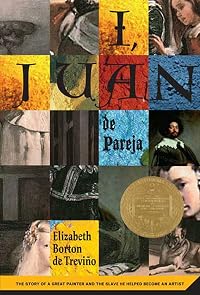
I, Juan de Pareja
by Elizabeth Borton de Trevino
On This Page
Description
Juan de Pareja, the slave who prepares the paints and canvases of the artist Velázquez, describes his work with his master and the climate of Spanish court life.Tags
Recommendations







Member Reviews
Juan de Pareja, our narrator, was a slave in the service of the famous Spanish artist, Velasquez. Spanish slavery of the time was evidently quite different from the brutal slavery of the American South, that we are all familiar with. Juan de Pareja was well treated, and indeed, loved by his master and mistress, and he in turn loved them. This fact naturally gives the book an uncomfortable "Uncle Tom" or "Song of the South" flavor to the narration. We modern readers do not really want to hear about slaves loving their owners. However, this novel is based on history. Pareja, Velasquez, and a few other major characters, were all real people. De Trevino has taken the little that is known about them, and used fiction and imagination to fill show more in the huge gaps in our knowledge. So this is historical fiction - not a biography. But it was fascinating to read in the brief afterward which parts of the story were definitely true.
Juan secretly taught himself to paint, by watching his master for so many years. And a few of Juan de Pareja's paintings survive today and are displayed in museums in Europe. But it was illegal in Spain for a slave to practice the arts. The episode in the story in which both Velasquez and the King of Spain himself discover that the famous artist's slave has been illegally painting is the highlight of the book, and according the the author, this episode is known and based on fact.
Unusual for a middle grade novel in that the narrator, though his story begins in childhood, is an adult through most of the book. Not many books for this age focus the story on adults. show less
Juan secretly taught himself to paint, by watching his master for so many years. And a few of Juan de Pareja's paintings survive today and are displayed in museums in Europe. But it was illegal in Spain for a slave to practice the arts. The episode in the story in which both Velasquez and the King of Spain himself discover that the famous artist's slave has been illegally painting is the highlight of the book, and according the the author, this episode is known and based on fact.
Unusual for a middle grade novel in that the narrator, though his story begins in childhood, is an adult through most of the book. Not many books for this age focus the story on adults. show less
Juan is the slave of the great Spanish painter Diego Valazquez and helps his master in his studio by preparing paints and stretching canvases. But Juan is an artist, too: he has taught himself by watching his master's technique, although such work is forbidden by slaves. Eventually he confesses his secret, and his master gives him his freedom. I really enjoyed the story and the audiobook.
Genre: Historical Fiction. 1966 Newbery Medal winner.
Genre: Historical Fiction. 1966 Newbery Medal winner.
Juan de Pareja was born a slave in 17th century Spain. When his mistress died, he was sent with the rest of her goods to her nephew, the painter Diego Velasquez. Despite their differences in station, the two men become friends, and eventually Juan becomes an artist in his own right, despite it being illegal to teach a slave any of the arts. Very interesting story, with a lot of detail about life in Spain and Italy during that time.
This is enjoyable biography of a noble and compassionate man, a slave who overcame the obstacles in his life to become a great painter. Unfortunately, it's not true. Well, I should say it's based on reality, but like the author herself says, "very little, for certain is known about [Juan de Pareja]." What is known is that Sr. Pareja was a slave, and was inherited by the great Spanish artist Diego Velázquez. We also know that Sr. Pareja became a painter, despite the fact that a slave was forbidden to do so under Spanish law. Ms. Trevino creatively fills in the gaps giving us a tale of what it might be like to be the slave of a great artist. While it isn't true history, it's good reading. You might as well check it out since she's gone show more to all the trouble to write it.
--J. show less
--J. show less
I don't know much about the world of art so I knew nothing about the painter Diego Valezquez nor Juan de Pareja. To discover this was a fictionalized biography was a delight and I was excited to learn about the world of art at the time they lived and painted. Pareja was a slave and legally in Spain was not allowed to paint. And yet he became a famous accomplished artist in his own time. How he accomplished that is part of a wonderful tale.
I listened to the audio book and was pleased that the reader pronounced names as they are pronounced in Castilian Spanish and not in the Latin American Spanish I'm used to. Using the correct pronunciation lent more believability to the dialogue in the story. Though, truth be told, I doubt I'd have show more marked it if she had not done so. show less
I listened to the audio book and was pleased that the reader pronounced names as they are pronounced in Castilian Spanish and not in the Latin American Spanish I'm used to. Using the correct pronunciation lent more believability to the dialogue in the story. Though, truth be told, I doubt I'd have show more marked it if she had not done so. show less
Hard to think of this as a children's book. The central character is adult through most of the book. His childhood is only mentioned in the first few chapters. It is an interesting look at being an artist and at a period of time in Spain. I appreciated the religious feelings that pervaded the story. Well researched and an interesting story. I found it was a great way to fall asleep in the evening. Not my favorite of the books that Vintage Book Circle has read, though the rest of the group liked it a lot.
Not only is this an enjoyable book that teaches much about history, and art, and courage, honor, & friendship, but it's more.
This is also an important book, very relevant right now as African-Americans are giving voice to the feeling many have that they are still not truly free.
It might not be to every child's taste, but I highly recommend it to every homeschooling family and at least one classroom in every Middle School.
More background, quotations, and discussions in the Children's Books group here: https://www.goodreads.com/topic/show/19581996-the-newbery-medal-winner-from-1966...
This is also an important book, very relevant right now as African-Americans are giving voice to the feeling many have that they are still not truly free.
It might not be to every child's taste, but I highly recommend it to every homeschooling family and at least one classroom in every Middle School.
More background, quotations, and discussions in the Children's Books group here: https://www.goodreads.com/topic/show/19581996-the-newbery-medal-winner-from-1966...
Members
- Recently Added By
Lists

A Child's Book Tour of Spain
26 works; 2 members

Sonlight Books
1,487 works; 25 members

Newbery Medal Winners - By Year
105 works; 7 members

CCE 1000 Good Books List
1,033 works; 12 members

Historical Fiction
889 works; 89 members

a picture or a thousand words
39 works; 5 members

Books Read in 2021
5,361 works; 113 members

Beautiful Feet Books
304 works; 7 members

The Story of the World: Activity Book Three: Early Modern Times
191 works; 3 members

Build Your Library Level 3
30 works; 1 member
2025-2026
2 works; 1 member

The Playful Pioneers
166 works; 1 member
Author Information

33 Works 3,082 Members
Awards and Honors
Awards
Common Knowledge
- Canonical title
- I, Juan de Pareja
- Original publication date
- 1965
- People/Characters
- Juan de Pareja; Diego Velázquez; Philip IV, King of Spain
- Important places
- Spain
- Dedication
- To my dear friend Virginia Rice
- First words
- I, Juan de Pareja, was born into slavery early in the seventeenth century.
- Last words
- (Click to show. Warning: May contain spoilers.)And I would be glad that to him it had never mattered, for his friendship was of the heart.
- Original language
- English
Classifications
Statistics
- Members
- 2,260
- Popularity
- 8,924
- Reviews
- 23
- Rating
- (3.89)
- Languages
- 5 — English, French, German, Russian, Spanish
- Media
- Paper, Audiobook, Ebook
- ISBNs
- 42
- ASINs
- 15