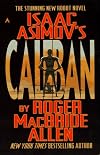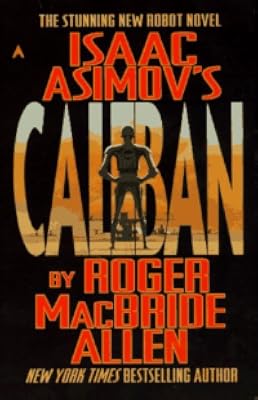
Isaac Asimov's Caliban
by Roger MacBride Allen
Isaac Asimov's Robot Mysteries (1), Asimov's Caliban (1)
On This Page
Description
Fiction. Science Fiction. HTML:In a universe protected by the Three Laws of Robotics, humans are safe. The First Law states, A robot may not injure a human being, or, through inaction, allow a human being to come to harm. When an experiment with a new type of robot brain goes awry, the unthinkable happens. Caliban is created... A robot without guilt or conscience. A robot with no knowledge of or compassion for humanity. A robot without the Three Laws. Caliban is a searing examination of show more Asimov's Three Laws of Robotics, a challenge welcomed and sanctioned by Isaac Asimov, the late beloved genius of science fiction, and written with his cooperation by one of today's hottest talents, Roger MacBride Allen, New York Times bestselling author of Ambush at Corella, The Modular Man, and The Ring of Charon. show lessTags
Recommendations

















Member Reviews
My Isaac Asimov kick starts to wind down with the first book of Allen's Caliban trilogy, a series that examines the Three Laws in a way Asimov himself hadn't done since Robots and Empire, and hadn't done with success since I, Robot. In addition, Allen creates a robot mystery better than any since The Naked Sun (possibly even The Caves of Steel). The planet of Inferno also manages to give us a good glimpse at both Spacer and Settler cultures; it's nice to see a bunch of Spacers who, while dependent on robots, aren't total nutjobs for once. Caliban himself is a compelling character, too, a type Asimov never did much with himself (aside from Andrew Martin, maybe)-- someone not quite a robot, not quite a human being.
We all knew who was probably innocent; add the complexity of everyone else being very suspect; and the true villain was not obvious until the middle of chapter 16. The story reads like a real Asimov detective thriller (only a hint of sex...and no one gets killed) and Allen deserves credit for inventing the gravitonic brain and explaining why the Spacer Worlds are doomed.
I found this to be very much in the Asimov style which I liked more when I was younger, but still appreciate. I enjoyed the undercurrent of the effect upon humans to have robots doing their bidding and looking out for the human's welfare. The story gives some perspective on the topic of AI that is different from what we normally see concerning the potential problems. I didn't think I'd want to follow up with the rest of the series on Caliban, but as I neared the end I found myself curious to see what happens in his future.
Allen's first Caliban novel does a wonderful job of continuing the work of the late Isaac Asimov. It takes a detailed look at the three laws, and their impacts on spacer society. Oh, and add a good old mystery to the mix, and you have yourself a good book.
But did Allen really have to use 'hell' and 'damn' in every other sentence?
But did Allen really have to use 'hell' and 'damn' in every other sentence?
I finally got around to reading this series, and, well, I can understand why several times I started to read, put the book away, and never came back. The three novels tell the story of how the planet Inferno is saved from its original, faulty terra-forming. Along the way new robots, with a modified set of 'Asimov' laws are created.
The story is competently written, but that is all. No spark of creativity, the characters are listless, going through the motions. The robots perhaps show more character than the humans? Or is that saying too much?
Ok, to read once, just to see what it is all about, but not on my 'must re-read list'.
The story is competently written, but that is all. No spark of creativity, the characters are listless, going through the motions. The robots perhaps show more character than the humans? Or is that saying too much?
Ok, to read once, just to see what it is all about, but not on my 'must re-read list'.
Finally quit half into the book. I had been slogging through it but all the while feeling like I was just killing time so I decided to quit it. A few interesting ideas, but the writing is mediocre and the book as a whole seemed like a moral story- the lazy "Spacers" allowing their humanity to dissipate through dependence on robots...
Not too bad, fairly light weight reading. But certainly not up to Asimov's standard.
Members
- Recently Added By
Author Information

Some Editions
Series


Belongs to Publisher Series
Work Relationships
Is contained in
Common Knowledge
- Canonical title
- Isaac Asimov's Caliban
- Original title
- Isaac Asimov's Caliban
- Original publication date
- 1993
- People/Characters
- R. CBN-001 "Caliban"; Dr. Fredda Leving; R. DNL-111 "Donald"; Alvar Kresh; R. Daabor 5132; Tonya Welton (show all 25); Gubber Anshaw; R. Bertran; Simcor Beddle; R. Sanlacore 123; R. Brenabar; Chanto Grieg; Reybon Derue; Santee Timitz; R. Tetlak; Tansaw Meldor; Mirta Lusser; Centor Pallichan; Jackdall; Sparfinch; R. HRT-234 "Horatio"; Dr. Gayol Patros; Davirnik Gidi; R. Chestrie; Abell Harcourt
Classifications
Statistics
- Members
- 770
- Popularity
- 36,564
- Reviews
- 12
- Rating
- (3.63)
- Languages
- 8 — Czech, Dutch, English, French, German, Hungarian, Italian, Spanish
- Media
- Paper, Ebook
- ISBNs
- 20
- UPCs
- 1
- ASINs
- 6