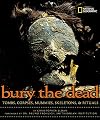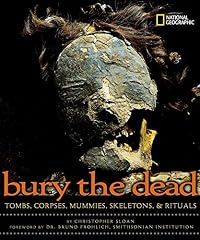
Bury the Dead: Tombs, Corpses, Mummies, Skeletons, & Rituals
by Christopher Sloan
On This Page
Description
Examines the customs and practices related to burial that have existed from ancient times to the present.Tags
Recommendations



















Member Reviews
Non-fiction lit for kids is fabulous these days. Here is a gloriously illustrated book that will satisfy the most morbid seeker of grossness -- while at the same time treating the subject with academic accuracy and intelligence.
My favorite tidbit -- "People on the island of Sulawesi in Indonesia bury infants in a tree [and there is an illustration of an enormous, lichen splotched, vine covered tree trunk up the length of which are placed little doors made from lashed together sticks] .... They believe the child will rise up safely to the heavens through the trunk."
My favorite tidbit -- "People on the island of Sulawesi in Indonesia bury infants in a tree [and there is an illustration of an enormous, lichen splotched, vine covered tree trunk up the length of which are placed little doors made from lashed together sticks] .... They believe the child will rise up safely to the heavens through the trunk."
Book is written by a qualified author, Christopher Sloan a senior editor for National Geographic Magazine and the author of two children's books one that was a School Library Journal Best Book of the Year for Feathered Dinosaurs. The illustrations and mostly the photographs are wonderful in this book, bright, large, and interesting. A great job by covering multiple cultures with the ritual of burying the dead, discussed ancient practices from cultures in the Americas,Africa, Europe and Asia. Very informative with facts, names, and dates. The book is designed to give readers a glimpse in how archaeologists learn about the lives of cultures by studying the culture's burial practices. Does not read like a text book but rich with show more information and knowledge. A concern is how the chapters are organized, at first glance you would think it is by chronological order with years but many of the chapter overlap in years, a bit confusing. Photographs and illustrations have detailed captions. This book does not go into great detail of the culture, which I believe is a strength, the chapters are short and to the point. If interest is sparked by the reader than the reader can find more information on the subject. I can see young boys being drawn to and enjoying this book about mummification, death, and burial practices.
Ages 8 - 12. show less
Ages 8 - 12. show less
"Bury the Dead," provides a rich history of how various cultures beginning from ancient times viewed death and buried their dead. The authors are highly qualified to write about the topic as well as relate it to children - Christopher Sloan is a Senior Editor at National Geographic and author of two children's books, and Dr. Bruno Frolich is an anthropologist working with the Smithsonian Institution specializing in the study of burial practices and trained in archaeology and forensic medicine. The information is current as the book features CT scans and digital reconstructions of remains.
What will engage the reader the most about "Bury the Dead" is that not only is the rich details and facts eloquently present throughout the work, but show more the authors sensitivity in communicating how different cultures cope with death - which was best illustrated by their coverage of Aleutian and Indonesian funeral practices for the death of infants. The beautiful and intricate photos and illustrations create the feeling of involvement for the reader.
Great tool to use in an Ancient Civilizations or World History lesson for ages 10-12. show less
What will engage the reader the most about "Bury the Dead" is that not only is the rich details and facts eloquently present throughout the work, but show more the authors sensitivity in communicating how different cultures cope with death - which was best illustrated by their coverage of Aleutian and Indonesian funeral practices for the death of infants. The beautiful and intricate photos and illustrations create the feeling of involvement for the reader.
Great tool to use in an Ancient Civilizations or World History lesson for ages 10-12. show less
National Geographic editor Christopher Sloan reveals that ancient burial sites unravel a culture's perspectives on death and life after death. The cultures include Europe, Africa, Asian, and the Americas. Sloan begins the book with a prehistory of the tombs of ancient Egypt and closes the chapter about modern burial practices and how they reflect our current cultures. The modern burial practices include Indonesia, the Amazon rainforest,the Yanomami, and the Ghana. In Ghana, for instance, people currently bury their dead in coffins in the shapes of cars, fish, and other animals. Some of the ancient burial sites include the golden graves of the Scytho-Siberians, the horde of clay warrior surrounding the tomb of the first Quin emperor, and show more the grave of the Moche Lord of Sip ne Peru.
Sloan has included an astounding number of vivid color photographs, timelines, realistic artwork, location maps, colorful diagrams, a bibliography, and an index. It is suggested those who have weak hearts skip close-up photographs of mummies, flessless skulls, and mortal remains--I did. The photos also include excavations, artifacts, and burial sites. It will fascinate potential archaeologists, anthropologists, and cultural historians. Sloan makes notes of displeasing ethnic groups when he discusses that ancient burial sites are dug up for research. He does a wonderful job of providing such an appealing and reader-friendly text that is not overshadowed by the breathtaking photos from the National Geographic Society's archives. show less
Sloan has included an astounding number of vivid color photographs, timelines, realistic artwork, location maps, colorful diagrams, a bibliography, and an index. It is suggested those who have weak hearts skip close-up photographs of mummies, flessless skulls, and mortal remains--I did. The photos also include excavations, artifacts, and burial sites. It will fascinate potential archaeologists, anthropologists, and cultural historians. Sloan makes notes of displeasing ethnic groups when he discusses that ancient burial sites are dug up for research. He does a wonderful job of providing such an appealing and reader-friendly text that is not overshadowed by the breathtaking photos from the National Geographic Society's archives. show less
“Bury the Dead: Tombs, Corpses, Mummies, Skeletons, and Rituals” is a Survey book that is produced by National Geographic. The book gives an overall view of the topic of how people all over the world burying their dead. It is very interesting in that the author uses scientific information and documentation to piece together a belief system from another time and at the same time it gives the reader an insight on what it is to be an archeologist.
The illustrations in the book show how archeologist use the clues they find to understand the civilizations of centuries past. The pictures support the content very well; they are colored illustrations that sometimes take up the whole page. They include captions that further explain the show more content. I believe many young readers will be very intrigued by both the pictures and the content.
The book also gives some information on the tools archeologists use such as computerized tomography (CT) scans. Using these CT scans enables archeologists to see through fragile items without actually touching them so that they may be preserved for future generations. Embalming techniques and practices are also discussed in some detail.
I was impressed by the historical content as well as the academic language used. The information in the book was selected by the author because it was well documented, and the author is a senior edition for National Geographic. The information in this text focuses in the practices in Europe, Africa, Asia, and the Americas.
Ages 4th grade and Up show less
The illustrations in the book show how archeologist use the clues they find to understand the civilizations of centuries past. The pictures support the content very well; they are colored illustrations that sometimes take up the whole page. They include captions that further explain the show more content. I believe many young readers will be very intrigued by both the pictures and the content.
The book also gives some information on the tools archeologists use such as computerized tomography (CT) scans. Using these CT scans enables archeologists to see through fragile items without actually touching them so that they may be preserved for future generations. Embalming techniques and practices are also discussed in some detail.
I was impressed by the historical content as well as the academic language used. The information in the book was selected by the author because it was well documented, and the author is a senior edition for National Geographic. The information in this text focuses in the practices in Europe, Africa, Asia, and the Americas.
Ages 4th grade and Up show less
Sloan, C. (2002). Bury the dead: Tombs, corpses, mummies, skeletons, and rituals. Washington D.C.: National Geographic Society.
In Bury the Dead, Sloan describes how people in different cultures bury the dead. In particular, he looks at few samples from Egypt, China, Russia, and Peru. Sloan takes readers on an adventure from finding mummies in Egypt to tombs in Peru. He explains the change over time in how people bury the dead. Ultimately, by examining the dead, it provides insight into that society, culture, and people group.
Sloan is a Senior Editor at National Geographic magazine. Bury the Dead provides an extensive list of principal consultants, which include the Director of the Smithsonian Institute and many professors. In the back, show more Sloan provides a bibliography, which authenticate his research.
The book presents current methods used by archaeologists. For instance, he explains that a computerized tomography (CT) scan enables scientists to see a child skeleton inside a burial without actually opening the burial.
Each page is filled with photos, diagrams, and paintings to support the text. Each visual has a caption, which further clarifies information. The text is also written in an organized manner. Sloan clearly distinguishes fact from theory. He even makes a point of writing that “we do not know what long-ago people were thinking when they buried the dead” (p.57). At the same time, archaeologists can uses facts to make inferences about the past.
I thought that Bury the Dead provided a broad overview of the topic. Sloan did not oversimplify information. Reference aids, such as the table of contents and glossary, were also easy to use and helpful. The pictures are fascinating and will surely draw in readers. Warning: some pictures are quite morbid.
This book is appropriate for children ages 10 and up. show less
In Bury the Dead, Sloan describes how people in different cultures bury the dead. In particular, he looks at few samples from Egypt, China, Russia, and Peru. Sloan takes readers on an adventure from finding mummies in Egypt to tombs in Peru. He explains the change over time in how people bury the dead. Ultimately, by examining the dead, it provides insight into that society, culture, and people group.
Sloan is a Senior Editor at National Geographic magazine. Bury the Dead provides an extensive list of principal consultants, which include the Director of the Smithsonian Institute and many professors. In the back, show more Sloan provides a bibliography, which authenticate his research.
The book presents current methods used by archaeologists. For instance, he explains that a computerized tomography (CT) scan enables scientists to see a child skeleton inside a burial without actually opening the burial.
Each page is filled with photos, diagrams, and paintings to support the text. Each visual has a caption, which further clarifies information. The text is also written in an organized manner. Sloan clearly distinguishes fact from theory. He even makes a point of writing that “we do not know what long-ago people were thinking when they buried the dead” (p.57). At the same time, archaeologists can uses facts to make inferences about the past.
I thought that Bury the Dead provided a broad overview of the topic. Sloan did not oversimplify information. Reference aids, such as the table of contents and glossary, were also easy to use and helpful. The pictures are fascinating and will surely draw in readers. Warning: some pictures are quite morbid.
This book is appropriate for children ages 10 and up. show less
Part E Nonfiction-Survey
Sloan, C. (2002). Bury the dead: tombs, corpses, mummies, skeletons, & rituals. Washington, D.C.: National Geographic.
Archaeologists study the rituals of burying the dead to learn about humanity and, as some scientists think, to study the first examples of spiritual thinking in humans. Some clues to humanity include signs that people started looking after family that was sick or old and could not care for themselves. In addition to exploring the rituals of dead that have been preserved in tombs and mummies, the book also acknowledges the rituals that would not leave behind evidence for archaeologists to explore.
The fascinating photographs and precise, explicit illustrations help young readers explore the ways show more of humans and ancient cultures. The information-rich captions make it easy to do a picture walk, exploring the information within the book. Ages 9-15. show less
Sloan, C. (2002). Bury the dead: tombs, corpses, mummies, skeletons, & rituals. Washington, D.C.: National Geographic.
Archaeologists study the rituals of burying the dead to learn about humanity and, as some scientists think, to study the first examples of spiritual thinking in humans. Some clues to humanity include signs that people started looking after family that was sick or old and could not care for themselves. In addition to exploring the rituals of dead that have been preserved in tombs and mummies, the book also acknowledges the rituals that would not leave behind evidence for archaeologists to explore.
The fascinating photographs and precise, explicit illustrations help young readers explore the ways show more of humans and ancient cultures. The information-rich captions make it easy to do a picture walk, exploring the information within the book. Ages 9-15. show less
Members
- Recently Added By
Author Information
12 Works 726 Members
Christopher Sloan is the Senior Editor for Art and the paleobiology specialist at National Geographic magazine
Awards and Honors
Common Knowledge
- Original publication date
- 2002
- Important places
- Egypt; Russia; Peru; China
- First words
- The Chacopoya buried their dead on the sides of cliffs that erupt out of the green jungles of Peru.
- Quotations
- Today in Ghana, the Ga people bury their dead in coffins made in shapes of car, fish, and other animals, and the Dani people of Irian Jaya preserve their great warriors by smoking them.
By studying the remains--or lack of remains--of our own burial rituals, scientist can improve their understanding of the past.
"People on the Island of Sulawesi in Indonesia bury infants in a tree...they believe the child will rise up safely to the heavens through the trunk." - Last words
- (Click to show. Warning: May contain spoilers.)Will they be able to guess correctly what we were thinking when we buried the dead?
Classifications
Statistics
- Members
- 130
- Popularity
- 250,487
- Reviews
- 7
- Rating
- (3.94)
- Languages
- English
- Media
- Paper, Audiobook
- ISBNs
- 4
- ASINs
- 1