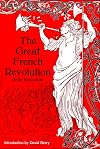
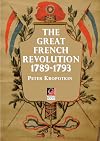
The Great French Revolution, 1789-1793
by Peter Kropotkin
On This Page
Description
"The Great French Revolution, 1789-1793 is Peter Kropotkin's most substantial historical work. In it he presents a people's history of the world-shaking events of the Revolution and shows the key role the working men and women of the towns and countryside played in it. Without the constant pressure of popular organisations and activity, the politicians would never have created a Republic, nor been able to survive the counterrevolutionary forces internally or externally. Focusing on such mass show more movements--and especially the peasant majority--rather than on the few great men beloved of bourgeois accounts, this is a groundbreaking account of the period and a seminal work of "history from below." Later research may have corrected some factual details and opened new avenues of scholarship, but Kropotkin's text remains an exemplar of anarchist history-writing, challenging both bourgeois republican and Marxist interpretations of the Revolution. Yet it is more than a history: Kropotkin uses the experience of the French Revolution to aid us in our current struggles and to learn its lessons in order to ensure the success of future revolutions. This book raises issues which have resurfaced time and again, as well as offering solutions based on the self-activity of the masses, the new, decentralised, directly democratic social organisations they forged during the Revolution, and the need to transform a political revolt into a social revolution which seeks to secure the well-being of all by transforming the economy from the start"-- show lessTags
Recommendations



























Member Reviews
Written by one of the founders of anarchism, this very readable history examines the revolution from the point of view of the average person. As such, the various machinations of the political bodies take second place to economic changes. Kropotkin sees the major conflict of the period as being between the emerging bourgeoisie, who undermine the revolution by upholding property rights, and "the people," who drive the revolution to destroy feudalism and return collectively owned land taken from them during the reigns of Louis XIV & Louis XV.
Kropotkin sensed that revolution was coming to Russia (and, he thought, Germany and Austria) and he looks to the French Revolution to understand the threats and interests that could derail the more show more radical goals. Not surprisingly, it comes down to middle class greed wearing down revolutionary fervor. But, he ends on an optimistic note claiming that the course of revolution is not linear and that many of the more obscene injustices of 1789 were destroyed forever, in ways that never could have been achieved by mere reform. show less
Kropotkin sensed that revolution was coming to Russia (and, he thought, Germany and Austria) and he looks to the French Revolution to understand the threats and interests that could derail the more show more radical goals. Not surprisingly, it comes down to middle class greed wearing down revolutionary fervor. But, he ends on an optimistic note claiming that the course of revolution is not linear and that many of the more obscene injustices of 1789 were destroyed forever, in ways that never could have been achieved by mere reform. show less
Kropotkin the great anarchist had a very diverse learning. Biology, geography, literature, politics and history were areas he addressed in his works. In The Great French Revolution he sets out to give an account of the revolution from below. Were other historians often focuses on the perceived leaders and documents Kropotkin let the anonymous masses take the centre stage.
As always in Kropotkin's works the language is easy to grasp and made for the common people. Kropotkin wanted his works to be read by the working man and peasant. If the academic world took interest he was glad, but it doesn't seem to have been his main intention.
If the language is good it has to be said that the chapters don't fit to each other very well. The big show more picture can feel like a bit of a mess. Many of Kropotkin's other works is put together in a more stringent way.
I think Kropotkin chose to write this work because he felt the ordinary people's struggles had been overlooked and he also believed there was (anarcho-)communist tendency among the masses. For Kropotkin, as he tried to show in mutual aid, the common people always have communistic tendencies they turn into some kind of practice. For Kropotkin, as opposed to Karl Marx, the communist society seem to have always been a possibility. By showing the communist tendencies in the french revolution he tries to make this hypothesis stronger.
His argumentation usually feel persuasive (although there is a lack of sources compared to today's serious scholarly research). But there are occasions were it seem like he just argues from a biased point of view. When for example the peasants demands communal sharing of the lands and the workers of Paris opposes the rich this is a spontaneous expression of their inner desires. When on the other hand the farmers rises against the republic they are simply manipulated by the priests.
I haven't read much about the french revolution, so I can't say whether Kropotkin's account gives any new insight that can't be found somewhere else. I would say this probably shouldn't be the first book to read about it, but it might be a good second book to read. For people who will are interested because it is Kropotkin I'll recommend you read "Conquest of bread", "Mutual aid" and "Memoirs of a Revolutionist" first. Then this one may be worth a read. show less
As always in Kropotkin's works the language is easy to grasp and made for the common people. Kropotkin wanted his works to be read by the working man and peasant. If the academic world took interest he was glad, but it doesn't seem to have been his main intention.
If the language is good it has to be said that the chapters don't fit to each other very well. The big show more picture can feel like a bit of a mess. Many of Kropotkin's other works is put together in a more stringent way.
I think Kropotkin chose to write this work because he felt the ordinary people's struggles had been overlooked and he also believed there was (anarcho-)communist tendency among the masses. For Kropotkin, as he tried to show in mutual aid, the common people always have communistic tendencies they turn into some kind of practice. For Kropotkin, as opposed to Karl Marx, the communist society seem to have always been a possibility. By showing the communist tendencies in the french revolution he tries to make this hypothesis stronger.
His argumentation usually feel persuasive (although there is a lack of sources compared to today's serious scholarly research). But there are occasions were it seem like he just argues from a biased point of view. When for example the peasants demands communal sharing of the lands and the workers of Paris opposes the rich this is a spontaneous expression of their inner desires. When on the other hand the farmers rises against the republic they are simply manipulated by the priests.
I haven't read much about the french revolution, so I can't say whether Kropotkin's account gives any new insight that can't be found somewhere else. I would say this probably shouldn't be the first book to read about it, but it might be a good second book to read. For people who will are interested because it is Kropotkin I'll recommend you read "Conquest of bread", "Mutual aid" and "Memoirs of a Revolutionist" first. Then this one may be worth a read. show less
Ratings
Members
- Recently Added By
Author Information

178+ Works 5,771 Members
Work Relationships
Common Knowledge
- Canonical title
- The Great French Revolution, 1789-1793
- Important events
- French Revolution (1789)
Classifications
- Genres
- Nonfiction, History, General Nonfiction
- DDC/MDS
- 944.04 — History & geography History of Europe France and Monaco France Revolution 1789-1804
- LCC
- DC148 .K8 — History of Europe, Asia, Africa and Oceania France – Andorra – Monaco History of France Modern, 1515- Revolutionary and Napoleonic period, 1789-1815
- BISAC
Statistics
- Members
- 128
- Popularity
- 255,291
- Reviews
- 2
- Rating
- (4.00)
- Languages
- 8 — Chinese, Dutch, English, French, German, Italian, Spanish, Swedish
- Media
- Paper, Ebook
- ISBNs
- 21
- ASINs
- 10