Tusculan Disputations
by Cicero
On This Page
Description
It was Cicero's custom in the opportunities of his leisure to take some friends with him into the country, where, instead of amusing themselves with idle sports or feasts, their diversions were wholly speculative, tending to improve the mind and enlarge the understanding. In this manner he now spent five days at his Tusculan villa in discussing with his friends the several questions just mentioned. For, after employing the mornings in declaiming and rhetorical exercises, they used to retire show more in the afternoon 8into a gallery, called the Academy, which he had built for the purpose of philosophical conferences, where, after the manner of the Greeks, he held a school, as they called it, and invited the company to call for any subject that they desired to hear explained, which being proposed accordingly by some of the audience became immediately the argument of that day's debate. These five conferences, or dialogues, he collected afterward into writing in the very words and manner in which they really passed and published them under the title of his Tusculan Disputations, from the name of the villa in which they were held. show lessTags
Recommendations



Member Reviews
Everything that would be of interest to the well-educated man of affairs is covered in his works. Together with his exceptional intelligence and fundamental warmth, they also expose Cicero's conceit and emotional instability. Since then, speakers have been influenced by his oratory style.
Perhaps it's the translation ... I feel as though I would enjoy Cicero in the original, but since I don't know Latin I cannot back that up or even provide a good reason why.
Anyhoo, while C. draws on a great number of (perhaps more intellectually substantial?) predecessors for his philosophical thoughts, the Tusculan Disputations just seems to kind of -- in the immortal words of MST3K's Mike Nelson -- wander around the house. Mind you, it's an attractive house, a witty house, but this house (work) does not make a good case for Romans being "as good at" philosophy as the Greeks (I'm not sure C makes that claim so directly and boldly).
Anyhoo, while C. draws on a great number of (perhaps more intellectually substantial?) predecessors for his philosophical thoughts, the Tusculan Disputations just seems to kind of -- in the immortal words of MST3K's Mike Nelson -- wander around the house. Mind you, it's an attractive house, a witty house, but this house (work) does not make a good case for Romans being "as good at" philosophy as the Greeks (I'm not sure C makes that claim so directly and boldly).
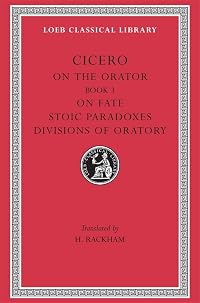
Edition: // Descr: xxxvii, 578 p. 17 cm. // Series: The Loeb Classical Library Call No. { 875 C48-L 6 } Series Edited by T.E. Page With an English Translation by J.E. King Contains Latin and English Versions, Appendices, and Index. // //
Edition: // Descr: // Series: Call No. { 875 C48 43 } Edited by O. Heine. // //
Edition: // Descr: // Series: Call No. { 875 C48 42 } Edited by O. Heine. There are 2 copies. // //
171.2 CIC
Apr 20, 2020Italian
Ratings
Members
- Recently Added By
Author Information

2,149+ Works 26,758 Members
Born in Arpinum on January 3, 106 B.C., Marcus Tullius Cicero was a Roman orator, writer, and politician. In Rome, Cicero studied law, oratory, philosophy, and literature, before embarking on a political career. Banished from Rome in 59 B.C. for the execution of some members of the Catiline group, Cicero devoted himself to literature. Cicero was show more pardoned by Julius Caesar in 47 B.C., and returned to Rome to deliver his famous speeches, known as the "Philippics," urging the senate to declare war on Marc Antony. Cicero's chief works, written between 46 and 44 B.C., can be classified in the categories of philosophical works, letters, and speeches. The letters, edited by his secretary Tiro, showcase a unique writing style and charm. The most popular work of the period was De Officiis, a manual of ethics, in which Cicero espoused fundamental Christian values half a century before Christ. Cicero was murdered in Formiae, Italy, on December 4, 43 B.C., by Antony's soldiers after the triumvirate of Antony, Lepidus, and Octavius was formed. (Bowker Author Biography) show less
Some Editions
Series
Belongs to Publisher Series
Work Relationships
Common Knowledge
- Canonical title
- Tusculan Disputations
- Original title
- Tusculanae disputationes
- First words*
- Als ich mich endlich von meiner Arbeit als Verteidiger vor Gericht und von den Pflichten als Senator ganz oder doch zum größten Teil befreit sah, da kehrte ich - vor allem auf deine Mahnung hin, Brutus - zu jenen Studien zu... (show all)rück, die ich im Geist zwar festgehalten, unter dem Zwang der Umstände aber zurückgestellt hatte und die während langer Zeit liegen geblieben waren.
- Quotations*
- A: Anser du meg som så forrykt at jeg skulle tro på slike eventyr?
M: Du tror altså ikke på dem?
A: Absolutt ikke.
M: Det var virkelig trist.
A: Hvorfor det?
M: Fordi jeg kunne vært så veltalende hvis jeg... (show all) skulle ha talt mot slike eventyr.
Undertiden - men sjelden - kan det tillates for en mann å stønne; å hyle, ikke engang for en kvinne.
Theodoros sa til Lysimakhos som truet ham med døden: 'Du får sannelig utrettet noe stort hvis du har fått samme makt som en giftflue.' - Original language
- Latin
*Some information comes from Common Knowledge in other languages. Click "Edit" for more information.
Classifications
Statistics
- Members
- 391
- Popularity
- 80,005
- Reviews
- 6
- Rating
- (3.57)
- Languages
- 12 — Catalan, Czech, Dutch, English, Finnish, French, German, Italian, Latin, Norwegian (Bokmål), Spanish, Swedish
- Media
- Paper, Audiobook, Ebook
- ISBNs
- 48
- ASINs
- 19