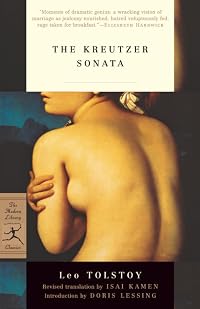
The Kreutzer Sonata
by Leo Tolstoy
On This Page
Description
Pozdnyshev jealously observes the intimacy that emerges between his wife and a violin player. Haunted by 'The Kreutzer Sonata' over which they bonded; it plays round and round in Pozdnyshev's head driving him to distraction and to an unquenchable rage. The Kreutzer Sonata is a psychologically fascinating novella, offering interesting insights into the power play between the sexes.Tags
Recommendations










Member Recommendations

JuliaMaria "Eine Frage der Schuld" gibt die Antwort der Ehefrau von Tolstoi auf die Kreutzersonate. Beide mit autobiographischen Bezügen.
SnootyBaronet Jealousy
Member Reviews
OH BOY, DO I HAVE A LOT OF FEELINGS ABOUT THIS BOOK. Most especially, about the choice to include it in a series titled Great Loves. Despite the fact that the narrator begins his tale with a rant on how awful love is -- I would argue that there is very little love on display in this book. Rather, a great deal of possessiveness, and also the stifling nature of heteronormativity.
Despite all that (which did frequently get on my nerves), this is still Tolstoy, so it's still somehow fascinating and compelling even as I often wanted to hold the main character's face under water. (And yes, it seems clear that he is the character Tolstoy identifies with.) I was drawn along, rooting for the wife and for the man to gain any inkling of his show more inherent ass-hattedness, even though it is clear from the very beginning of his tale that neither will happen.
A compulsive but frustrating but train-wrecky NOT-A-LOVE-STORY. show less
Despite all that (which did frequently get on my nerves), this is still Tolstoy, so it's still somehow fascinating and compelling even as I often wanted to hold the main character's face under water. (And yes, it seems clear that he is the character Tolstoy identifies with.) I was drawn along, rooting for the wife and for the man to gain any inkling of his show more inherent ass-hattedness, even though it is clear from the very beginning of his tale that neither will happen.
A compulsive but frustrating but train-wrecky NOT-A-LOVE-STORY. show less
Praised by many as Tolstoy's best short story—or novella, really—I'm shocked that I've never read this until now, if only for the reason that Tolstoy's best inevitably means one of the best novellas ever written. And The Kreutzer Sonata is definitely that; it's also one of the beginning texts of existentialist literature, and I can imagine Camus and even Proust reading this with relish.
In a mere hundred or so pages, Tolstoy attacks everything: the oppressive system of gender inequality; the class system; capitalism, money, and the ignorance in which children are reared; marriage; religion; medicine; the legal system—in short, every subject under the sun is scrutinized and unashamedly bashed to pieces here, in a novella that show more renders the act of confession as the only means of redemption in a world of lost faith, principles, and morals, a motif that pairs this rather well with Camus's La chute, whose own narrator seems oddly reminiscent at times with Tolstoy's in Kreutzer.
One can see why this was banned and why there was such a scandal when Tolstoy published this in 1889, and many of its subjects and concerns are still sadly relevant today. show less
In a mere hundred or so pages, Tolstoy attacks everything: the oppressive system of gender inequality; the class system; capitalism, money, and the ignorance in which children are reared; marriage; religion; medicine; the legal system—in short, every subject under the sun is scrutinized and unashamedly bashed to pieces here, in a novella that show more renders the act of confession as the only means of redemption in a world of lost faith, principles, and morals, a motif that pairs this rather well with Camus's La chute, whose own narrator seems oddly reminiscent at times with Tolstoy's in Kreutzer.
One can see why this was banned and why there was such a scandal when Tolstoy published this in 1889, and many of its subjects and concerns are still sadly relevant today. show less
3,5
For the sake of his pleasure he makes women, who ought to be his helpmates in the progress of humanity towards truth and goodness, into his enemies.
Almost a satirical discussion of courtship and marriage. I guess if the sexes weren’t forced into certain roles by society, none of this killing would have happened?
Not only was marriage not happiness, it was something exceedingly painful and distressing. But, like everyone else, I refused to admit this to myself and I hid it not only from others, but also from myself.
For the sake of his pleasure he makes women, who ought to be his helpmates in the progress of humanity towards truth and goodness, into his enemies.
Almost a satirical discussion of courtship and marriage. I guess if the sexes weren’t forced into certain roles by society, none of this killing would have happened?
Not only was marriage not happiness, it was something exceedingly painful and distressing. But, like everyone else, I refused to admit this to myself and I hid it not only from others, but also from myself.
Well, what a strange little book this turned out to be from the master.
Is it a good read? Yes, it is. Structured around a series of short chapters and incidents, it's just right for the shot-away modern attention span (surely, the novella is the perfect form for our age?) You know what's coming, almost from the outset, because the protagonist, Troukhatchevsky, tells you so. And yet, by delaying the crucial moment and delaying it, Tolstoy builds unbearable tension. In other words, the story telling is as masterful as you would expect, as are the characterisation and fine detailing.
The obsessive nature of the protagonist and the bizarre philosophy to which he adheres put me in mind of Raskolnikov. Well, it was after all the century of show more grand ideas, culminating not long after in that Republic of Ideas, the USSR. These peculiarities made Troukhatchevsky a less tragic, less sympathetic figure than otherwise he might have been. Even the counter-philosophies were rather difficult to take, from a 21st Century perspective. The theme of jealousy and its un-reason, on the other hand, remain powerfully and universally relevant, all the more so when developed by one of the great writers. show less
Is it a good read? Yes, it is. Structured around a series of short chapters and incidents, it's just right for the shot-away modern attention span (surely, the novella is the perfect form for our age?) You know what's coming, almost from the outset, because the protagonist, Troukhatchevsky, tells you so. And yet, by delaying the crucial moment and delaying it, Tolstoy builds unbearable tension. In other words, the story telling is as masterful as you would expect, as are the characterisation and fine detailing.
The obsessive nature of the protagonist and the bizarre philosophy to which he adheres put me in mind of Raskolnikov. Well, it was after all the century of show more grand ideas, culminating not long after in that Republic of Ideas, the USSR. These peculiarities made Troukhatchevsky a less tragic, less sympathetic figure than otherwise he might have been. Even the counter-philosophies were rather difficult to take, from a 21st Century perspective. The theme of jealousy and its un-reason, on the other hand, remain powerfully and universally relevant, all the more so when developed by one of the great writers. show less
Tolstoy, once again, speaking truth to power: men and women both are degraded, trapped and victimised by the social and cultural restraints put on women which prevent them from becoming, behaving, and being seen as human beings, and everything we "prove" with art and science to elevate ourselves as the most superior of animals is really just denial of the likelihood that we are the most slovenly and vicious animals of them all. If Tolstoy sounds pissed, I think it is only because he does wish for greater equality, mutual respect, and freedom to develop as whole beings, and recognises we're never going to get there until we drop the charades, and admit how screwed up we really are and have been; over a hundred years after Tolstoy and our show more denials, delusions, rationalisations and justifications are stronger (and more convoluted) than ever, liberation from the various injustices and oppressions we inflict upon each other and ourselves is still not on the horizon. The frustration expressed in The Kreutzer Sonata is, to this reader at least, perfectly understandable and relevant to this day. show less
The Kreutzer Sonata is one of Tolstoy’s later works and revolves around his moral beliefs about lust, love, and marriage. To the point: a conversation takes place on a train between passengers about love and marriage. One passenger, Pozdnyshev, becomes agitated and says (I paraphrase), love and marriage are a bunch of crap. He then recounts in detail how and why he killed his wife in a jealous fit.
This is Tolstoy, so the story is well-crafted and all the other key words and catch phrases that describe excellent writing. What I found interesting is that Pozdnyshev blames society’s loose morals for setting him up for failure in his marriage. As a young man he partied. He slept around, drank, etc. He goes on to say his former purely show more pleasure driven relations with women, which for the most part were secretly accepted by society if not openly condoned, ruined his relationship with his wife.
"Yes, my relations with women were lost forever. Pure relations with women, from that time forward, I could no longer have. I had become what is called a voluptuary; and to be a voluptuary is a physical condition like the condition of a victim of the morphine habit, of a drunkard, and of a smoker.
Just as the victim of the morphine habit, the drunkard, the smoker, is no longer a normal man, so the man who has known several women for his pleasure is no longer normal. He is abnormal forever. He is a voluptuary. Just as the drunkard and the victim of the morphine habit may be recognized by their face and manner, so we may recognize a voluptuary. He may repress himself and struggle, but nevermore will he enjoy simple, pure, and fraternal relations toward woman. By his way of glancing at a young woman one may at once recognize a voluptuary; and I became a voluptuary, and I have remained one."
I find the idea interesting in light of today’s obsession with sexuality and porn. The book is an insight into Victorian morality (Can it be Victorian if it’s Russian?,) and it can actually be read as an early feminist text.
Is it worth reading? If you’re interested in the aforementioned topics and want a quick Russian literature read, yes. If you want action and intrigue and don’t care what people thought about sex, love, and marriage in the olden days, no. show less
This is Tolstoy, so the story is well-crafted and all the other key words and catch phrases that describe excellent writing. What I found interesting is that Pozdnyshev blames society’s loose morals for setting him up for failure in his marriage. As a young man he partied. He slept around, drank, etc. He goes on to say his former purely show more pleasure driven relations with women, which for the most part were secretly accepted by society if not openly condoned, ruined his relationship with his wife.
"Yes, my relations with women were lost forever. Pure relations with women, from that time forward, I could no longer have. I had become what is called a voluptuary; and to be a voluptuary is a physical condition like the condition of a victim of the morphine habit, of a drunkard, and of a smoker.
Just as the victim of the morphine habit, the drunkard, the smoker, is no longer a normal man, so the man who has known several women for his pleasure is no longer normal. He is abnormal forever. He is a voluptuary. Just as the drunkard and the victim of the morphine habit may be recognized by their face and manner, so we may recognize a voluptuary. He may repress himself and struggle, but nevermore will he enjoy simple, pure, and fraternal relations toward woman. By his way of glancing at a young woman one may at once recognize a voluptuary; and I became a voluptuary, and I have remained one."
I find the idea interesting in light of today’s obsession with sexuality and porn. The book is an insight into Victorian morality (Can it be Victorian if it’s Russian?,) and it can actually be read as an early feminist text.
Is it worth reading? If you’re interested in the aforementioned topics and want a quick Russian literature read, yes. If you want action and intrigue and don’t care what people thought about sex, love, and marriage in the olden days, no. show less
A far cry in length from War & Peace but nonetheless this little novella packs quite the punch. On a train journey, passengers begin to gossip about a story they’ve heard of a man killing his wife. Much to their horror, he turns out to be in their very compartment and begins to tell his tale.
The novel is told in very short chapters and, for added irony, I listened to this as an audio book read by a husband and wife team on Librivox.org.
Tolstoy uses the novel to convey his strong opinions on immorality and marriage. It was his firm conviction that society’s tolerance of profligate male youth was wrong, particularly as it hypocritically frowned on any woman who dared to take lovers. He felt that women were victims of this immorality show more both before marriage and then within it.
The narrator tells of how his crime has led him to a clear view of what
he now realises was the deplorable behaviour of his youth. Once married, his immorality is barely checked and his relationship with his wife sours over the years. Finally, he is consumed with jealousy over what he suspects is an affair she is having with a violinist. The eponymous Sonata is a piece of music they make together. In a fit of rage, he kills her.
There are no real spoilers here. The narrator is pretty up front and honest from the start and the story is easy to follow as the tension builds to the inevitable crime. I liked the vehicle that Tolstoy uses for this bold attack on immorality and, as should be the case with a classic, there is much here that is still relevant today. This would make an excellent read for a book club because it is short, engaging and raises plenty of questions worth discussing. show less
The novel is told in very short chapters and, for added irony, I listened to this as an audio book read by a husband and wife team on Librivox.org.
Tolstoy uses the novel to convey his strong opinions on immorality and marriage. It was his firm conviction that society’s tolerance of profligate male youth was wrong, particularly as it hypocritically frowned on any woman who dared to take lovers. He felt that women were victims of this immorality show more both before marriage and then within it.
The narrator tells of how his crime has led him to a clear view of what
he now realises was the deplorable behaviour of his youth. Once married, his immorality is barely checked and his relationship with his wife sours over the years. Finally, he is consumed with jealousy over what he suspects is an affair she is having with a violinist. The eponymous Sonata is a piece of music they make together. In a fit of rage, he kills her.
There are no real spoilers here. The narrator is pretty up front and honest from the start and the story is easy to follow as the tension builds to the inevitable crime. I liked the vehicle that Tolstoy uses for this bold attack on immorality and, as should be the case with a classic, there is much here that is still relevant today. This would make an excellent read for a book club because it is short, engaging and raises plenty of questions worth discussing. show less
Members
- Recently Added By
Lists

1001 Books You Must Read Before You Die
1,448 works; 1,134 members

Russian Literature
184 works; 32 members

Favourite 19th century fiction
257 works; 60 members

Best Love Stories
107 works; 14 members

Short and Sweet
246 works; 24 members

Western World's Greatest Books - Project Gutenberg
295 works; 15 members

Top Five Books of 2017
757 works; 230 members

1,001 BYMRBYD Concensus
723 works; 27 members

Authors from Russia
8 works; 1 member

Books Read in 2023
5,547 works; 145 members

Russian Literature Sequence
28 works; 1 member

Books Read in 2016
4,666 works; 197 members

Dishonourable Mentions of 2014
80 works; 23 members
Literature About Adultery
69 works; 10 members

Is the book too misogynist to read/recommend?
40 works; 9 members

Bibliografia essenziale
86 works; 2 members

Biggest Disappointments
606 works; 163 members

romance
7 works; 1 member

history
12 works; 1 member

short stories / novella
23 works; 1 member

My Favorite Russian Novels
37 works; 2 members
Author Information

2,504+ Works 129,650 Members
Count Lev Nikolayevich Tolstoy was born on September 9, 1828 in Russia. He is usually referred to as Leo Tolstoy. He was a Russian author who is regarded as one of the greatest authors of all time. Leo Tolstoy is best known for his novels War and Peace (1869) and Anna Karenina (1877). Tolstoy's fiction includes dozens of short stories and several show more novellas such as The Death of Ivan Ilyich, Family Happiness, and Hadji Murad. He also wrote plays and numerous philosophical essays. Tolstoy had a profound moral crisis and spiritual awakening in the 1870's which he outlined in his work, A Confession. His literal interpretation of the ethical teachings of Jesus, centering on the Sermon on the Mount, caused him to become a fervent Christian anarchist and pacifist. His ideas of nonviolent resistance which he shared in his works The Kingdom of God is Within You, had a profund impact on figures such as Mohandas Gandhi and Martin Luther King, Jr. On September 23, 1862 Tolstoy married Sophia Andreevna Behrs. She was the daughter of a court physician. They had 13 children, eight of whom survived childhood. Their early married life allowed Tolstoy much freedom to compose War and Peace and Anna Karenina with his wife acting as his secretary and proofreader. The Tolstoy family left Russia in the aftermath of the Russian Revolution and the subsequent establishment of the Soviet Union. Leo Tolstoy's relatives and descendants moved to Sweden, Germany, the United Kingdom, France and the United States. Tolstoy died of pneumonia at Astapovo train station, after a day's rail journey south on November 20, 1910 at the age of 82. (Bowker Author Biography) Count Leo Tolstoy was born in 1828 on the family estate of Yasnaya Polyana in the Tula province. He married in 1862 & was the father of 13 children. Tolstoy managed the estate of Yasnaya Polyana & ran its peasant schools, while writing his great novels, "War & Peace" (1869) & "Anna Karenina" (1877). He died in 1910. (Publisher Provided) show less
Some Editions
Awards and Honors
Notable Lists
Series
Belongs to Publisher Series
Amstel literaire vierkanten (ALV 6)
Světová četba (152)
Edition Holzinger (Tolstoy, Leo)
Vintage Books (V-713)
Insel-Bücherei (Nr. 375)
Rainbow pocketboeken (1203)
Work Relationships
Is contained in
I capolavori (Anna Karenina - Guerra e pace - La morte di Ivan Il'ič- Resurrezione - La sonata a Kreutzer e altri racconti) (Italian Edition) by Lev Tolstoj
Is replied to in
Has as a student's study guide
Common Knowledge
- Canonical title
- The Kreutzer Sonata
- Original title
- Крейцерова соната
- Original publication date
- 1889
- People/Characters
- Pozdnyshev; Pozdnyshev's Wife; Narrator; Vasya; Liza; Egor (show all 8); Ivan Zakharych; Trukhachevsky
- Important places
- Russia; Moscow, Russia
- Related movies*
- The Kreutzer Sonata (2008 | IMDb)
- Original language
- Russian
*Some information comes from Common Knowledge in other languages. Click "Edit" for more information.
Classifications
- Genres
- General Fiction, Fiction and Literature
- DDC/MDS
- 891.733 — Literature & rhetoric Literatures of other languages East Indo-European and Celtic literatures Russian and East Slavic languages Russian fiction 1800–1917
- LCC
- PG3366 .K7 — Language and Literature Slavic languages and literatures. Baltic languages. Albanian language Slavic. Baltic. Albanian Russian literature Individual authors and works 1800-1870 Tolstoi
- BISAC
Statistics
- Members
- 1,885
- Popularity
- 11,383
- Reviews
- 45
- Rating
- (3.69)
- Languages
- 25 — Catalan, Chinese, Czech, Danish, Dutch, English, Estonian, Finnish, French, German, Greek, Hebrew, Hindi, Hungarian, Italian, Norwegian (Bokmål), Farsi/Persian, Polish, Portuguese, Romanian, Russian, Serbian, Spanish, Swedish, Turkish
- Media
- Paper, Audiobook, Ebook
- ISBNs
- 178
- ASINs
- 65