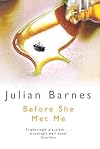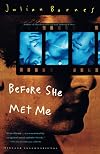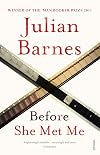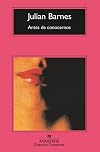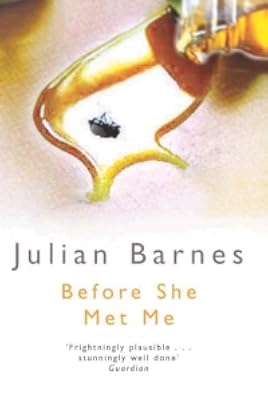
Before She Met Me
by Julian Barnes
On This Page
Description
At the start of this fiendishly comic and suspenseful novel, a mild-mannered English academic chuckles as he watches his wife commit adultery. The action takes place before she met him. But lines between film and reality, past and present become terrifyingly blurred in this sad and funny tour de force from the author of Flaubert's Parrot.Tags
Recommendations










Member Recommendations
SnootyBaronet Jealousy

Member Reviews
This is a book with a great title and intriguing concept from a well-regarded author. It does not live up to its promise. Instead of insightful observation, the story drifts along in self-indulgent adolescent argumentum ad misericordiam.
'Before She Met Me' is fashioned around a very interesting existential premise. Julian Barnes has developed a bounded situation focused on the study of fidelity, self-worth, jealousy and, by extension, ownership. A husband finds himself perversely enthralled to the point of torment with the (presumed) love life of his wife from the point immediately prior to them getting together and extending back in time to long before the otherwise loving couple even knew each other. It is a claustrophobic little show more story, planted in the fertile soil of jealous infatuation that a certain type of man could fall into when he considers his very faithful partner's previous sexual relationships, real or imagined; the things - or people - she did "before she met me".
The protagonist, Graham, after an accidental discovery triggers his preoccupation with his loving and faithful wife Ann's carnal past, finds it quickly becomes an idée fixe that hinders his ability to operate normally in the world. The emotional and psychological welfare of both characters become severly compromised. Graham's increasing obsession quickly spirals into a set of deleterious behaviours that provoke the disintegration of their marriage, all the more tragic because both Graham and Ann are devoted, faithful and truly love each other. This novel could have been an absorbing study into the nature of jealousy, resentment, responsibility for past actions, privacy, 'ownership' and relationships. But despite the compelling premise the articulation of this is wanting, with a plot arc and characters that are completely unconvincing. The opening chapter was clever and drew me in, but the more that I read I felt flat and unengaged as a reader. The whole effort just feels lazy, like Barnes had a good idea for a book but couldn't be bothered with doing the work or necessary background preparation. Or that perhaps the whole exercise was just an opportunity to exorcise any demons he himself may have been harbouring.
The cast of characters are caricatures devoid of complexity. The protagonist Graham is completely unlikeable and his best friend, Jack, is just plain unbelievable - a completely excessive and indulgent piece of characterisation. The only character I had some fellow feeling for was Ann, Graham's wife. The other two women characters are clumsy plot devices with no substance as believable women: Graham's ex-wife Barbara is just a distant cliché and the wife of that exaggerated caricature Jack is no more than a cardboard cut-out place holder in the narrative.
Although as a reader I initially felt a mild intellectual and emotive interest in Graham's predicament, it was difficult to work up any sympathy for this boring, uninspiring, obsessive cartoon of a man. If anything, I felt growing annoyance and intolerance for his increasingly stupid and selfish behaviour; which as the novel progresses becomes increasingly less plausible and more disproportionate to its causes. Barnes, for a professional novelist, does not seem to have a good grasp of emotive and motivating factors in this particular novel. Graham's deterioration is presented in an unedifying and dubious succession of incidents without plausible explication, and without any human insight into this man's existential predicament being provided by Barnes.
Overall the story has trouble with maintaining plausibility. In parts it reads more like a writing exercise than a novel. The main characters are bores, and the attempts by Barnes at incorporating the terminologies and theories from the field of psychology are clumsy and amateurish. Worse, there is no rewarding culmination for those readers who persevere to the end. Instead, to my mind, we are faced with a resolution that is both unsatisfying and unforgivingly lazy on the author's part.
I did quite enjoy one later chapter, as a bounded situation sketch, where Graham and Ann host a party at their house. This section would almost work on its own as a short story. But unfortunately much of the novel was just too clinical and distant, which left me cold and empty - at odds with the potential richness of its underlying material.
This was my first book by Barnes and I had been looking forward to it. But upon reading I found the prose and the story indulgent, unengaging and tiresome. It took a struggle to finish even though it is quite short. The generous part of me feels that the major problems faced by this book are that it just hasn't aged well and is quite dated. But another part feels that maybe this book has always faced this problem. For starters it's not that old, but the use of language and the way the characters relate seem much older than it's publication date of 1982. It must have felt even a little out of touch to contemporary readers back then. It's more like Graham is a forty year old in 1952 England rather than a forty year old in 1982 England. I wonder what Barnes himself would think if he read it again now.
For my part, I hope 'Before She Met Me' is an exception and not a good representation of Barnes' otherwise good work, as I also have his far more recent 'Staring at the Sun' waiting on my shelf to be read. show less
'Before She Met Me' is fashioned around a very interesting existential premise. Julian Barnes has developed a bounded situation focused on the study of fidelity, self-worth, jealousy and, by extension, ownership. A husband finds himself perversely enthralled to the point of torment with the (presumed) love life of his wife from the point immediately prior to them getting together and extending back in time to long before the otherwise loving couple even knew each other. It is a claustrophobic little show more story, planted in the fertile soil of jealous infatuation that a certain type of man could fall into when he considers his very faithful partner's previous sexual relationships, real or imagined; the things - or people - she did "before she met me".
The protagonist, Graham, after an accidental discovery triggers his preoccupation with his loving and faithful wife Ann's carnal past, finds it quickly becomes an idée fixe that hinders his ability to operate normally in the world. The emotional and psychological welfare of both characters become severly compromised. Graham's increasing obsession quickly spirals into a set of deleterious behaviours that provoke the disintegration of their marriage, all the more tragic because both Graham and Ann are devoted, faithful and truly love each other. This novel could have been an absorbing study into the nature of jealousy, resentment, responsibility for past actions, privacy, 'ownership' and relationships. But despite the compelling premise the articulation of this is wanting, with a plot arc and characters that are completely unconvincing. The opening chapter was clever and drew me in, but the more that I read I felt flat and unengaged as a reader. The whole effort just feels lazy, like Barnes had a good idea for a book but couldn't be bothered with doing the work or necessary background preparation. Or that perhaps the whole exercise was just an opportunity to exorcise any demons he himself may have been harbouring.
The cast of characters are caricatures devoid of complexity. The protagonist Graham is completely unlikeable and his best friend, Jack, is just plain unbelievable - a completely excessive and indulgent piece of characterisation. The only character I had some fellow feeling for was Ann, Graham's wife. The other two women characters are clumsy plot devices with no substance as believable women: Graham's ex-wife Barbara is just a distant cliché and the wife of that exaggerated caricature Jack is no more than a cardboard cut-out place holder in the narrative.
Although as a reader I initially felt a mild intellectual and emotive interest in Graham's predicament, it was difficult to work up any sympathy for this boring, uninspiring, obsessive cartoon of a man. If anything, I felt growing annoyance and intolerance for his increasingly stupid and selfish behaviour; which as the novel progresses becomes increasingly less plausible and more disproportionate to its causes. Barnes, for a professional novelist, does not seem to have a good grasp of emotive and motivating factors in this particular novel. Graham's deterioration is presented in an unedifying and dubious succession of incidents without plausible explication, and without any human insight into this man's existential predicament being provided by Barnes.
Overall the story has trouble with maintaining plausibility. In parts it reads more like a writing exercise than a novel. The main characters are bores, and the attempts by Barnes at incorporating the terminologies and theories from the field of psychology are clumsy and amateurish. Worse, there is no rewarding culmination for those readers who persevere to the end. Instead, to my mind, we are faced with a resolution that is both unsatisfying and unforgivingly lazy on the author's part.
I did quite enjoy one later chapter, as a bounded situation sketch, where Graham and Ann host a party at their house. This section would almost work on its own as a short story. But unfortunately much of the novel was just too clinical and distant, which left me cold and empty - at odds with the potential richness of its underlying material.
This was my first book by Barnes and I had been looking forward to it. But upon reading I found the prose and the story indulgent, unengaging and tiresome. It took a struggle to finish even though it is quite short. The generous part of me feels that the major problems faced by this book are that it just hasn't aged well and is quite dated. But another part feels that maybe this book has always faced this problem. For starters it's not that old, but the use of language and the way the characters relate seem much older than it's publication date of 1982. It must have felt even a little out of touch to contemporary readers back then. It's more like Graham is a forty year old in 1952 England rather than a forty year old in 1982 England. I wonder what Barnes himself would think if he read it again now.
For my part, I hope 'Before She Met Me' is an exception and not a good representation of Barnes' otherwise good work, as I also have his far more recent 'Staring at the Sun' waiting on my shelf to be read. show less
Although perhaps not as carefully crafted as John Fowle's 'The Collector', Barnes has achieved in this short novel (or long short story) somewhat the same effect - insinuating the reader into the mind of a madman in such a way that renders the psychotic simply eccentric until the inevitable climax. One has a sense that Barnes is taking the opportunity to make a few wry observations about writers and academia along the way, but without perhaps sufficient acerbity to make them truly interesting. All in all there is a lack of passion in the writing here, a dulling down of the sensations - as if Barnes doesn't want the madness of his character to stand out too starkly until the end. One kind of wishes he'd taken the same story and talked up show more the madness of the people (and the world) around his character, and posed the question 'what is insanity in a insane world?'. But for all of these criticisms this is an interesting read, and might make a much better movie one day. show less
A entertaining little novella that describes what happens when Graham, a lecturer in history by trade, becomes unduly obsessed with his wife's sexual past. Readers shouldn't expect "Othello" or a dour meditation on the uses of history; "Before She Met Me" has all the hallmarks of an indulgent head-clearing exercise, and that's not a terrible thing. Barnes keeps his writing witty and light, for the most part, and he's not afraid to exaggerate where it suits him. He uses Jack, a garrulous, randy, bearded show-off of a writer, to take potshots at literary culture while Graham's ex-wife Barbara plays the one-dimensional vindictive harpy. Everyone, it seems, takes swipes at mass culture, lending the novel a sort of cranky Britishness that show more plays well against its smuttier elements. While nowhere near as affecting or observant as "Talking It Over," Barnes still seems to have real affection for some of the characters he's created here. Though I wouldn't call it his best work, I think "Before She Met Me" will still satisfy those in search of something short, light, and well-crafted. show less
Well... That was, well, not bad, but certainly stupid.
So after a long affair, a college professor leaves his wife and marries his lover. And then he starts to question his new wife's previous relationships to the point of obsession which results in a murder and a suicide? It was unusual topic, but Graham had no reason to be jealous. As for her ongoing affair with his friend Jack, Graham shouldn't have done that. Killing for revenge is stupid.
Unlike other Barnes' novels (this was my fifth) this one feels like a proper story (Just like my favourite "The Sense of an Ending"), but something's missing. It just feels stupid. I'll give Barnes a pass though because this was only his second novel. (Three years later he wrote wonderful show more "Flaubert's Parrot") He was probably still finding himself as a writer. Some elements are still here (deep analysis of actions, for example)
And there weren't enough memorable quotes. Only two or three I believe whereas in the others I had at least a dozen. show less
So after a long affair, a college professor leaves his wife and marries his lover. And then he starts to question his new wife's previous relationships to the point of obsession which results in a murder and a suicide? It was unusual topic, but Graham had no reason to be jealous. As for her ongoing affair with his friend Jack, Graham shouldn't have done that. Killing for revenge is stupid.
Unlike other Barnes' novels (this was my fifth) this one feels like a proper story (Just like my favourite "The Sense of an Ending"), but something's missing. It just feels stupid. I'll give Barnes a pass though because this was only his second novel. (Three years later he wrote wonderful show more "Flaubert's Parrot") He was probably still finding himself as a writer. Some elements are still here (deep analysis of actions, for example)
And there weren't enough memorable quotes. Only two or three I believe whereas in the others I had at least a dozen. show less
well-written. uncomfortable story of a messed up mind. i didn't understand ann's choices really. someone compared it to the collector.
The second marriage of Graham Hendrick, a historian, is ideal until his ex-wife send him to a b-film. There he discovers that Ann, his present wife was a second rate actress. In the film she is 'unfaithful' and that hurts him badly. His wife confirms she had a 'life' before she met him. She has effectively acted in some films and even had adventures. And that is normal; she did not know him!!!
Graham develops a phobia; he skims all the dark cinemas and watches all the films of his wife. He reads her dairies and travel guides.
His jealousy becomes unbearable.
Ann, once had an affair with their common friend Jack, a writer. Graham decorticates all the works of Jack. He imagines he finds clues of the love life of Jack and his wife. In his show more madness he believes the affair is still going on.
He murders Jack and waits for his wife.
After one night in turmoil, Ann finds the clues that leads her to the house of Jack and finds her husband.
He commits suicide.
+
Typical style of Julian Barnes; nice contrast between the way of writing (cold - keeping distance - typical British stiff upper lip) and the subject ( warm human feelings)
Sophisticated humor
with philosophical cliffhangers; what is love, jealousy, the past …
Surprising end
-
Not always enthralling
Conclusion:
A man destroys his happiness by focussing on the life his wife had before she met him. show less
Graham develops a phobia; he skims all the dark cinemas and watches all the films of his wife. He reads her dairies and travel guides.
His jealousy becomes unbearable.
Ann, once had an affair with their common friend Jack, a writer. Graham decorticates all the works of Jack. He imagines he finds clues of the love life of Jack and his wife. In his show more madness he believes the affair is still going on.
He murders Jack and waits for his wife.
After one night in turmoil, Ann finds the clues that leads her to the house of Jack and finds her husband.
He commits suicide.
+
Typical style of Julian Barnes; nice contrast between the way of writing (cold - keeping distance - typical British stiff upper lip) and the subject ( warm human feelings)
Sophisticated humor
with philosophical cliffhangers; what is love, jealousy, the past …
Surprising end
-
Not always enthralling
Conclusion:
A man destroys his happiness by focussing on the life his wife had before she met him. show less
This is the story of Graham Hendricks and his obsession with his wife's past.
After seeing his wife, Ann, in a minor role in a film, Graham becomes obsessed with her past relationships. He questions her about past boyfriends, and attends every movie she ever had a small role in. As the story unfolds, we watch Graham move from obsession to insanity.
This is a well written novel. The conclusion, while inevitable, nonetheless manages to be surprising.
After seeing his wife, Ann, in a minor role in a film, Graham becomes obsessed with her past relationships. He questions her about past boyfriends, and attends every movie she ever had a small role in. As the story unfolds, we watch Graham move from obsession to insanity.
This is a well written novel. The conclusion, while inevitable, nonetheless manages to be surprising.
Members
- Recently Added By
Author Information

89+ Works 43,043 Members
Julian Barnes was born in Leicester, England, on January 19, 1946. He received a degree in modern languages from Magdalen College, Oxford University in 1968. He has held jobs as a lexicographer for the Oxford English Dictionary, a reviewer and literary editor for the New Statesmen and the New Review, and a television critic. He has written show more numerous works of fiction including Arthur and George, Pulse: Stories, The Noise of Time, and England, England. He received the Somerset Maugham Award in 1980 for Metroland, the Geoffrey Faber Memorial Prize in 1985 and a Prix Medicis in 1986 for Flaubert's Parrot, and the Man Booker Prize in 2011 for The Sense of an Ending. He also writes non-fiction works including Letters from London, The Pedant in the Kitchen, and Nothing to Be Frightened Of. He received the Shakespeare Prize by the FVS Foundation in 1993, the Austrian State Prize for European Literature in 2004, and the David Cohen Prize for Literature in 2011. He writes detective novels under the pseudonym Dan Kavanaugh. His works under this name include Duffy, Fiddle City, Putting the Boot In, and Going to the Dogs. (Bowker Author Biography) show less
Some Editions
Awards and Honors
Notable Lists
Series
Belongs to Publisher Series
Common Knowledge
- Canonical title
- Before She Met Me
- Original title
- Before She Met Me
- Original publication date
- 1982
- People/Characters
- Graham Hendricks; Ann Hendricks
- Epigraph
- Man finds himself in the predicament that nature has endowed him essentially with three brains which, despite great differences in structure, must function together and communicate with one another. The oldest of these brains... (show all) is essentially reptilian. The second has been inherited from the lower mammals, and the third is a late mammalian development, which ... has made man peculiarly man. Speaking allegorically of these brains within a brain, we might imagine that when the psychiatrist bids the patient to lie on the couch, he is asking him to stretch out alongside a horse and a crocodile.
Paul D. MacLean, Journal of Nervous and Mental Diseases
Vol. CXXXV, No 4, October 1962
Il vaut mieux encore être marié qu'être mort.
Molière, Les Fourberies de Scapin. - Dedication
- To Pat
- First words
- The first time Graham Hendrick watched his wife commit adultery he didn't mind at all.
- Quotations*
- Non intendevi quella cosa lì, Graham, vero? Quando mi hai detto x, non ti riferivi in realtà a y, Graham? Vivere con te è come giocare a scacchi con qualcuno che abbia due serie di cavalli, Graham.
Altri ancora incitavano alla prudenza e lo mettevano in guardia: il gatto scottato con l'acqua calda teme pure la fredda. - Last words
- (Click to show. Warning: May contain spoilers.)By the time the first policemen reached inside the broken window to undo the catch, the armchair was irrevocably soaked.
- Blurbers
- Waugh, Harriet; Kermode, Frank
- Original language
- English
- Canonical DDC/MDS
- 823.914
- Canonical LCC
- PR6052.A6657
*Some information comes from Common Knowledge in other languages. Click "Edit" for more information.
Classifications
Statistics
- Members
- 811
- Popularity
- 34,093
- Reviews
- 12
- Rating
- (3.38)
- Languages
- 13 — Catalan, Czech, Danish, Dutch, English, French, German, Italian, Serbian, Slovak, Spanish, Swedish, Turkish
- Media
- Paper, Audiobook, Ebook
- ISBNs
- 34
- ASINs
- 10