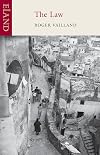
The Law
by Roger Vailland
On This Page
Description
Now back in print, the atmospheric 1957 novel that explores the mezzogiorno, the noonday culture of southern Italy. The Law is an experience I will not easily forget. -V.S. NaipaulTags
Recommendations
















Member Reviews
This book is a literary exploration of the culture of Southern Italy as it dragged itself into modernity after the Second World War. The book won the Prix Goncourt in 1957 and, if it fails to be a masterpiece , it is precisely because it seems to have been written to win a literary prize.
There are the obvious nods to the Italian literature of the South. The book is an exercise in local colour and yet one fears that the local colour derives from an assiduous reading about Southern Italy rather than from a life lived in it.
The extended central sequence in which the wife of the judge has a doomed fling with the son of the local mobster is so obviously a pastiche of the French nineteenth century novel that it casts doubt on the good faith show more of much of the apparent realism of the rest of the novel.
However, despite this flaw, the book is a fascinating commentary on power and sexuality in a culture caught between feudalism and capitalism, sneering, brutal and corrupt yet suppressed into codes by habit.
It is a culture that is recognisable as having the same set of norms that would have applied to the region under the Romans and Robert Knapp’s recent ‘Invisible Romans’ would make a good comparative companion piece.
The book is rich with references to the relationship of past to future, the manipulation of the ‘rules’ by both men and women and the winners and the losers in the game. The plotting is exquisite.
Sexuality plays a major role, above all the sexual tolerances and viciousnesses (completely incomprehensible to Northern Europeans) by which life becomes tolerable so long as honour is not compromised. The male use of power to win sex is endemic as is female cunning.
In short, it is a brilliant fictionalisation of a society but one that amounts to a sociological treatise. It is detached and intellectual – and so very post-war French.
One almost questions whether it does not have some Marxist origin, except that Vailland writes throughout with such detachment and even sympathy for every character trapped within the ‘Law’, creatures of the social, that the observation implies no political programme.
The rather peremptory ending suggests that the story could just have gone on and on but just with different permutations of the relationships between characters who, though well written as flesh and blood, are better seen as ‘types’ – or perhaps pawns on a chessboard with the Law as gamesman.
This 'Law', of course, is not to be confused with the formal process of Law which is presented as just a sub-set of a greater 'Law' - as intrinsically political, corrupt and based on injustices that also match Knapp's account of the situation amongst the ancient Romans.
The promoters of the book seem to have had difficulty in finding a way to sell it to the public since, while the Prix Goncourt win would have helped it as might the Booker in London today, a literary-sociological description of a poor quasi-feudal society needs more punch than that.
They tried to sell it as a mystery based around the theft of a wallet and they over-played the rather brief section in which the Law is symbolised in a cruel, macho game, but these represent just the mcguffin that isn’t and an allegorical plot device respectively.
Not quite a masterpiece but a highly intelligent book that reads well in its detached intellectual way. show less
There are the obvious nods to the Italian literature of the South. The book is an exercise in local colour and yet one fears that the local colour derives from an assiduous reading about Southern Italy rather than from a life lived in it.
The extended central sequence in which the wife of the judge has a doomed fling with the son of the local mobster is so obviously a pastiche of the French nineteenth century novel that it casts doubt on the good faith show more of much of the apparent realism of the rest of the novel.
However, despite this flaw, the book is a fascinating commentary on power and sexuality in a culture caught between feudalism and capitalism, sneering, brutal and corrupt yet suppressed into codes by habit.
It is a culture that is recognisable as having the same set of norms that would have applied to the region under the Romans and Robert Knapp’s recent ‘Invisible Romans’ would make a good comparative companion piece.
The book is rich with references to the relationship of past to future, the manipulation of the ‘rules’ by both men and women and the winners and the losers in the game. The plotting is exquisite.
Sexuality plays a major role, above all the sexual tolerances and viciousnesses (completely incomprehensible to Northern Europeans) by which life becomes tolerable so long as honour is not compromised. The male use of power to win sex is endemic as is female cunning.
In short, it is a brilliant fictionalisation of a society but one that amounts to a sociological treatise. It is detached and intellectual – and so very post-war French.
One almost questions whether it does not have some Marxist origin, except that Vailland writes throughout with such detachment and even sympathy for every character trapped within the ‘Law’, creatures of the social, that the observation implies no political programme.
The rather peremptory ending suggests that the story could just have gone on and on but just with different permutations of the relationships between characters who, though well written as flesh and blood, are better seen as ‘types’ – or perhaps pawns on a chessboard with the Law as gamesman.
This 'Law', of course, is not to be confused with the formal process of Law which is presented as just a sub-set of a greater 'Law' - as intrinsically political, corrupt and based on injustices that also match Knapp's account of the situation amongst the ancient Romans.
The promoters of the book seem to have had difficulty in finding a way to sell it to the public since, while the Prix Goncourt win would have helped it as might the Booker in London today, a literary-sociological description of a poor quasi-feudal society needs more punch than that.
They tried to sell it as a mystery based around the theft of a wallet and they over-played the rather brief section in which the Law is symbolised in a cruel, macho game, but these represent just the mcguffin that isn’t and an allegorical plot device respectively.
Not quite a masterpiece but a highly intelligent book that reads well in its detached intellectual way. show less
I'm not sure I can do this little gem of a novel justice. It's the story of life in a small village in Apulia, 'that wild, remote heel of the Italian peninsula.' It proceeds at a leisurely, meandering pace, yet each paragraph and each section fit as perfectly within the book as pieces fit within a jigsaw puzzle: I can't imagine any other way to have put it together.
The book is funny and, at times, a little sad. It centers around Marietta, who on the verge of womanhood, inspires lust in all the men in the village. Several old lechers argue among themselves about who will 'take' her virginity. I'm happy to report that Marietta outsmarts them all, in more ways than one.
The plot involves 500,000 lira that was stolen from some Swedish show more tourists. The Judge, Allesandro, is getting pressure from above to solve the case, but is stuck with a corrupt and lazy police chief. The Judge's beautiful wife, Dona Lucrezia, meanwhile, is secretly in love with Francesco, a naive young student, who is the son of one of the 'capos' in town. However, this is not a mystery novel, but a novel of characters, and these characters and others charm, enchant and amuse us. Vaillard brings this small village at a time shortly after the end of World War II to vivid life.
And, then there's the sinister game of 'The Law,' which is apparently played in the bars and taverns of Southern Italy, and which in this case motivates some of the characters to take the actions they do, and in other cases serves to illustrate their true nature.
The New York Times said that this book deserves every reading it will get, and I agree. show less
The book is funny and, at times, a little sad. It centers around Marietta, who on the verge of womanhood, inspires lust in all the men in the village. Several old lechers argue among themselves about who will 'take' her virginity. I'm happy to report that Marietta outsmarts them all, in more ways than one.
The plot involves 500,000 lira that was stolen from some Swedish show more tourists. The Judge, Allesandro, is getting pressure from above to solve the case, but is stuck with a corrupt and lazy police chief. The Judge's beautiful wife, Dona Lucrezia, meanwhile, is secretly in love with Francesco, a naive young student, who is the son of one of the 'capos' in town. However, this is not a mystery novel, but a novel of characters, and these characters and others charm, enchant and amuse us. Vaillard brings this small village at a time shortly after the end of World War II to vivid life.
And, then there's the sinister game of 'The Law,' which is apparently played in the bars and taverns of Southern Italy, and which in this case motivates some of the characters to take the actions they do, and in other cases serves to illustrate their true nature.
The New York Times said that this book deserves every reading it will get, and I agree. show less
I read this book many years ago but it has stayed with me and I would encourage others to read it. It is the story of a sleepy italian fishing village where a traditional drinking game requires the drinkers to reveal scandalous parts of their history. It is this device that unravels the intricate ties of class, power, violence and abuse that underlie the tensions and relationships of the village. But it is also quite bleakly humorous.
5309. The Law, by Roger Vailland Translated from the French by Peter Wiles (read 6 Sep 2015) This won the Prix Goncourt for 1957. It is the 7th such winner I have read. It tells of a stupid card game of sorts supposedly played in south Italy called The Law. There is a lot of adultery and fornication set out in the novel and none of it is of interest. .I was dismayed by the corruption and crime apparently tolerated in the community depicted. i could not find the novel of much interest.
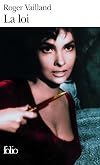
Black and white dustwrapper showing the beautiful Gina Lollobrigida, knife in hand.
Great jacket design by Jean Carlu
פעם התרגשתי מהספר הזה. הוא עדיין קריא מאוד אבל נראה מיושן. סיפור של משחקי כוח ומין בעיירה איטלקית דרומית רדומה. נראה כאילו שעשו אותו לפי סרט עם ג'ינה לולובריג'ידה ומרצ'לו מסטרויאני ולא להפך.
Nov 6, 2011Hebrew
Members
- Recently Added By
Author Information

57+ Works 474 Members
Some Editions
Awards and Honors
Awards
Distinctions
Series
Belongs to Publisher Series
Work Relationships
Is contained in
Is a supplement to
Common Knowledge
- Canonical title*
- La legge
- Original title
- La loi
- Alternate titles*
- Das Gesetz
- Original publication date
- 1957 (Librairie Garamond) (Librairie Garamond); 1957
- Related movies
- La Legge (1959 | IMDb)
- Original language
- French
*Some information comes from Common Knowledge in other languages. Click "Edit" for more information.
Classifications
Statistics
- Members
- 174
- Popularity
- 188,879
- Reviews
- 8
- Rating
- (3.86)
- Languages
- 8 — Dutch, English, French, German, Hungarian, Italian, Spanish, Swedish
- Media
- Paper, Ebook
- ISBNs
- 7
- ASINs
- 27