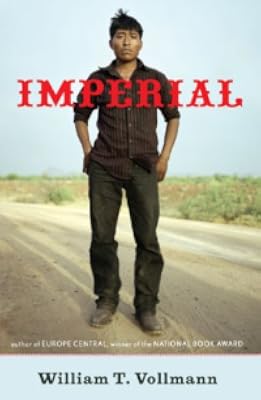
Imperial
by William T. Vollmann
On This Page
Description
For generations of migrant workers, Imperial County--the California desert region where the U.S. borders Mexico--has held the promise of paradise and the reality of hell. Award-winning writer Vollmann takes readers deep into the heart of this haunted region.Tags
Recommendations







Member Reviews
Who is our author, William T. Vollman? Imagine that Norman Maclean took peyote, climbed to the top of the Y in the Hollywood sign, and spent three days up there hallucinating that he was Hunter S. Thompson. Then on the third night he disappeared and no one heard a thing from him until five months later he stepped off a cargo ship in San Pedro with a tattoo and a slight limp that he didn't have before. That, perhaps, is William T. Vollman. Or else that's only the memory of a William T. Vollman who never was.
William T. Vollman is a slightly mad person, and this is a very mad book. I've been reading it for months and I'm not even a quarter of the way through. Imperial County is a sprawling enigma of a place that's hard to love yet hard not show more to be transfixed by, and so it's perhaps fitting that Imperial the book is a sprawling work wrought over a decade by an author who cannot bring himself to believe wholeheartedly in anything Imperial has ever stood for, but cannot bring himself to leave it alone either.
I don't know that I could recommend this book, exactly, to anyone. But if the gaze of a confident man is set upon this course, well, there's hardly anything I could say to turn you from it. Nor would I, perhaps. This world needs those seekers who do not doubt themselves.
Imperial the book is a tangled mess of borders, of histories, of loss, of people whose faces are right before you but still unknowable, or maybe familiar but just out of reach of the faded photograph's point of focus; of fragments of dreams that were and stories that never were, lives that are lived only in the records they left or lives that were lived beyond the reach of our records at all. Of course, I think William T. Vollman would agree that Imperial the county, Imperial the land, Imperial that resists all attempts at delineation; Imperial is all of those things, too. show less
William T. Vollman is a slightly mad person, and this is a very mad book. I've been reading it for months and I'm not even a quarter of the way through. Imperial County is a sprawling enigma of a place that's hard to love yet hard not show more to be transfixed by, and so it's perhaps fitting that Imperial the book is a sprawling work wrought over a decade by an author who cannot bring himself to believe wholeheartedly in anything Imperial has ever stood for, but cannot bring himself to leave it alone either.
I don't know that I could recommend this book, exactly, to anyone. But if the gaze of a confident man is set upon this course, well, there's hardly anything I could say to turn you from it. Nor would I, perhaps. This world needs those seekers who do not doubt themselves.
Imperial the book is a tangled mess of borders, of histories, of loss, of people whose faces are right before you but still unknowable, or maybe familiar but just out of reach of the faded photograph's point of focus; of fragments of dreams that were and stories that never were, lives that are lived only in the records they left or lives that were lived beyond the reach of our records at all. Of course, I think William T. Vollman would agree that Imperial the county, Imperial the land, Imperial that resists all attempts at delineation; Imperial is all of those things, too. show less
1300 pages about a place most Americans have never heard of--though they have probably heard of Coachella and undoubtedly enjoy their winter vegetables and American-grown dates. I learned A TON while reading this book. Some things I have already read about/known about--the New River flowing in 1849, the accidental creation of the Salton Sea, the growth of Mexicali and Tijuana, the Colorado River no longer reaching the Gulf of California. It was nice to be able to fit those things into things I did not know much about at all--the boom and bust of Imperial County, the various canal in the area, the Chinese community of Mexicali, the changing relationship of the people on the different sides of the border.
Vollmann defines "Imperial" as show more more than just Imperial County. It is the county, but he looks at is as the Salton Sink and associated irrigated lands. And, of course, the places that are so linked--Los Angeles, San Diego, Yuma and the Colorado River (in the US and Mexico). But the heart of this book is the Imperial and Mexicali Valleys; the boomtowns, hustlers, speculators, immigrants (to both sides of the border), crops, heat, and the water. Always the water. Because Water Is Here. Or, in the case of Mexico, Water is Not Here if the US has anything to say about it.
This book was published in 2009, and various chapters were researched even 10 years before that. It is a bit dated--or, some of his speculations have not come to pass. But that is fine and really to be expected. I also appreciated one way he tied this book together--with phrases, used over and over. Water is here! We need have no fear our lands will not become better and better as the years go by. [Which sounds so much like the "Rain follows the plow" mantra from the Great Plains]. I think we all feel sorry for 'em. He sold out at a fancy price.
Vollmann clearly but a ton of work and all kinds of research (historic, interviews, travel, photography) into this book. I questions how great his recordkeeping is, though, as when he discusses places I know well, he often gets them wrong. Many of these are simple facts that could be so easily checked (Ocean Park the neighborhood, the street, library, playground are all in Santa Monica, he says Ocean Park is in Venice; he says pomelos and grapefruits are the same thing; he is confused about how Mexican last names work; coyotes in Los Angeles; he even mixes up an over/underpass.) He also leaves out things that really should be mentioned in the context he is discussing--Prop 13 and Coachella (the festival--which was brand new/did not exist when he started his research, but was established by publication). He claims to have hired people to do genealogical work (and even thanks some people by name)--but the work done was poor. Sure it wasn't as quick and easy in 2000 to do this research--but there were long-standing methods and even the censuses he needed were available.
And then sometimes this book gets a bit too personal. I don't need to read about Vollmann's relationship with his ex, and his moping--and then this disappears somewhere in the middle of the book. Or all those times he hangs out with prostitutes in Mexicali (yes, he interviews some, but he also suggests that he partakes of the goods, so to speak). Are their interviews relevant if they are just trying to please him? And then the adjectives he uses when describing people. Men often get no adjective, just a title, or a name. Or big-shouldered, unshaven, tubby, old. Women are much more likely to be given at least one adjective: beautiful, chunky, haggard, old, fat, pretty, used up, wrinkled.
This book has over 200 chapters, and nearly that many epigraphs. These are interesting and come from a variety of sources--newspapers, government reports, novels, and so forth. I was glad to see [book:Babbitt|169718]Babbitt (Sinclair Lewis) used several times. It is a fantastic book and clearly Vollmann finds it interesting too. show less
Vollmann defines "Imperial" as show more more than just Imperial County. It is the county, but he looks at is as the Salton Sink and associated irrigated lands. And, of course, the places that are so linked--Los Angeles, San Diego, Yuma and the Colorado River (in the US and Mexico). But the heart of this book is the Imperial and Mexicali Valleys; the boomtowns, hustlers, speculators, immigrants (to both sides of the border), crops, heat, and the water. Always the water. Because Water Is Here. Or, in the case of Mexico, Water is Not Here if the US has anything to say about it.
This book was published in 2009, and various chapters were researched even 10 years before that. It is a bit dated--or, some of his speculations have not come to pass. But that is fine and really to be expected. I also appreciated one way he tied this book together--with phrases, used over and over. Water is here! We need have no fear our lands will not become better and better as the years go by. [Which sounds so much like the "Rain follows the plow" mantra from the Great Plains]. I think we all feel sorry for 'em. He sold out at a fancy price.
Vollmann clearly but a ton of work and all kinds of research (historic, interviews, travel, photography) into this book. I questions how great his recordkeeping is, though, as when he discusses places I know well, he often gets them wrong. Many of these are simple facts that could be so easily checked (Ocean Park the neighborhood, the street, library, playground are all in Santa Monica, he says Ocean Park is in Venice; he says pomelos and grapefruits are the same thing; he is confused about how Mexican last names work; coyotes in Los Angeles; he even mixes up an over/underpass.) He also leaves out things that really should be mentioned in the context he is discussing--Prop 13 and Coachella (the festival--which was brand new/did not exist when he started his research, but was established by publication). He claims to have hired people to do genealogical work (and even thanks some people by name)--but the work done was poor. Sure it wasn't as quick and easy in 2000 to do this research--but there were long-standing methods and even the censuses he needed were available.
And then sometimes this book gets a bit too personal. I don't need to read about Vollmann's relationship with his ex, and his moping--and then this disappears somewhere in the middle of the book. Or all those times he hangs out with prostitutes in Mexicali (yes, he interviews some, but he also suggests that he partakes of the goods, so to speak). Are their interviews relevant if they are just trying to please him? And then the adjectives he uses when describing people. Men often get no adjective, just a title, or a name. Or big-shouldered, unshaven, tubby, old. Women are much more likely to be given at least one adjective: beautiful, chunky, haggard, old, fat, pretty, used up, wrinkled.
This book has over 200 chapters, and nearly that many epigraphs. These are interesting and come from a variety of sources--newspapers, government reports, novels, and so forth. I was glad to see [book:Babbitt|169718]Babbitt (Sinclair Lewis) used several times. It is a fantastic book and clearly Vollmann finds it interesting too. show less
He wrote an article in Harper's that made me want more. I had a long think with myself between paper and electronic. Though I prefer anything with a lot of charts and illustrations on paper, I went for the electronic edition to avoid carrying the brick. This made the swim to the other side unencumbered such that I could sprawl as freely as the book. However, had this been an older book with a certain kind of smell, a name scrawled in the front, some underlinings and marginalia, I would have carried the brick. Those are sensual details pertaining to books I find hard to resist. The presence of a previous reader is pleasant company on a long trek.
This trek was worth it. Vollman is a fine writer with the very fine ability of keeping me show more fascinated by a subject I thought held no interest for me. It is a masterpiece among studies of place. It makes me want to take Prairy Erth (William Least Heat Moon) down from the shelf for a reread. And there's the water. I will never see any body of water quite the same again. show less
This trek was worth it. Vollman is a fine writer with the very fine ability of keeping me show more fascinated by a subject I thought held no interest for me. It is a masterpiece among studies of place. It makes me want to take Prairy Erth (William Least Heat Moon) down from the shelf for a reread. And there's the water. I will never see any body of water quite the same again. show less
The book is 1,306 long pages, divided into 13 Parts, with a 24-page bibliography, a 17-page chronology, a list of people Vollmann interviewed, and 112 pages of notes. It is longer than 'Infinite Jest' or 'Science and Sanity' (two books I have always associated), but shorter than 'The Anatomy of Melancholy.'
1
These are thoughts about Part One, 'Introductions,' which is itself 182 pages long, and divided into 12 chapters. This Part really is a single long introduction, and it reads as a coherent, if not unified, essay. The question it raised for me, at first intermittently and then insistently, was: What motivation could I have to read the other 12 Parts of the book? Aside, that is, from the motivation I might have if I were treating this show more like James Mitchener's 'Texas,' which is incidentally exactly 16 pages longer than 'Imperial,' a fact that couldn't possibly have escaped Vollmann. That motivation would be to learn about the history of Imperial County, and its current politics, sociology, linguistics, botany, geology, and other statistics, all arranged in a nicely palatable fictionalized form. That wouldn't be my motivation in reading past Part One of 'Imperial,' partly because I am not that interested in Imperial County (it is, as Vollmann knows so well, not exactly a picturesque or relaxing place), but also because I doubt that in five or seven hundred more pages I might be convinced that Imperial County is a microcosm of the United States -- especially because Vollmann flirts with that idea and nicely rejects it.
Other reasons for reading past Part One? 'Imperial' is not a novel, and in fact chapter 11 of Part One sets out that argument in a very entertaining fashion, imagining how Flaubert or Steinbeck might have written 'Imperial,' and reminding itself (that is, Vollmann reminds himself) that novels always end up being just what the novelist intended, that they are opportunistically assembled from minor travesties against truth. So if you were to read 'Imperial' in hopes of finding the ruined and bleached skeleton of the postmodern 'Moby-Dick' (a comparison Vollmann himself makes, as if just to stave off the inevitable reviewer's remark), you would be reading against the grain. Which is, as Vollmann would say, entirely your business.
A third reason to continue reading past Part One: to find out what new genre he is creating. Vollmann is past master at what is superficially called the postmodern 'game' of authorial awareness, forever talking about the book called 'Imperial' that he hopes, hoped, and still might hope to write, and playing themes and variations with irrelevancies, digressions, apostrophes, and inappropriate but irresistible stories. So people who read Vollmann have to be interested in what kind of books he is producing -- or rather, why they are so stubbornly unclassifiable, and how interesting that stubbornness might become. I saw 'Imperial' filed in a university bookstore under 'US History,' but in those first 182 pages he tells us a lot about the 'love of his life' and how it felt to break up with her, and he gives us plenty of evidence of his interest in interviewing unreliable, uninformed, atypical people, whose 'testimony' would not make the cut in any normative history text. (He also tells us about interviews with bigots and people who have suffered, and then he's making points, but I always find the dull interviews the best: the ones where the 'informant' says he doesn't know, or isn't sure, or doesn't want to talk.) I like his unclassifiable maximalist aesthetic, but it is not a reason to read the entire book: in fact if that is what drew me to Vollmann, I would happily stop after Part One because that Part so clearly frames the genreless category and ambitions of the book, and so clearly samples most or all of its major voices and styles.
But I have a fourth reason to continue reading past Part One, even though it also isn't a reason to continue reading all thirteen Parts. His writing is stupendous. His prose is sharp and parsimonious (note that: the writing continuously refreshes itself, and never, in the first 182 pages, feels like it will need the crutches of statistics or long quotations to make it to the end). He looks and thinks with every line. This is not a reason to read the book in its entirety, because it has nothing to do with criteria of unity or coherence, and it does not justify the book's exact length: but it does justify the book's relative length, and it is enough to prompt me to read one more Part.
2
And these are thoughts about Part Eleven, 'Postscripts,' pp. 827-990. This is the second, and last, section of the book I expect to read. I have been wondering -- page by page, while I'm supposed to be paying attention to what he's telling me -- about what he expected his ideal reader to be thinking. And to the extent that I can understand how he imagined his ideal reader, I realize that I won't ever really understand such a reader.
One thing an ideal reader is clearly not supposed to be thinking is: This is second-rate reporting, so I'll go and read something written by a better investigator. In the chapter on the maquiladores, Vollmann fails, again and again, to get any definitive information. He buys a spy camera, and tells us for pages and pages how it doesn't work; in the end he gets videos, but they are too blurry to be of much use, and he can't transfer them to his computer anyway. Over and over, interviews are inconclusive, and the people he talks to are ill-informed. An ideal reader is not meant to think: This isn't necessarily a bigger picture, or a more balanced picture: it's just an incomplete picture. So an ideal reader must be meant to be sensitive to some gathering larger truth, one that is accumulates in narrative asides, in intrusions of expressive writing, in the often unaccountable divisions into chapters and numbered sections. At one point Vollmann writes: 'Like most human records, this account essentially recounts failure.' (p. 905) Well, an ideal reader apparently would take that as poetry, and as an elegant admission of every writer's limitations. But in order for such a reading to happen, it is important not to also think that things could have been managed better, that some failures are more partial than others: and how is it possible not to think that? What notion of maximalist writing can possibly be that capacious, that forgiving? What kind of reader could come across a tightly written story like 'German's Story' (pp. 901-904) and not wonder, in retrospect, about the hundreds of pages of loose, unaffecting, unpersuasive, but impeccably indulgent maximalist overspill in the pages before it?
In short: I am baffled when I try to picture Vollmann's concept of his ideal reader, but as the book proceeds I can hardly think of anything else. On p. 887, Vollmann writes: 'like many other insane people I long to be considered 'balanced.'' 'Imperial' is balanced, in an obvious and respectable way, because Vollmann always tries to present both sides of every issue. But so do many journalists. If I think Vollmann is 'insane,' I don't think so in the way he apparently intends, which is that he's excessive, obsessive, compulsive, and dedicated without limits. I think he is 'insane' because his enterprise depends on not thinking in any plausible way about any plausibly reflective reader. show less
1
These are thoughts about Part One, 'Introductions,' which is itself 182 pages long, and divided into 12 chapters. This Part really is a single long introduction, and it reads as a coherent, if not unified, essay. The question it raised for me, at first intermittently and then insistently, was: What motivation could I have to read the other 12 Parts of the book? Aside, that is, from the motivation I might have if I were treating this show more like James Mitchener's 'Texas,' which is incidentally exactly 16 pages longer than 'Imperial,' a fact that couldn't possibly have escaped Vollmann. That motivation would be to learn about the history of Imperial County, and its current politics, sociology, linguistics, botany, geology, and other statistics, all arranged in a nicely palatable fictionalized form. That wouldn't be my motivation in reading past Part One of 'Imperial,' partly because I am not that interested in Imperial County (it is, as Vollmann knows so well, not exactly a picturesque or relaxing place), but also because I doubt that in five or seven hundred more pages I might be convinced that Imperial County is a microcosm of the United States -- especially because Vollmann flirts with that idea and nicely rejects it.
Other reasons for reading past Part One? 'Imperial' is not a novel, and in fact chapter 11 of Part One sets out that argument in a very entertaining fashion, imagining how Flaubert or Steinbeck might have written 'Imperial,' and reminding itself (that is, Vollmann reminds himself) that novels always end up being just what the novelist intended, that they are opportunistically assembled from minor travesties against truth. So if you were to read 'Imperial' in hopes of finding the ruined and bleached skeleton of the postmodern 'Moby-Dick' (a comparison Vollmann himself makes, as if just to stave off the inevitable reviewer's remark), you would be reading against the grain. Which is, as Vollmann would say, entirely your business.
A third reason to continue reading past Part One: to find out what new genre he is creating. Vollmann is past master at what is superficially called the postmodern 'game' of authorial awareness, forever talking about the book called 'Imperial' that he hopes, hoped, and still might hope to write, and playing themes and variations with irrelevancies, digressions, apostrophes, and inappropriate but irresistible stories. So people who read Vollmann have to be interested in what kind of books he is producing -- or rather, why they are so stubbornly unclassifiable, and how interesting that stubbornness might become. I saw 'Imperial' filed in a university bookstore under 'US History,' but in those first 182 pages he tells us a lot about the 'love of his life' and how it felt to break up with her, and he gives us plenty of evidence of his interest in interviewing unreliable, uninformed, atypical people, whose 'testimony' would not make the cut in any normative history text. (He also tells us about interviews with bigots and people who have suffered, and then he's making points, but I always find the dull interviews the best: the ones where the 'informant' says he doesn't know, or isn't sure, or doesn't want to talk.) I like his unclassifiable maximalist aesthetic, but it is not a reason to read the entire book: in fact if that is what drew me to Vollmann, I would happily stop after Part One because that Part so clearly frames the genreless category and ambitions of the book, and so clearly samples most or all of its major voices and styles.
But I have a fourth reason to continue reading past Part One, even though it also isn't a reason to continue reading all thirteen Parts. His writing is stupendous. His prose is sharp and parsimonious (note that: the writing continuously refreshes itself, and never, in the first 182 pages, feels like it will need the crutches of statistics or long quotations to make it to the end). He looks and thinks with every line. This is not a reason to read the book in its entirety, because it has nothing to do with criteria of unity or coherence, and it does not justify the book's exact length: but it does justify the book's relative length, and it is enough to prompt me to read one more Part.
2
And these are thoughts about Part Eleven, 'Postscripts,' pp. 827-990. This is the second, and last, section of the book I expect to read. I have been wondering -- page by page, while I'm supposed to be paying attention to what he's telling me -- about what he expected his ideal reader to be thinking. And to the extent that I can understand how he imagined his ideal reader, I realize that I won't ever really understand such a reader.
One thing an ideal reader is clearly not supposed to be thinking is: This is second-rate reporting, so I'll go and read something written by a better investigator. In the chapter on the maquiladores, Vollmann fails, again and again, to get any definitive information. He buys a spy camera, and tells us for pages and pages how it doesn't work; in the end he gets videos, but they are too blurry to be of much use, and he can't transfer them to his computer anyway. Over and over, interviews are inconclusive, and the people he talks to are ill-informed. An ideal reader is not meant to think: This isn't necessarily a bigger picture, or a more balanced picture: it's just an incomplete picture. So an ideal reader must be meant to be sensitive to some gathering larger truth, one that is accumulates in narrative asides, in intrusions of expressive writing, in the often unaccountable divisions into chapters and numbered sections. At one point Vollmann writes: 'Like most human records, this account essentially recounts failure.' (p. 905) Well, an ideal reader apparently would take that as poetry, and as an elegant admission of every writer's limitations. But in order for such a reading to happen, it is important not to also think that things could have been managed better, that some failures are more partial than others: and how is it possible not to think that? What notion of maximalist writing can possibly be that capacious, that forgiving? What kind of reader could come across a tightly written story like 'German's Story' (pp. 901-904) and not wonder, in retrospect, about the hundreds of pages of loose, unaffecting, unpersuasive, but impeccably indulgent maximalist overspill in the pages before it?
In short: I am baffled when I try to picture Vollmann's concept of his ideal reader, but as the book proceeds I can hardly think of anything else. On p. 887, Vollmann writes: 'like many other insane people I long to be considered 'balanced.'' 'Imperial' is balanced, in an obvious and respectable way, because Vollmann always tries to present both sides of every issue. But so do many journalists. If I think Vollmann is 'insane,' I don't think so in the way he apparently intends, which is that he's excessive, obsessive, compulsive, and dedicated without limits. I think he is 'insane' because his enterprise depends on not thinking in any plausible way about any plausibly reflective reader. show less
i am currently on page 490, chapter 74 and i cannot put this book down (because it would crush my lap)just j/k! this book is comforting to me as well as informative, i learn more about the histories my own state of california through vollmann's eyes...the agriculture, the relations or lack thereof with the people of mexico, how water matters and where it is these days. he is always present in the book but to me that is heartening because i trust him as a guide. this is not encyclopedia brittanica.....and he knows that...though he does quote from the eb often enough...there is humor often here and often here there is beauty in the way he describes the light falling on palms, mexicans enjoying a quinceanera. he looks for truths in his own show more ways...rafting down the new river in all of its glorious pollution, searching for chinese tunnels in mexicali no many how many people tell him they do not exist.
he doesn't play sides, though i am certain when the rest of the world eventually reads this they may disagree as is their wont. he also does not hold his opinions back, they are evident as recurrent phrases that form mantras that follow you throughout.
less than halfway through and i am fearing the end..like all good books... show less
he doesn't play sides, though i am certain when the rest of the world eventually reads this they may disagree as is their wont. he also does not hold his opinions back, they are evident as recurrent phrases that form mantras that follow you throughout.
less than halfway through and i am fearing the end..like all good books... show less
Imperial is sprawling, contradictory, and intense. Parts wildly compelling, others poorly (and idiosyncratically) edited and dull. But in the best parts -- when Vollmann's talking with people otherwise unheard, or with people who are lying and misdirecting -- it's a good read. If you can make it through the other bits (the statistics, tables, oddly-conceived historical reconstructions, tedious font choices, removal of personal boundary, rambling).
Members
- Recently Added By
Published Reviews
ThingScore 56
Tipping the scales at four pounds, sprawling 1,344 pages, Imperial comes packaged in the promise of an epic... In a generation of gadgets and their glow, his painstaking efforts to document the old-fashioned way can be inspiring. Yet the very qualities that have marked Vollmann’s best work—his restless investigative spirit, his eye for the broader sweep of history, his intense verbal show more energy—tend to backfire in the larger book. The result is a messy, unrealized narrative. show less
added by Shortride
His obsession with this bizarre corner of America is chronicled in Imperial, an astounding thousand pages of land records, newspaper morgue finds, rafting trips down the nation’s most polluted waterway, history, interviews, artistic critique, and excursions into Los Angeles and Mexico. Together they form a devastating portrait of a region pumped up by boosters, plagued by contrast with its show more Southern neighbor, and haunted by the legacy of its desperate, foolish experiments with recalcitrant rivers. Vollmann has written a kind of American non-fiction Moby Dick, with himself as Ahab, not so much documenting as doggedly pursuing a quarry that only he perceives. show less
added by Shortride
With “Imperial,” he tosses everything he finds into his great desert Dumpster, for chapter upon chapter, resisting explanation, graspable conclusions and comprehensible analysis. No stray fact is deemed unimportant, no metaphor unexhausted.
added by Shortride
Author Information

54+ Works 9,831 Members
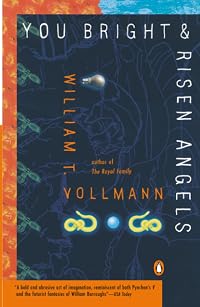
Journalist and novelist William T. Vollmann was born in 1959 and educated at Cornell University. He worked as a comptuer programmer before becoming a journalist and covering Bosnia, Sarajevo and Afghanistan. He has written extensively since 1987, when his first book, You Bright and Risen Angels, was published. The Atlas (1996) won the PEN Center show more USA West Award for the best novel by a writer living west of the Mississippi. His newest work of Non-Fiction is entitled, Imperial. (Bowker Author Biography) show less
Awards and Honors
Work Relationships
Has as a reference guide/companion
Common Knowledge
- Canonical title
- Imperial
- Original publication date
- 2009-07-30
- Disambiguation notice
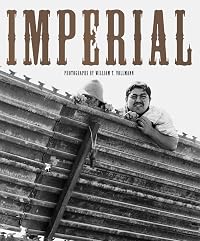
- Please distinguish this LT Work, William Vollmann's 1100-page study of migrant workers in Imperial County, California (2009), from his similarly-titled, 224-page, large format companion book of photographs (also 2009). Than... (show all)k you.
Classifications
- Genres
- Nonfiction, General Nonfiction, History
- DDC/MDS
- 304.87949907208624 — Society, government, & culture Social sciences, sociology & anthropology Factors affecting social behavior Movement of people
- LCC
- F868 .I2 .V65 — Local History of the United States, Canada and Latin America United States local history California
- BISAC
Statistics
- Members
- 281
- Popularity
- 114,354
- Reviews
- 7
- Rating
- (3.94)
- Languages
- English
- Media
- Paper, Ebook
- ISBNs
- 6
- ASINs
- 4