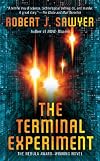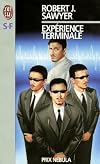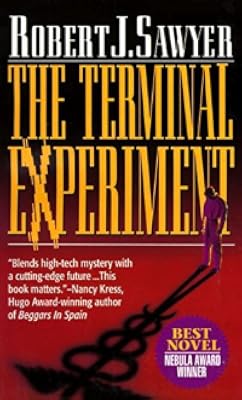
The Terminal Experiment
by Robert J. Sawyer
On This Page
Description
Fiction. Science Fiction. Thriller. Dr. Peter Hobson has created three electronic simulations of his own personality. But they all have escaped from Hobson's computer into the web-and one of them is a killer.Tags
Recommendations















Member Reviews
This was wretched. I read it because it's about mind-uploading, and I am co-teaching a class on that... but I will not be teaching this book. Let me take the time to explain.
The book has two concurrent ideas in play. One is that the main character, a designer of medical devices, is preoccupied with the idea that there's no definitive way of knowing when someone transitions between being alive and being dead. He invents an extremely discriminating device to map the brain, and using it on someone at the moment they die, detects what he dubs "the soulwave" leaving their body. This rocks the world: suddenly we know when people are alive and dead, we know what kind of life counts as alive and dead, and so on. But once the device is show more invented and made public, this idea basically vanishes from the plot of the novel, and just becomes a background element; between chapters, we read news updates of how this is affecting society. But it never affects the story, it never even really affects our main character, who could have just easily been an inventor of a new type of soda pop, and the plot would have proceeded in exactly the same way. This seems to me to be one of the worst sorts of science fiction; it's a complete lack of imagination. Isaac Asimov says in Asimov on Science Fiction that in sociology-dominant sf, the author should come up with a society affected by a "what if—" and then "[t]he actual plot of the story, the suspense, the conflict, ought to arise—if this were a first-class story—out of the particular needs and frustrations of people in such a society" (p. 172). None of that is true here; Sawyer squanders his central idea. Interesting extrapolation in the background, but none in the foreground.
The other idea is that the main character sells his mind-scanning technology to an AI research firm. He asks if they can upload his consciousness into a computer... and they just do! Apparently all you have to do is scan the brain in order to have a working simulation of the brain. This seems like a huge leap to me. Like, being able to map where neurons are does not equate to being able to simulate how someone thinks! On top of this, the book acts like this is no big deal, and that no one will be interested in it! Even though the soulwave thing doesn't affect the plot at all, it does change the world. But the characters totally brush off the idea that anyone would even want to upload a brain. This surely has theological and philosophical repercussions even bigger than those of the soulwave. Where there was once one person, there are now four (they make three copies of the main character's brain). They call a press conference to announce the soulwave... but treat this advancement as if its old news. Again, it's a complete failure of imagination when it comes to worldbuilding. At one point they even go, "Oh, who would be interested in such technology anyway?" Like, everyone would!
The brain uploading stuff also reads as hugely improbable. Even though the technology was just invented, the AI researcher can just hit a couple buttons to rewrite the main character's personality. Of the three uploaded scans, one is edited to simulate how he would be if he was immortal, the other is edited to simulate how he would be without a physical self. And then all three selves can move themselves around because the original knows how directories work... I don't think that follows. Also, why don't they copy themselves if they are files? Somehow there's only one copy of each of the three versions. That a brain uploaded to a computer instantly becomes a super-hacker seems like something from a cheesy 1970s sci-fi film, not a supposedly serious 1990s near-future sf novel, but it's how the entire plot resolves; they stop the copy that goes evil by uploading the copy of a police officer's brain into the Internet to get him!
On top of all this, the prose reads like it was written by a tedious pedant. Utterly lifeless. This won the Nebula!?
(Not Sawyer's fault, but the way the book is dated by being written in the 1990s but set in 2011 is often hilarious. There's a bit that essentially goes, "He's taken over the entire Internet... AOL and CompuServe!" Well... maybe it is Sawyer's fault; his version of the future seems exactly like his present except that they have e-readers.) show less
The book has two concurrent ideas in play. One is that the main character, a designer of medical devices, is preoccupied with the idea that there's no definitive way of knowing when someone transitions between being alive and being dead. He invents an extremely discriminating device to map the brain, and using it on someone at the moment they die, detects what he dubs "the soulwave" leaving their body. This rocks the world: suddenly we know when people are alive and dead, we know what kind of life counts as alive and dead, and so on. But once the device is show more invented and made public, this idea basically vanishes from the plot of the novel, and just becomes a background element; between chapters, we read news updates of how this is affecting society. But it never affects the story, it never even really affects our main character, who could have just easily been an inventor of a new type of soda pop, and the plot would have proceeded in exactly the same way. This seems to me to be one of the worst sorts of science fiction; it's a complete lack of imagination. Isaac Asimov says in Asimov on Science Fiction that in sociology-dominant sf, the author should come up with a society affected by a "what if—" and then "[t]he actual plot of the story, the suspense, the conflict, ought to arise—if this were a first-class story—out of the particular needs and frustrations of people in such a society" (p. 172). None of that is true here; Sawyer squanders his central idea. Interesting extrapolation in the background, but none in the foreground.
The other idea is that the main character sells his mind-scanning technology to an AI research firm. He asks if they can upload his consciousness into a computer... and they just do! Apparently all you have to do is scan the brain in order to have a working simulation of the brain. This seems like a huge leap to me. Like, being able to map where neurons are does not equate to being able to simulate how someone thinks! On top of this, the book acts like this is no big deal, and that no one will be interested in it! Even though the soulwave thing doesn't affect the plot at all, it does change the world. But the characters totally brush off the idea that anyone would even want to upload a brain. This surely has theological and philosophical repercussions even bigger than those of the soulwave. Where there was once one person, there are now four (they make three copies of the main character's brain). They call a press conference to announce the soulwave... but treat this advancement as if its old news. Again, it's a complete failure of imagination when it comes to worldbuilding. At one point they even go, "Oh, who would be interested in such technology anyway?" Like, everyone would!
The brain uploading stuff also reads as hugely improbable. Even though the technology was just invented, the AI researcher can just hit a couple buttons to rewrite the main character's personality. Of the three uploaded scans, one is edited to simulate how he would be if he was immortal, the other is edited to simulate how he would be without a physical self. And then all three selves can move themselves around because the original knows how directories work... I don't think that follows. Also, why don't they copy themselves if they are files? Somehow there's only one copy of each of the three versions. That a brain uploaded to a computer instantly becomes a super-hacker seems like something from a cheesy 1970s sci-fi film, not a supposedly serious 1990s near-future sf novel, but it's how the entire plot resolves; they stop the copy that goes evil by uploading the copy of a police officer's brain into the Internet to get him!
On top of all this, the prose reads like it was written by a tedious pedant. Utterly lifeless. This won the Nebula!?
(Not Sawyer's fault, but the way the book is dated by being written in the 1990s but set in 2011 is often hilarious. There's a bit that essentially goes, "He's taken over the entire Internet... AOL and CompuServe!" Well... maybe it is Sawyer's fault; his version of the future seems exactly like his present except that they have e-readers.) show less
In the near future Peter Hobson is a scientist in Toronto who has invented a super EEG that can determine the exact moment there is absolutely no electrical activity going on in the brain anymore and a person is truly dead. However, while testing his device he discovers something he calls the soulwave, a bit of energy nothing like normal brain activity that leaves the body at the exact time of death. Separately, another business has developed a method for immortality using nanobots. So now there is a possibility of life after death because we do have something like a soul, or immortality.
Together with his friend Sarkar, who has a company in AI, Peter starts an experiment to discover what immortality or life after death mean for a human. show more They make a three digital copies of Peter, one without a reference to a body (life after death), one without fear of death (immortality) and a control copy who is like Peter in every way. They are run on a mainframe at Sarkar's company, but soon feel trapped and escape to the Net. And then people in Peter's surroundings begin to die. People Peter wasn't that fond of...
I raced through this book, I could not put it down. I was both fascinated by the discovery and implications of that discovery of the soulwave, as I was by the experiment with the three not so artificial intelligences running loose in the net. I liked how there is a science fiction storyline in the soulwave and AI's, and a human one, with Peter and Cathy's relationship. I thought the conclusion was really good too, even the epilogue, although it was unnecessary. Five out of five stars. show less
Together with his friend Sarkar, who has a company in AI, Peter starts an experiment to discover what immortality or life after death mean for a human. show more They make a three digital copies of Peter, one without a reference to a body (life after death), one without fear of death (immortality) and a control copy who is like Peter in every way. They are run on a mainframe at Sarkar's company, but soon feel trapped and escape to the Net. And then people in Peter's surroundings begin to die. People Peter wasn't that fond of...
I raced through this book, I could not put it down. I was both fascinated by the discovery and implications of that discovery of the soulwave, as I was by the experiment with the three not so artificial intelligences running loose in the net. I liked how there is a science fiction storyline in the soulwave and AI's, and a human one, with Peter and Cathy's relationship. I thought the conclusion was really good too, even the epilogue, although it was unnecessary. Five out of five stars. show less
Although not all that old, this book felt terribly dated. Both in terms of the technology, which is an unimaginative extension of the 1995 world of dial-up Internet access merged with unrealistic depictions of AI, and the sexist attitudes towards women.
The worst part for me wasthe ending, with it's religiously imbued metaphysical dualism. It would have been much stronger to have left the questions of souls and the afterlife as mysterious, as was done throughout the rest of the book.
Still, the characters overall were compelling, the pacing was good, and the underlying moral dilemmas are well thought out and still just as relevant, including a sensitive handling of abortion, which remains controversial even today.
The worst part for me was
Still, the characters overall were compelling, the pacing was good, and the underlying moral dilemmas are well thought out and still just as relevant, including a sensitive handling of abortion, which remains controversial even today.
Readable but very lumpy thriller. It won the 1995 Nebula. I've only read one other competitor, Mother of Storms, also a near-future thriller, but I would've picked that.
Thrillers can be challenging for SF writers. There's a difference between SF and SF thrillers that a New Yorker essay described nicely. It's not how well-worked out the idea is. Thriller writers like Michael Crichton and others often do a fair amount of research to make the idea seem as plausible as possible. The key difference is that thriller writers see an SF disruption as a crisis to be dealt with so that things return to normal. SF authors see an SF disruption as a permanent change to explore. You can even see it in old books for kids about trips to space. Non-SF show more authors made sure the kids came home. SF authors were all about moving into space.
The thriller part is simple: Peter Hobson creates three online simulations of himself -- a perfect copy and two variants -- and one of them turns to murdering people Hobson had strongly negative feelings toward. This doesn't actually happen until nearly midway into the novel. Much time is spent on the necessary development of Peter's character and his relationships with others. He has to be sympathetic but flawed enough to justify murderous intent. But equally as much time is spent on the enabling technology: Peter's development of a brain scanner that can capture neuronal behavior quickly in great detail. Peter is not interested in making simulations, but in capturing brain activity at the time of death. This is motivated convincingly by an experience assisting the harvesting of organs from someone who just died. Lump #1: What his scanner reveals at the point of death is a very big idea, not disclosed in the book blurb, though not hard to guess. It is referred to in "news items" through the rest of the book, but is irrelevant to the thriller plot, and only pops up in the story in the epilogue. In contrast, why Peter creates the simulations is glossed over in a few sentences of unconvincing dialog.
A smaller but noticeble lump is when one of the simulations starts an artificial life project. This is returned to several times in the story but never leads anywhere that I can see.
The final lumps are the numerous multipage pauses where Peter and his hacker friend stop to discuss AI, brains, simulated evolution, networks, and so on.
Note: the novel was written in the 1990s and set in 2011. My edition came out in 2011 and has a foreword where Sawyer talks about how this was a breakthrough novel for him, and how he decided to not try and update it to better match an internet different than what he forecast.
For all the carping, I do recommend Terminal Experiment. It's a fun read, both for plot and ideas. Just be prepared for a lot of lumpy loose ends. show less
Thrillers can be challenging for SF writers. There's a difference between SF and SF thrillers that a New Yorker essay described nicely. It's not how well-worked out the idea is. Thriller writers like Michael Crichton and others often do a fair amount of research to make the idea seem as plausible as possible. The key difference is that thriller writers see an SF disruption as a crisis to be dealt with so that things return to normal. SF authors see an SF disruption as a permanent change to explore. You can even see it in old books for kids about trips to space. Non-SF show more authors made sure the kids came home. SF authors were all about moving into space.
The thriller part is simple: Peter Hobson creates three online simulations of himself -- a perfect copy and two variants -- and one of them turns to murdering people Hobson had strongly negative feelings toward. This doesn't actually happen until nearly midway into the novel. Much time is spent on the necessary development of Peter's character and his relationships with others. He has to be sympathetic but flawed enough to justify murderous intent. But equally as much time is spent on the enabling technology: Peter's development of a brain scanner that can capture neuronal behavior quickly in great detail. Peter is not interested in making simulations, but in capturing brain activity at the time of death. This is motivated convincingly by an experience assisting the harvesting of organs from someone who just died. Lump #1: What his scanner reveals at the point of death is a very big idea, not disclosed in the book blurb, though not hard to guess. It is referred to in "news items" through the rest of the book, but is irrelevant to the thriller plot, and only pops up in the story in the epilogue. In contrast, why Peter creates the simulations is glossed over in a few sentences of unconvincing dialog.
A smaller but noticeble lump is when one of the simulations starts an artificial life project. This is returned to several times in the story but never leads anywhere that I can see.
The final lumps are the numerous multipage pauses where Peter and his hacker friend stop to discuss AI, brains, simulated evolution, networks, and so on.
Note: the novel was written in the 1990s and set in 2011. My edition came out in 2011 and has a foreword where Sawyer talks about how this was a breakthrough novel for him, and how he decided to not try and update it to better match an internet different than what he forecast.
For all the carping, I do recommend Terminal Experiment. It's a fun read, both for plot and ideas. Just be prepared for a lot of lumpy loose ends. show less
Después de un libro largo y denso, lo mejor es leer algo de Robert J. Sawyer. Experimentó terminal es de lectura rápida, sin embargo bajo la aparentemente liviana superficie cuenta con temas muy elaborados y que dan bastante más de si que lo que dura la lectura del libro
Who else writes like Sawyer nowadays? This is thoughtful and engaging, sometimes even thrilling, as I've come to expect from him. I love all the different ideas sprinkled through, the predictions of possible near-future politics, culture, and technology. I love the 'exoticism' to me of the Canadian setting (and the view from there of the US).
But this particular book isn't perfect, because it hasn't aged well, SF-wise. We still have VCRs, but can create fully sentient and self-aware AI. We have smart-homes, but not smart phones (not even cell phones, it seems!). Of course Sawyer isn't a prophet and he's not to blame, but reading such 'errors' does pull me out of the story.
Still, a read I didn't want to put down. Sawyer's work reminds me show more of why I liked the best of [a:Michael Crichton|5194|Michael Crichton|https://images.gr-assets.com/authors/1359042651p2/5194.jpg]. I will def. continue to read more Sawyer and welcome recommendations.
edit: This review has seven 'likes' and yet nobody offered recommendations for readalikes. People, please! :) show less
But this particular book isn't perfect, because it hasn't aged well, SF-wise. We still have VCRs, but can create fully sentient and self-aware AI. We have smart-homes, but not smart phones (not even cell phones, it seems!). Of course Sawyer isn't a prophet and he's not to blame, but reading such 'errors' does pull me out of the story.
Still, a read I didn't want to put down. Sawyer's work reminds me show more of why I liked the best of [a:Michael Crichton|5194|Michael Crichton|https://images.gr-assets.com/authors/1359042651p2/5194.jpg]. I will def. continue to read more Sawyer and welcome recommendations.
edit: This review has seven 'likes' and yet nobody offered recommendations for readalikes. People, please! :) show less
This book is practically advertised as a mystery. "Dr. Peter Hobson... has created three electronic simulations of his own personality. ... But now all three of them have escaped from Hobson's computer... and one of them is a killer." Now I have a soft spot for science fiction mysteries ever since I read Asimov's Mysteries in days of yore. (Note to self: pull that one off the shelf for a re-read.) Problem is, the mystery of The Terminal Experiment isn't all that hard to figure out. The science fiction part, on the other hand is excellent. Dr. Hobson's impetus for creating his simulations is his scientific discovery of the human soul. Mr. Sawyer does an excellent job of showing the consequences of this discovery while also telling the show more tale of troubles between Hobson and his wife. (Which provides motives for the killing spree.) The tale evolves, all the while looking at the concept of death and life after death. Another excellent tale, securing Mr. Sawyer's position as one of my favorite scince fiction authors. I've got to reserve some more room for his books on my shelf.
--J. show less
--J. show less
Members
- Recently Added By
Lists

Nebula Award
111 works; 14 members
Author Information

107+ Works 20,048 Members
Robert J. Sawyer was born in Ottawa on April 29, 1960, but raised in Toronto. In 1980, while still in high school, Sawyer submitted a short story to the the Rochester Museum and Science Center, which was running a contest for light show ideas. Sawyer didn't win, but the Museum purchased his story Motive anyway and it ran for 192 performances. show more Sawyer went on to attend Toronto's Ryerson Polytechnical Institute, majoring in Radio and Television Arts. In September 1979, he had his first piece of fiction published at the end of his first year, in Ryerson's literary annual, White Wall Review. Sawyer graduated from Ryerson in 1982. Sawyer was hired back the following semester to teach television studio production techniques to second- and third-year students. In the four months interim, he worked for minimum wage at the local SF bookstore, spending all his earnings on books. From 1984 to 1992, while teaching, Sawyer also coordinated a social group of Toronto-area science-fiction writers founded by SF editor Judith Merril. He established a Canadian region of the Science Fiction and Fantasy Writers of America; and in 1998, served as that organization's president. Sawyer also retained freelance nonfiction writing contracts, writing articles for newspapers and magazines, press releases and brochures for corporations, newsletters for government departments. He churned out vast amounts of promotional materials and over 200 articles for computing and personal-finance magazines in a span of five years. But in that time, his only really significant publication was the novelette Golden Fleece, which appeared as the cover story in the September 1988 edition of Amazing Stories. The novel-length Golden Fleece was sold to Warner Books a year later in 1989. The sales of his first five books were uninspiring and Sawyer faced being dropped by his publisher. Sawyer decided to take the time to write a book, without a contract, take as long as necessary, and produce a blockbuster. He also wanted to tackle a controversial issue and deal with it head on. With that in mind, Sawyer wrote The Terminal Experiment, about abortion and the soul. His publisher rejected it on grounds of controversy. HarperPrism then bought the book and serialization rights were sold to Analog, the number-one best-selling English-language SF magazine. The Terminal Experiment went on to win the Science Fiction and Fantasy Writers of America's Nebula Award for Best Novel of 1995. His novel Frameshift was his first book published in hardcover, and was nominated for the Hugo Award, and won Japan's Seiun Award for best foreign novel of the year. (Bowker Author Biography) show less
Awards and Honors
Awards
Notable Lists
Series
Belongs to Publisher Series
Work Relationships
Is contained in
Common Knowledge
- Original title
- The Terminal Experiment
- Alternate titles
- Terminal Experiment
- Original publication date
- 1995
- Important places
- Toronto, Ontario, Canada
- Epigraph
- In the last analysis, it is our conception of death which decides our answers to all the questions life puts to us.
- Dag Hammarskjold (1905-1961), United Nations Secretary General - Dedication
- For Ted Bleaney with thanks for twenty years of friendship
- First words
- "What room is Detective Philo in?" asked Peter Hobson, a tall, thin man of forty-two, with hair an equal mixture of black and gray.
- Last words
- (Click to show. Warning: May contain spoilers.)It was home.
- Blurbers
- Kress, Nancy
- Original language
- English Canada
Classifications
Statistics
- Members
- 920
- Popularity
- 29,295
- Reviews
- 24
- Rating
- (3.49)
- Languages
- 10 — Dutch, English, French, German, Hungarian, Italian, Lithuanian, Polish, Romanian, Spanish
- Media
- Paper, Audiobook, Ebook
- ISBNs
- 22
- ASINs
- 10