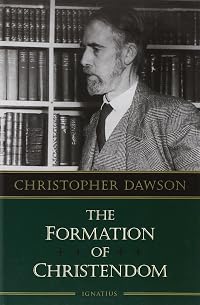
The Formation of Christendom
by Christopher Dawson
122 Members (4.25)
On This Page
Description
Together with its sequel The Dividing of Christendom, this book was the fruit of the Harvard lectures that Christopher Dawson delivered as the first occupant of the Charles Chauncey Stillman Chair of Roman Catholic Studies from 1958-1962. Here, as in all his works, he sees religion as the dynamic element of culture. This work traces the formation of Christian culture from its roots in the Judeo-Christian tradition through the rise and fall of medieval Christendom, and ends with an epilogue show more in which the author reflects on the defining characteristics of Christianity in general and the Catholic Church in particular. In the introductory section of this work, Dawson highlights the importance of language in the origin and development of civilization. Christina Scott, the author?s daughter and first biographer, summarises Dawson?s ideas on this point in her work A Historian and his World: ?In the beginning was the word: language was the gateway to the human world and was the single factor that distinguished man from the animal kingdom.? Language, as Dawson wrote, ?enables man to think, to create a new world of imagination and reason.? In parts two and three Dawson traces the beginnings of Christian culture in the first centuries after Christ through to the decline of medieval unity. Some of the tantalizing chapter headings include The Christian and Jewish Idea of Revelation, The Foundation of Europe: The Monks of the West, The Carolingian Age, Feudal Europe and the Age of Anarchy, The Achievement of Medieval Thought, and East and West in the Middle Ages. Dawson shared with Arnold Toynbee the ideal of a universal spiritual society as the goal of history; but whereas Dr. Toynbee saw this as achievable by a consensus of the great world religions, Dawson concludes his work with a clear exposition of the Catholic ideal of a universal spiritual society. It provides an excellent summary of the author?s view of the uniqueness and universality of the Catholic Church, as well as its fundamentally non-sectarian basis. His concluding words demonstrate his commitment to the concept of unity: ?On the other hand, if Christianity were to lead the nations still further apart from one another into spiritual disunity, it would defeat the central purpose of the Church?s institution.? show lessTags
Recommendations








Member Reviews
Members
- Recently Added By
Author Information

44+ Works 2,762 Members
Christopher Dawson (1889-1970) is recognized as one of the most important Catholic historians of the twentieth century, authoring numerous books, articles, and scholarly monographs. Dawson was lecturer in the History of Culture, University College, Exeter; Gifford lecturer; and Charles Chauncey Stillman Chair of Roman Catholic Studies at Harvard show more University from 1958 to 1962. show less
Classifications
Statistics
- Members
- 122
- Popularity
- 267,943
- Rating
- (4.25)
- Languages
- English, Polish
- Media
- Paper, Ebook
- ISBNs
- 4
- ASINs
- 2