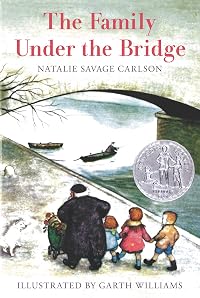
The Family Under the Bridge
by Natalie Savage Carlson
On This Page
Description
An old tramp, adopted by three fatherless children when their mother hides them under a bridge on the Seine, finds a home for mother and children and a job for himself.Tags
Recommendations













Member Reviews
I have mixed feelings about this book and I want to do a fair review. This book was published in 1958, and things were different back then. I can't imagine this happening 60 years later in France, America, or anywhere else.
There's a couple of things I can't help but sternly disapprove of. When Madame Calcet criticizes the gypsies because she's worried about her children, Armand dismisses the gypsies' tendencies (it reputation) to steal, and sounds as if he is ok with their stealing because apparently they don't know better. Also, Armand has expressed a strong dislike of bathing, which makes me wonder why the children and Madame Calcet never complain about his odor, I imagine he would be smelling pretty god-awful.
The ending is also show more really cliched. Yes, this is a children's book (for primary school-age kids) and briefly touches upon the negative aspect of homelessness but I still found the ending grating. Yes, again, this book was written 60 years ago, in a different time, so my final verdict is that this book simply has not aged well. It certainly isn't a book I would give to my children, and I'm glad I got this book for free. It was also a really quick read, I finished it in less than a hour. show less
There's a couple of things I can't help but sternly disapprove of. When Madame Calcet criticizes the gypsies because she's worried about her children, Armand dismisses the gypsies' tendencies (it reputation) to steal, and sounds as if he is ok with their stealing because apparently they don't know better. Also, Armand has expressed a strong dislike of bathing, which makes me wonder why the children and Madame Calcet never complain about his odor, I imagine he would be smelling pretty god-awful.
The ending is also show more really cliched. Yes, this is a children's book (for primary school-age kids) and briefly touches upon the negative aspect of homelessness but I still found the ending grating. Yes, again, this book was written 60 years ago, in a different time, so my final verdict is that this book simply has not aged well. It certainly isn't a book I would give to my children, and I'm glad I got this book for free. It was also a really quick read, I finished it in less than a hour. show less
Armand was happy with his life as a hobo on the streets of Paris, with no job, no responsibilities, and no family. Then one winter day he discovered the three young Calcet children—Suzy, Paul and Evelyne—and their dog Jo-Jo under the bridge where he liked to shelter during the cold season. Evicted from their home, the children were living with their mother on the streets, afraid to seek shelter lest they be separated from one another by the authorities. Slowly, Armand began to take these "starlings" under his wing, helping them and their mother evade some well-meaning busybodies, and finding them shelter with his gypsy friends. But the old man knew in his heart that this family needed a home, and that somehow, he must help them to show more find it...
Published in 1958, The Family Under the Bridge was one of four Newbery Honor Books in 1959—the others were Along Came a Dog by Meindert DeJong, Chúcaro: Wild Pony of the Pampa by Francis Kalnay, and The Perilous Road by William O. Steele—and is a brief, beginning chapter-book for the younger intermediate set. Given its reputation, and the fact that so many of my friends seem to have loved it, I fully expected to be charmed by it myself, especially as the theme of a homeless family finally finding a home is one I always find heartwarming, a Christmas setting has great appeal for me, and the artwork of illustrator Garth Williams is a nostalgic favorite. For the most part, I was not disappointed, entering into the story with sympathy for both Armand and the Calcet children, rooting for their eventual discovery that they are in fact one big family, and happily triumphant at the conclusion, in which they find their home (and Armand finds his purpose). I don't know that I was as emotionally involved in the story, as I expected to be, given all of the above, but I certainly found it very engaging, and can see why it is a childhood favorite for so many. Recommended to young readers who are just getting into longer novels, and who enjoy heartwarming family stories set at the holidays. show less
Published in 1958, The Family Under the Bridge was one of four Newbery Honor Books in 1959—the others were Along Came a Dog by Meindert DeJong, Chúcaro: Wild Pony of the Pampa by Francis Kalnay, and The Perilous Road by William O. Steele—and is a brief, beginning chapter-book for the younger intermediate set. Given its reputation, and the fact that so many of my friends seem to have loved it, I fully expected to be charmed by it myself, especially as the theme of a homeless family finally finding a home is one I always find heartwarming, a Christmas setting has great appeal for me, and the artwork of illustrator Garth Williams is a nostalgic favorite. For the most part, I was not disappointed, entering into the story with sympathy for both Armand and the Calcet children, rooting for their eventual discovery that they are in fact one big family, and happily triumphant at the conclusion, in which they find their home (and Armand finds his purpose). I don't know that I was as emotionally involved in the story, as I expected to be, given all of the above, but I certainly found it very engaging, and can see why it is a childhood favorite for so many. Recommended to young readers who are just getting into longer novels, and who enjoy heartwarming family stories set at the holidays. show less
Nice little story about an old homeless man who lives on the streets of Paris. He likes his freedom from what he considers the burdens of responsibilities like a job. He’s disgruntled one day to come ‘home’ and find three children huddled in his spot under a bridge, waiting for their mother. They’ve lost the place they rented and can’t quite afford a new one yet. Our tramp (the book uses this word repeatedly) doesn’t want anything to do with someone else’s children, but finds his heart gradually softening towards them. First he takes advantage of their cuteness and sweet voices to help him panhandle, then he takes them to meet his friends in a gypsy camp (another objectionable word used in this book) and later he ends up show more helping them find a new place to live. And realizing that being a little settled down with family to care for (who also care for you) isn’t so bad after all. The story is replete with Christmas season details and some light humor. I found it quite charming, which wasn’t my expectations at all. I thought it would be stuffy and old-fashioned and it is some of that, but really I liked it better than I had anticipated. show less
The book The Family Under the Bridge is about a hobo in Paris and three homeless children. The story describes the fantastic adventures of the children and the older man have around Paris with Gypsies and Santa Clause. I enjoyed this book because of the unlikely friendship that developed between the children and the homeless man. The descriptive language used by the author made me feel like I was in Paris with the children. I would recommend this book to children who enjoy realistic fiction set in European cities.
This is definitely one of those interesting books that you may trip upon and be trapped into reading. And it will touch your heart if not for the simplicity of the book's message about how family whether blood or not can change a person, to hope for a better turn or due to its Christmas theme.
What touched me with this book is the realism of the background whether it was the situation of being homeless, of a family trying to survive hard times or just the opposite views of glorious Paris. You were definitely not at home anymore when the pages of this book were opened up to you.
The relationships between the characters was a bit on the strange side and not very realistically given, especially as a modern comparison to our times. And yet show more it was since of these weird interactions that you were able to figure out a hazy timeline for the book.
Cute story but not one that I am going to be continually reading around Christmas with my other Christmas books. show less
What touched me with this book is the realism of the background whether it was the situation of being homeless, of a family trying to survive hard times or just the opposite views of glorious Paris. You were definitely not at home anymore when the pages of this book were opened up to you.
The relationships between the characters was a bit on the strange side and not very realistically given, especially as a modern comparison to our times. And yet show more it was since of these weird interactions that you were able to figure out a hazy timeline for the book.
Cute story but not one that I am going to be continually reading around Christmas with my other Christmas books. show less
Armand, an old man living on the streets of Paris, relishes his solitary life in the beautiful city. He is happy with his carefree existence, begging and doing odd jobs to keep himself warm and fed. With simple pleasures and no cares, what more could he need?
Then one day just before Christmas, Armand returns to his favorite spot beneath the bridge to find three cold and hungry children. Although he has no interest in children, Armand soon finds himself caring for the small family. It does not take Armand very long to realize that he must do whatever it takes to get them a real home.
Children will treasure this warm and funny adventure of family, freedom, and Santa Claus.
Then one day just before Christmas, Armand returns to his favorite spot beneath the bridge to find three cold and hungry children. Although he has no interest in children, Armand soon finds himself caring for the small family. It does not take Armand very long to realize that he must do whatever it takes to get them a real home.
Children will treasure this warm and funny adventure of family, freedom, and Santa Claus.
I honestly found this book to be quite depressing. The ending was good but the whole journey to get there was quite sad. I did think that it had a good message though of not judging others, especially when it came to the gypsies. Although that part was sad too, when they just assume they're in trouble and they will never know what they missed out on. It was heartbreaking when Armand keeps promising the children a house and then keeps breaking the promise.
Members
- Recently Added By
Published Reviews
ThingScore 75
Oh, how I loved this book! These are my favorite Garth Williams illustrations, and that is saying a lot. The story is simply wonderful...and it paints a magical picture of Paris--not the shiny images that you see in tourist photos, but a rich atmosphere with real characters. This is a oldie but such a goodie!
added by dominirose
Lists

Best Newbery Honor Books
257 works; 32 members

A Child's Book Tour of Paris
59 works; 5 members

Christmas Books
370 works; 40 members

Best Family Stories
241 works; 22 members

Sonlight Books
1,487 works; 25 members

Satori Smiles Children's Book List
262 works; 7 members

4th Grade Books
312 works; 5 members

Romalda Spalding's Writing Road To Reading
213 works; 3 members

Newbery Honor Books By Year - I - 1922-1980
199 works; 3 members

Paris, City of Lights
103 works; 17 members

Beautiful Feet Books
304 works; 7 members

Books Read in 2024
4,727 works; 128 members

HMS: Make Your Child a Lover of Books, Ages 9 & up
111 works; 2 members
Author Information

43+ Works 10,002 Members
All Editions
Awards and Honors
Work Relationships
Is contained in
Newbery Medal/Honor Chapter Books: Set of 12 (Tuck Everlasting ~ Sarah Plain and Tall ~ The View From Saturday ~ On My Honor ~ Maniac Magee ~ Dear Mr. Henshaw ~ Hoot ~ Holes ~ Whipping Boy ~ From the Mixed-Up Files of Mrs. Basil E. Frankweiler ~ Out of the Dust ~ The Black Pearl) by Natalie Babbitt
Has the adaptation
Common Knowledge
- Canonical title
- The Family Under the Bridge
- Original publication date
- 1958
- People/Characters
- Armand Pouly; Suzy Calcet; Paul Calcet; Evelyne Calcet; Madame Calcet
- Important places
- Paris, France
- Related movies
- CBS Library: Orphans, Waifs and Wards (1981 | IMDb)
- Dedication
- For Mary Lindley Steere
- First words
- Once there was an old hobo named Armand who wouldn't have lived anywhere but in Paris.
- Last words
- (Click to show. Warning: May contain spoilers.)He was a workingman of Paris.
- Canonical DDC/MDS
- 813.54
Classifications
- Genres
- Children's Books, Fiction and Literature
- DDC/MDS
- 813.54 — Literature & rhetoric American literature in English American fiction in English 1900-1999 1945-1999
- LCC
- PZ7 .C2167 .F — Language and Literature Fiction and juvenile belles lettres Fiction and juvenile belles lettres Juvenile belles lettres
- BISAC
Statistics
- Members
- 7,950
- Popularity
- 1,420
- Reviews
- 63
- Rating
- (4.01)
- Languages
- Chinese, English
- Media
- Paper, Ebook
- ISBNs
- 16
- ASINs
- 24