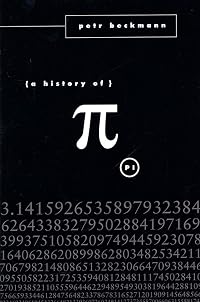
A History of Pi
by Petr Beckmann
On This Page
Description
The history of pi, says the author, though a small part of the history of mathematics, is nevertheless a mirror of the history of man. Petr Beckmann holds up this mirror, giving the background of the times when pi made progress and also when it did not, because science was being stifled by militarism or religious fanaticism. The mathematical level of this book is flexible, and there is plenty for readers of all ages and interests.Tags
Recommendations










Member Reviews
Fun. Skipping all the proofs (I'd love to take courses in geometry and algebra again, and learn calculus, but certainly can't get through them on my own in a narrative book) and noting the Beckmann's insertions of commentary as his interesting opinions. Because the author told us to do so, on both counts, as we so choose.
Feeling enlightened & engaged. Marking many passages with bookdarts.
"Euclid is not the father of geometry. He is the father of mathematical rigor." Therefore, you math teachers, be sure to teach the reasoning, not just algorithm.
"There is much indirect evidence of Hindu mathematics. Like everyone else in the Belt, they knew Pythagoras' Theorem long before Pythagoras was born." "It had been known to every show more rope-stretcher (surveyor) from the Nile to the Yang Tse Kand for a thousand years before Pythagoras' witchcraft."
(Yes, Beckmann disses Pythagoras. And Aristotle. And the Romans. And convinces me to opine likewise....)
Author points out: “History repeats itself. Historians repeat each other.”
― Philip Guedalla
Says it's been happening since the ancient Greeks. Historians repeat Plutarch as being snobbish about experimentation, but he couldn't have known, rather he was likely repeating from Plato and Aristotle, "the fathers of intellectual snobbery."
I appreciate the author's reminder to me to read more Shaw:
“The reasonable man adapts himself to the world: the unreasonable one persists in trying to adapt the world to himself. Therefore all progress depends on the unreasonable man.”
― George Bernard Shaw, Man and Superman
I need to ask my son about "continued fractions" and "lost mathematics" ... those units deemed, at least contemporary to the 1970 writing of this, to be too difficult for high school, too easy for college, and thus not taught. See also Diophantine equations. ... :bemused:
Re' Edmund Halley: "Of his many discoveries, the greatest was that of the [b:The Principia: Mathematical Principles of Natural Philosophy|231083|The Principia Mathematical Principles of Natural Philosophy|Isaac Newton|https://i.gr-assets.com/images/S/compressed.photo.goodreads.com/books/1386924124l/231083._SY75_.jpg|846336] in Newton's drawer." (And his corresponding accomplishment was prodding Newton the finish all three parts, and funding publication.)
Even towards the end, when the discussions (much less the equations and proofs) were beyond me, I found bits worth reading. "... infinities of different orders can be described by new numbers... showing that the joys of mathematics are truly endless: They go beyond infinity."
Welp, I guess I just gave you the 'executive summary.' Still, I do recommend it if you're interested and can readily find a copy. The copy I read was a Little Free Library discovery. show less
Feeling enlightened & engaged. Marking many passages with bookdarts.
"Euclid is not the father of geometry. He is the father of mathematical rigor." Therefore, you math teachers, be sure to teach the reasoning, not just algorithm.
"There is much indirect evidence of Hindu mathematics. Like everyone else in the Belt, they knew Pythagoras' Theorem long before Pythagoras was born." "It had been known to every show more rope-stretcher (surveyor) from the Nile to the Yang Tse Kand for a thousand years before Pythagoras' witchcraft."
(Yes, Beckmann disses Pythagoras. And Aristotle. And the Romans. And convinces me to opine likewise....)
Author points out: “History repeats itself. Historians repeat each other.”
― Philip Guedalla
Says it's been happening since the ancient Greeks. Historians repeat Plutarch as being snobbish about experimentation, but he couldn't have known, rather he was likely repeating from Plato and Aristotle, "the fathers of intellectual snobbery."
I appreciate the author's reminder to me to read more Shaw:
“The reasonable man adapts himself to the world: the unreasonable one persists in trying to adapt the world to himself. Therefore all progress depends on the unreasonable man.”
― George Bernard Shaw, Man and Superman
I need to ask my son about "continued fractions" and "lost mathematics" ... those units deemed, at least contemporary to the 1970 writing of this, to be too difficult for high school, too easy for college, and thus not taught. See also Diophantine equations. ... :bemused:
Re' Edmund Halley: "Of his many discoveries, the greatest was that of the [b:The Principia: Mathematical Principles of Natural Philosophy|231083|The Principia Mathematical Principles of Natural Philosophy|Isaac Newton|https://i.gr-assets.com/images/S/compressed.photo.goodreads.com/books/1386924124l/231083._SY75_.jpg|846336] in Newton's drawer." (And his corresponding accomplishment was prodding Newton the finish all three parts, and funding publication.)
Even towards the end, when the discussions (much less the equations and proofs) were beyond me, I found bits worth reading. "... infinities of different orders can be described by new numbers... showing that the joys of mathematics are truly endless: They go beyond infinity."
Welp, I guess I just gave you the 'executive summary.' Still, I do recommend it if you're interested and can readily find a copy. The copy I read was a Little Free Library discovery. show less
This is one of the weirdest books I've ever read, certainly the weirdest math book. Sure, it covers the history of calculating approximations of pi from Antiquity to the mid 20th century, but it also has an entire chapter devoted to the thuggery of the Roman empire; asides on the sex life of Catherine the Great; an apparently made up Latin quote from Empress Maria Therese's doctor on manually stimulating the clitorem ante coitum; condemnations of the Asiatic Soviets; another section on how much of an idiot Aristotle was... almost every page had something that made me stop and go "wait, what the hell was that?"
Pi is an amazing, irrational, and indispensable tool in the mathematical and scientific world. Nature loves a curve, and it takes pi to measure them. At its core, pi is the ratio of the circumference of a circle to its radius. It is a strange quirk of the universe that it takes a little more than three radii to completely measure the circumference. And it’s the “little more” part that has been vexing mathematicians for the last ten thousand years. Petr Beckmann’s A History of Pi (originally written in 1971) is a unique look at the social, scientific, and mathematical history of this strange constant.
Ostensibly this book is about the evolution of how pi is conceived and used in mathematics and science, and indeed, you’ll get show more that. The author traces calculations from the dawn of Homo sapiens to the modern day computational methods. There’s the standard Egypt to Aristotle to Newton to Euler to computer timeline (with a good foray into Chinese mathematics included) with plenty of illustrations and geometrics proofs to satisfy the numerically minded.
But then the wheels fall off the wagon. Amid all these wonderful proofs and historical oddities, the author can’t seem to go a single chapter without slighting some nationality, historical figure, or group of peoples. You have to watch out for his unapologetic stance towards just about everybody. He calls out Aristotle for his dullness, the Romans for their engineering backwards-ness, and the Egyptians for their politics. You’ll come for the math, but you’ll stay for the rants. They actually make this book worth reading. It’s as if Glenn Beck or Rush Limbaugh decided to write a book about the history of the circle. Beckmann’s Eastern European bluntness is all at once refreshing, hilarious, and a bit outdated. It may offend a few people, but it does serve to break up the dryness of pure math history. If you can stomach a little Archie Bunker-style look into the uses of pi, then this book will make for a hum-dinger of a read. show less
Ostensibly this book is about the evolution of how pi is conceived and used in mathematics and science, and indeed, you’ll get show more that. The author traces calculations from the dawn of Homo sapiens to the modern day computational methods. There’s the standard Egypt to Aristotle to Newton to Euler to computer timeline (with a good foray into Chinese mathematics included) with plenty of illustrations and geometrics proofs to satisfy the numerically minded.
But then the wheels fall off the wagon. Amid all these wonderful proofs and historical oddities, the author can’t seem to go a single chapter without slighting some nationality, historical figure, or group of peoples. You have to watch out for his unapologetic stance towards just about everybody. He calls out Aristotle for his dullness, the Romans for their engineering backwards-ness, and the Egyptians for their politics. You’ll come for the math, but you’ll stay for the rants. They actually make this book worth reading. It’s as if Glenn Beck or Rush Limbaugh decided to write a book about the history of the circle. Beckmann’s Eastern European bluntness is all at once refreshing, hilarious, and a bit outdated. It may offend a few people, but it does serve to break up the dryness of pure math history. If you can stomach a little Archie Bunker-style look into the uses of pi, then this book will make for a hum-dinger of a read. show less
Dr. Beckmann wasn’t known for being afraid of saying what he felt, dissing Aristotle, Julius Caesar, the medieval Catholic Church, and Stalin (who he never dignifies with a mention by name, but simply calls “the Soviet Jenghiz Khan”; I personally think this is something of an insult to Genghis Khan).
Although Beckmann claims the book is nonmathematical, it’s chock full of geometry, algebra, trigonometry and calculus; I really need to read it again while equipped with AutoSketch and MathCAD, to follow some of the derivations. There are a few claims – for example, that late medieval Florentine bankers were forbidden to use infidel Arabic numerals and that a Spaniard was burned at the stake for claiming to have solved a quartic show more equation – where I would like to check the footnotes. However, there is one well-documented debunking of an urban legend – that the Indiana legislature once nearly voted to make π equal to 3 based on the Biblical reference in II Kings 7. What Beckmann uncovered is nearly as interesting; Edwin J. Goodwin of Solitude, Indiana, had succeeded in squaring the circle and many other interesting geometrical problems, and offered his new mathematics textbook to the State of Indiana royalty-free if they adopted his value for π. The bill made it to a second reading before it was intercepted by a visiting mathematics professor and tabled. The irony here is that the language of the bill is so complicated that it isn’t clear exactly what value Goodwin was proposing; as near as Beckmann can make it out it’s 16√3, which would have made pi about 9.2376 – as Beckmann notes, the most serious overestimate in the history of mathematics.
A lot of useful capsule biographies of eminent historic mathematicians, so it’s a valuable little book even if you don’t follow – or don’t want to follow – the math. In case you want to calculate the diameter of the universe to the nearest nanometer, the first 10000 digits of pi are included in the endpapers. Recommended. show less
Although Beckmann claims the book is nonmathematical, it’s chock full of geometry, algebra, trigonometry and calculus; I really need to read it again while equipped with AutoSketch and MathCAD, to follow some of the derivations. There are a few claims – for example, that late medieval Florentine bankers were forbidden to use infidel Arabic numerals and that a Spaniard was burned at the stake for claiming to have solved a quartic show more equation – where I would like to check the footnotes. However, there is one well-documented debunking of an urban legend – that the Indiana legislature once nearly voted to make π equal to 3 based on the Biblical reference in II Kings 7. What Beckmann uncovered is nearly as interesting; Edwin J. Goodwin of Solitude, Indiana, had succeeded in squaring the circle and many other interesting geometrical problems, and offered his new mathematics textbook to the State of Indiana royalty-free if they adopted his value for π. The bill made it to a second reading before it was intercepted by a visiting mathematics professor and tabled. The irony here is that the language of the bill is so complicated that it isn’t clear exactly what value Goodwin was proposing; as near as Beckmann can make it out it’s 16√3, which would have made pi about 9.2376 – as Beckmann notes, the most serious overestimate in the history of mathematics.
A lot of useful capsule biographies of eminent historic mathematicians, so it’s a valuable little book even if you don’t follow – or don’t want to follow – the math. In case you want to calculate the diameter of the universe to the nearest nanometer, the first 10000 digits of pi are included in the endpapers. Recommended. show less
This a well written book that sits at the edge of math and history. Its genius is in the tone. Mr Beckmann is an opinionated fellow (don't ask him for his thoughts on the United Nations), but his arguments are intelligent, well put together, and easy to understand.
As for the math, I understood the first half. The second half I usually got the concepts, but the actual math was beyond me. The illustrations of the principals were actually useful and placed in a spot that fit the narrative.
I also was very impressed that he he didn't neglect what was happening in Asia- for the time it was written (1970's), it would have taken a lot of research to get this information.
One last thing, the time the book was written, computers were nowhere show more near what they are in today. It took about 28 hours to calculate pi to 250,000 places. I suspect the laptop I'm typing this on can do it in a few minutes. This doesn't detract from the book, but adds to the charm. It's amazing how far we've come, technology wise, in the last 50 years. show less
As for the math, I understood the first half. The second half I usually got the concepts, but the actual math was beyond me. The illustrations of the principals were actually useful and placed in a spot that fit the narrative.
I also was very impressed that he he didn't neglect what was happening in Asia- for the time it was written (1970's), it would have taken a lot of research to get this information.
One last thing, the time the book was written, computers were nowhere show more near what they are in today. It took about 28 hours to calculate pi to 250,000 places. I suspect the laptop I'm typing this on can do it in a few minutes. This doesn't detract from the book, but adds to the charm. It's amazing how far we've come, technology wise, in the last 50 years. show less
Beckmann makes math history entertaining by setting it in a larger historical context, and liberally lacing the story with his own political opinions.
As one of the most important numbers in mathematics, π really does need its own history, and Beckmann gives a good overview of mathematicians' attempts to approximate or calculate π throughout history. His story is not just one of abstract mathematical endeavor, however; he sets those mathematical advances in their social and political context.
His history is geographically complete, at least as complete as the records are available; aside from the Near Eastern and Greek attempts at calculating π, he discusses Chinese, Japanese, and Mayan knowledge of π, to the extent that there are show more surviving records.
Beckmann's writing style is clear, and while he does include a good deal of math, the story still flows if the reader skips over the harder parts. show less
As one of the most important numbers in mathematics, π really does need its own history, and Beckmann gives a good overview of mathematicians' attempts to approximate or calculate π throughout history. His story is not just one of abstract mathematical endeavor, however; he sets those mathematical advances in their social and political context.
His history is geographically complete, at least as complete as the records are available; aside from the Near Eastern and Greek attempts at calculating π, he discusses Chinese, Japanese, and Mayan knowledge of π, to the extent that there are show more surviving records.
Beckmann's writing style is clear, and while he does include a good deal of math, the story still flows if the reader skips over the harder parts. show less
I like books about the history of math and numbers, but this one was a bit of a slog at times. Lots of equations. It also was strangely dated, what with the author's frequent scathing commentary on the USSR. He also feels a strong hatred for the Romans. Putting all that aside, there are some really interesting nuggets here and there, but in general I imagine this book would only appeal to the truly diehard number nerds.
Members
- Recently Added By
Lists

Books in the bibliography of Godel, Escher, Bach by Douglas Hofstadter
97 works; 3 members

HS Mathematics class library
79 works; 6 members

The r/AskScience Reading List
159 works; 3 members
Author Information

22 Works 1,488 Members
Common Knowledge
- Canonical title
- A History of Pi
- Alternate titles
- A History of π
- Original publication date
- 1971
- People/Characters
- Archimedes of Syracuse; Isaac Newton; Leonhard Euler; Ahmes the scribe; Aristotle, 384-322; Carl Friedrich Gauss (show all 7); Christiaan Huygens
- Dedication
- TO ŠMUDLA
who never doubted the success of this book - First words
- Preface
The history of π is a quaint little mirror of the history of man.
Classifications
Statistics
- Members
- 1,384
- Popularity
- 17,127
- Reviews
- 17
- Rating
- (3.45)
- Languages
- Czech, English, Finnish
- Media
- Paper, Ebook
- ISBNs
- 10
- ASINs
- 11