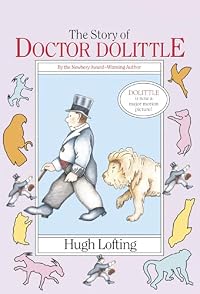
The Story of Doctor Dolittle
by Hugh Lofting
Doctor Dolittle (1), Doctor Dolittle (Publication Order) (1920)
On This Page
Description
The adventures of a kind-hearted doctor, who is fond of animals and understands their language, as he travels to Africa with some of his favorite pets to cure the monkeys of a terrible sickness.Tags
Recommendations















Member Recommendations

Member Reviews
It's funny that this part of Audible.com's "Audible Kids" edition. All that means is the audio is bookended with a chorus of kids screaming "Audible Kids!" The talk of coons, darkies, and n*ggers should get this banned more often than the oft-cited The Adventures of Huckleberry Finn. Of course, the "Black Prince" tribal leader in this mostly African adventure isn't as evil as he seems, he really just wants to get away and be a white man ... with blue eyes. Still, the Bond-esque English sanguine attitude of John Dolittle is quaint but what really makes this edition is the gusto the narrator David Case throws into grunting and squeaking through the animal dialogues of Gub-Gub the pig, Jip the dog, Chee-Chee, Dab-Dab the duck, and the show more two-headed Pushmi-pullyu. show less
At times, The Story of Doctor Dolittle is gentle, imaginative, and charming. But it fails the first test for a children's book: would you read it to a child?
I first saw Doctor Dolittle books in the arms of a quiet, pretty girl on her way to the elementary school we attended. The colorful stickers on the face of the second book captured my imagination. Many years later, I learned that the author had, remarkably, written the original Doctor Dolittle stories in the trenches of WWI, wanting to spare his children the reality of his daily life. So I was inclined to give him the benefit of the doubt on charges of racism.
But sadly, there's no room for doubt. And even without the caricatures and the slurs and the bizarre subplot of the African show more prince who wants to turn his skin white so that he won't scare Sleeping Beauty(!), the book doesn't quite hold together. show less
I first saw Doctor Dolittle books in the arms of a quiet, pretty girl on her way to the elementary school we attended. The colorful stickers on the face of the second book captured my imagination. Many years later, I learned that the author had, remarkably, written the original Doctor Dolittle stories in the trenches of WWI, wanting to spare his children the reality of his daily life. So I was inclined to give him the benefit of the doubt on charges of racism.
But sadly, there's no room for doubt. And even without the caricatures and the slurs and the bizarre subplot of the African show more prince who wants to turn his skin white so that he won't scare Sleeping Beauty(!), the book doesn't quite hold together. show less
I have read and seen versions of The Story of Doctor DoLittle, but never before the original by Hugh Lofting published in 1920. The original is extremely and blatantly racist, with a story about an African prince who will do anything if the doctor can only make him white. My understanding is that later editions (I am not sure how much later) have thankfully completely written out that subplot and altered other text and illustrations to remove racial elements and render this story into its current view as an innocent children's story. For me, I don't think I can unsee the image of Prince Bumpo, his quest to be acceptable to his Sleeping Beauty princess, and of Dr. Dolittle's cruel use of of Prince Bumpo.
Read my complete review at show more target="_top">http://www.memoriesfrombooks.com/2020/02/the-story-of-doctor-dolittle.html show less
Read my complete review at show more target="_top">http://www.memoriesfrombooks.com/2020/02/the-story-of-doctor-dolittle.html show less
Summary: Dr. Dolittle is a British country doctor with a soft spot for animals - so much so that his human clientele has dropped off steeply due to the abundance of animals around his house. His parrot, Polynesia, wisely suggests that he become an animal doctor rather than a people doctor, and sets about teaching him the secret language that animals use to talk to each other. With this knowledge, Dr. Dolittle becomes the best animal doctor there ever was, and his fame spreads among animals far and wide. Eventually, he is called to Africa where there is a great sickness among the monkeys, but getting there safely - and back - is no mean feat for a poor country doctor.
Review: I loved the Dr. Dolittle Treasury when I was younger, and I was show more pleased to find that the original version of the first book has lost none of its charm, even now that I'm a grownup. One the one hand, it is a product of its time, and there's some casual racism surrounding Dr. Dolittle's trip to Africa that reads uncomfortably today. But, on the other hand, I think the desire to talk to the animals is a pretty universal one amongst children (or maybe just amongst children destined to grow up to be biologists?), and the animals are absolutely the star of the show. Lofting renders their personalities clearly and uniquely, so that they're all each individuals as well as representatives of their species - most dog owners will recognize their own pet in Jip, for example. There are plenty of adventures to keep this short book moving along quickly, some good laughs, and the fact that it was written for children keeps the language from becoming dense or overblown. It's not a particularly deep book, but it is charming and fun, and deserves its status as a children's classic. 4 out of 5 stars.
Recommendation: Anyone who has kids who like animals, or anyone who *was* a kid who liked animals should definitely pick this one up for a nice little break. show less
Review: I loved the Dr. Dolittle Treasury when I was younger, and I was show more pleased to find that the original version of the first book has lost none of its charm, even now that I'm a grownup. One the one hand, it is a product of its time, and there's some casual racism surrounding Dr. Dolittle's trip to Africa that reads uncomfortably today. But, on the other hand, I think the desire to talk to the animals is a pretty universal one amongst children (or maybe just amongst children destined to grow up to be biologists?), and the animals are absolutely the star of the show. Lofting renders their personalities clearly and uniquely, so that they're all each individuals as well as representatives of their species - most dog owners will recognize their own pet in Jip, for example. There are plenty of adventures to keep this short book moving along quickly, some good laughs, and the fact that it was written for children keeps the language from becoming dense or overblown. It's not a particularly deep book, but it is charming and fun, and deserves its status as a children's classic. 4 out of 5 stars.
Recommendation: Anyone who has kids who like animals, or anyone who *was* a kid who liked animals should definitely pick this one up for a nice little break. show less
This book was a success with my kids. It is the story of how Dr. Dolittle came to learn the language of the animals and made his first trip to Africa to cure the sick monkeys. He also collected the pushme pullyou. This is a pretty sraightforward prose style. It was originally written in the form of letters home to Lofting's children when he was an engineer stationed in Africa during World War I. The sentences are short, declarative sentences, without a lot of description or pacing. A lot of dialogue and a fast paced plot. The words are easy and the print in this voluem is larger and easier for a child to read to herself than the second volume, the Voyages of Dr. Dolittle (which also has a more sophisticated style) (Perhaps Lofting's show more children were simply older when he wrote the second volume.
I particularly enjoyed the character of the doctor, who is somewhat taciturn. The voices of the animals are heard often at greater length than his. I like the way he listenes carefully to what they say and almost always takes their advice. He really treats them like colleagues on an expedition. There is no significant human domination in the relationship -- other than that which results because the doctor can cure animals. Indeed, some of the animals seem so much more sensible than the doctor about things like money and housekeeping and business that we feel the doctor would be lost without their help. But he is so sincere and kind we understand exactly why they love him. show less
I particularly enjoyed the character of the doctor, who is somewhat taciturn. The voices of the animals are heard often at greater length than his. I like the way he listenes carefully to what they say and almost always takes their advice. He really treats them like colleagues on an expedition. There is no significant human domination in the relationship -- other than that which results because the doctor can cure animals. Indeed, some of the animals seem so much more sensible than the doctor about things like money and housekeeping and business that we feel the doctor would be lost without their help. But he is so sincere and kind we understand exactly why they love him. show less
I am certain I read this as a child, but I can barely remember it. The book is actually quite enjoyable, but with many dated words. The nearest analogue I can think of at this time are the C.S. Lewis Narnia books. Tremendous sea voyages require almost no preparation in both. It is madly Victorian, with all the conventions; Dr. Dolitle's sister becomes so fed up with his bad management of his physician's practice that she gets married to escape him. In parts, it is rather funny.
The Story of Doctor Dolittle is the first book in the Dolittle series and introduces the good Doctor and how he came to talk to the animals. It is shorter and aimed at a younger audience than the later books, but it has a great deal of Victorian charm and upbeat optimism that is infectious. There are about 12 books in the series, nine published between 1920 and 1933, the last 3 published posthumously in the 40s and 50s.
Dolittle is a small-town English gentleman who finds himself in the wrong occupation, a doctor of people, and gradually withdraws from society becoming a poor down and out town recluse. One day his English speaking pet parrot Polynesia lets him in on a secret that animals have a language of their own. Dolittle, now able show more to understand the complaints of animals, becomes a successful and world-renowned doctor of animals. Animal language is the central device of the series - in an age when every Disney film features English speaking animals it seems almost normal, but Lofting makes it seem new and marvelous. Indeed, the animals don't speak English, but each species has its own "secret" language - which is not too far from reality with "horse whisperers" and "dolphin languages".
It's impossible to talk about this first edition without mentioning the racism towards black Africans - not only the obvious language problems (the "n" and "c" words), but attitudes of colonialism such as European racial superiority - it goes a long way to explain why the book is not as popular as it could be, and better known from the movie series (the books went out of print by the 1970s and underwent bowdlerization). As an adult well versed in post-colonialism I have no problem recognizing and removing myself from the influence of racism, and find it instructive on what institutionalized racism looks like and how it can manifest in children's books; in other words, the non-political correctness is refreshingly curious.
Dolittle is a social misfit who has mostly found friends through nature outside of human society. He has decoded the language of nature, a language that is right there in front of us all, if we only take the time and sympathy to understand it. And he applies his powers for good and not evil, as a healer of animals and a righter of wrongs. Of course science is also the language of nature and "doctors" are also scientists. The Enlightenment optimism that science will lead to good and solve mankind's problem finds expression through the good will and kindness of Dolittle. In this sense, it is the "best and brightest" of society that will bring about goodness, a view popular in the early and middle 20th century. Today we are more skeptical of such paternalism and look for positive change through "open society", Dolittle should not be the only keeper of the language, but teach everyone. Perhaps in later books this happens. I look forward to reading the second book, The Voyages of Doctor Dolittle, which is longer and more mature, the basis for the film and it won a Newberry Medal.
--Review by Stephen Balbach, via CoolReading (c) 2008 cc-by-nd show less
Dolittle is a small-town English gentleman who finds himself in the wrong occupation, a doctor of people, and gradually withdraws from society becoming a poor down and out town recluse. One day his English speaking pet parrot Polynesia lets him in on a secret that animals have a language of their own. Dolittle, now able show more to understand the complaints of animals, becomes a successful and world-renowned doctor of animals. Animal language is the central device of the series - in an age when every Disney film features English speaking animals it seems almost normal, but Lofting makes it seem new and marvelous. Indeed, the animals don't speak English, but each species has its own "secret" language - which is not too far from reality with "horse whisperers" and "dolphin languages".
It's impossible to talk about this first edition without mentioning the racism towards black Africans - not only the obvious language problems (the "n" and "c" words), but attitudes of colonialism such as European racial superiority - it goes a long way to explain why the book is not as popular as it could be, and better known from the movie series (the books went out of print by the 1970s and underwent bowdlerization). As an adult well versed in post-colonialism I have no problem recognizing and removing myself from the influence of racism, and find it instructive on what institutionalized racism looks like and how it can manifest in children's books; in other words, the non-political correctness is refreshingly curious.
Dolittle is a social misfit who has mostly found friends through nature outside of human society. He has decoded the language of nature, a language that is right there in front of us all, if we only take the time and sympathy to understand it. And he applies his powers for good and not evil, as a healer of animals and a righter of wrongs. Of course science is also the language of nature and "doctors" are also scientists. The Enlightenment optimism that science will lead to good and solve mankind's problem finds expression through the good will and kindness of Dolittle. In this sense, it is the "best and brightest" of society that will bring about goodness, a view popular in the early and middle 20th century. Today we are more skeptical of such paternalism and look for positive change through "open society", Dolittle should not be the only keeper of the language, but teach everyone. Perhaps in later books this happens. I look forward to reading the second book, The Voyages of Doctor Dolittle, which is longer and more mature, the basis for the film and it won a Newberry Medal.
--Review by Stephen Balbach, via CoolReading (c) 2008 cc-by-nd show less
Members
- Recently Added By
Lists

Favorite Childhood Books
1,602 works; 516 members
1001 Children's Books You Must Read Before You Grow Up
774 works; 101 members

501 Must-Read Books
508 works; 71 members

Read the book and saw the movie
1,170 works; 195 members

Best Children's Books You've Read
197 works; 74 members

A Child's Book Tour of London
51 works; 7 members

Sonlight Books
1,487 works; 25 members

Overdue Podcast
803 works; 9 members

Written and Illustrated By
805 works; 1 member
The Complete Rory Gilmore Reading List
506 works; 5 members

Book Titles Mentioned In Newberry Medal And Honor Books
884 works; 3 members

Ambleside Y2
33 works; 1 member

My 100 Favorite Books of All Time
57 works; 2 members

Books Read in 2015
3,298 works; 126 members

1920s
141 works; 6 members

Works Referenced in The League of Extraordinary Gentlemen
122 works; 6 members

Tagged Doctors
15 works; 5 members

Books Read in 2012
815 works; 34 members

Children's Literature 1900 - 1950 in order
413 works; 8 members

CCE 1000 Good Books List
1,033 works; 12 members
Ambleside Books
459 works; 18 members

Satori Smiles Children's Book List
262 works; 7 members
Author Information

165+ Works 13,706 Members
Hugh Lofting was born in 1866 in Maidenhead, England. He trained as a civil engineer, getting his education from the Massachusetts Institute of Technology and the Polytechnic Institute of London. He worked in Africa, the West Indies and Canada and then settled in New York to become a writer. The stories about Doctor Dolittle began as letters to show more his children while overseas in England during World War I, where Lofting served with the British Army. The first Doctor Dolittle book published was "The Story of Doctor Dolittle" in 1920. He wrote thirteen more, winning the Newberry Medal in 1923 for "The Voyages of Doctor Dolittle." Lofting illustrated all of the Dolittle books himself. In 1967, the Doctor Dolittle books were made into a musical film starring Rex Harrison. Hugh Lofting died in 1947 at the age of 81. show less
Some Editions
Awards and Honors
Notable Lists
Series


Belongs to Publisher Series
Work Relationships
Is contained in
Is retold in
Has the adaptation
Is abridged in
Common Knowledge
- Canonical title
- The Story of Doctor Dolittle
- Original title
- The Story of Doctor Dolittle, Being the History of His Peculiar Life at Home and Astonishing Adventures in Foreign Parts
- Alternate titles
- Doctor Dolittle
- Original publication date
- 1920
- People/Characters
- Doctor Dolittle; Sarah Dolittle (Dr Dolittle's sister, housekeeper); Dab-Dab the duck; Jip the dog; Gub-Gub; Polynesia the parrot (show all 24); Too-Too; Theodosia (cat's-meat man's wife); Chee-Chee; King of the Jolliginki; Ermintrude (queen of the Jolliginki); Bumpo (prince of the Jolliginki); Leader of the Lions (king of the beasts); Chief Chimpanzee; Grand Gorilla; Oldest Orang-utang; Biggest Baboon; Major of the Marmosets; Pushmi-pullyu; Buffon [Dr Dolittle]; Ben Ali ('the Barbary Dragon' | Barbary pirate | 'the Barbary Dragon' | Barbary pirate); The Saucy Sally (cutter-rigged sloop); Trevelyan - mother [Dr Dolittle]; Trevelyan - son [Dr Dolittle]
- Important places
- Puddleby-on-the-Marsh, England, UK (fictional); West Country, England, UK; Africa; Jolliginki (ficticious African kingdom)
- Related movies
- Doctor Dolittle (1967 | IMDb); Doctor Dolittle (1998 | IMDb); Dolittle (2020 | IMDb)
- Dedication
- To
all children
Children in years
and children in heart
I dedicate this story - First words
- ONCE upon a time, many years ago - when our grandfathers were little children - there was a doctor; and his name was Dolittle - John Dolittle, M.D.
- Last words
- (Click to show. Warning: May contain spoilers.)... Go to sleep!"
- Original language
- English
Classifications
- Genres
- Children's Books, Fiction and Literature
- DDC/MDS
- 823.912 — Literature & rhetoric English & Old English literatures English fiction 1900- 1901-1999 1901-1945
- LCC
- PZ7 .L827 .S — Language and Literature Fiction and juvenile belles lettres Fiction and juvenile belles lettres Juvenile belles lettres
- BISAC
Statistics
- Members
- 4,814
- Popularity
- 2,936
- Reviews
- 48
- Rating
- (3.65)
- Languages
- 18 — Chinese, Czech, Danish, Dutch, English, Estonian, Finnish, French, German, Hungarian, Italian, Lithuanian, Norwegian (Bokmål), Polish, Romanian, Croatian, Spanish, Swedish
- Media
- Paper, Audiobook, Ebook
- ISBNs
- 276
- UPCs
- 2
- ASINs
- 125