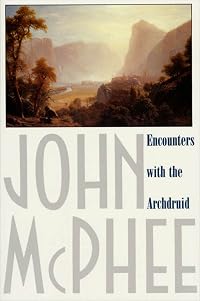
Encounters with the Archdruid
by John McPhee
On This Page
Description
The narratives in this book are of journeys made in three wildernesses - on a coastal island, in a Western mountain range, and on the Colorado River in the Grand Canyon. The four men portrayed here have different relationships to their environment, and they encounter each other on mountain trails, in forests and rapids, sometimes with reserve, sometimes with friendliness, sometimes fighting hard across a philosophical divide.Tags
Recommendations






































Member Recommendations
Member Reviews
I found this book to be riveting; both a nature travelogue and an applied ecology seminar in one slim volume. Sierra Club director David Brower is the Archdruid, a man who uses the word "conserve" the way Carl Sagan used "billions". He's a die-hard environmentalist with a gift for PR who fights a never-ending battle against the government, developers, miners, and even humanity at large in his quest to keep as much of America as possible out of the reach of man forever, and McPhee – whose writing talent is truly impressive – allows Brower and his nemeses to explain themselves and their views on nature at length in flawless, crystalline prose. Whether sparring over mining the Glacier National Park with geologist Charles Park, or show more settling Hilton Head Island with developer Charles Fraser, or damming the Grand Canyon with bureaucrat Floyd Dominy, Brower's unstinting defense of the wilderness touches on issues of conservation vs. preservation that become more relevant every day. His fervent devotion to the outdoors is nearly religious (hence the book's title), but so heartfelt and understandable, given the irreplaceable natural wonders he's fighting for, that by the end of the book I was practically cheering for him even though his antagonists were just as thoughtful and compelling as he was. Though the book is lightly infused with that peculiar 70s nature mysticism, in a world where Louisiana steadily washes out to the sea and the Everglades dwindles by the day to the size of a mud puddle Brower almost seems more reasonable now than when the book was written. Very thought-provoking, and McPhee is an absolutely superb writer. show less
Classic McPhee - he gets himself involved with leading characters of some facet of the world and we get to learn through him telling the story of his learning. Here David Brower, environmental activist, hangs out with a mining prospector, a real estate developer, and a dam builder. People will impact the environment one way or another just like any other organism. But clearly both through the growing number of people and the growing impact per person, we're degrading the environment to an unsustainable degree. Brower retells the story of creation, using a week as the time scale of planetary history. The industrial revolution happened in the last fortieth of a second. The logic of "we've always done things this way, why shouldn't we just show more continue?" doesn't hold because we have done things this way for only a very short time.
We get a very nice portrait of Brower here and also a good opportunity to reflect on what our real needs are. Another interesting puzzle presented here is the degree to which objectivity is suitable to solving environmental issues. This is an old book by now - published in 1971. Practically ancient history! Nowadays in the Trump era the notion of objectivity seems to have vanished almost completely from the public realm. But I am fascinated by the two facets of science, one that looks at the world, one that changes the world.
There is no deep analysis here. These are stories - pretty amazing stories, actually. David Brower at the dedication of the Glen Canyon Dam! There is rich soil here, giving readers plenty of opportunities for their own reflection and analysis. show less
We get a very nice portrait of Brower here and also a good opportunity to reflect on what our real needs are. Another interesting puzzle presented here is the degree to which objectivity is suitable to solving environmental issues. This is an old book by now - published in 1971. Practically ancient history! Nowadays in the Trump era the notion of objectivity seems to have vanished almost completely from the public realm. But I am fascinated by the two facets of science, one that looks at the world, one that changes the world.
There is no deep analysis here. These are stories - pretty amazing stories, actually. David Brower at the dedication of the Glen Canyon Dam! There is rich soil here, giving readers plenty of opportunities for their own reflection and analysis. show less
The book consists of 3 semi-fictionalized trips that the "hero" David Brower made in the late '60s with a mining engineer, a real estate developer, and a water reclamation engineer/bureaucrat. The reviews all said that McPhee gives a fair treatment to the "opposition". That's a bit of an understatement. I found all 3 to be more eloquent in their positions than Brower. Plus, 2 of the 3 antagonists always couch their arguments in terms of what the very best mining companies and real estate companies could do. But history has long shown that they will not do it. The book being 50 years old, the ecological positions are very stale even when they are well laid out. If you are interested in a book contrasting viewpoints between show more ecologists/conservationists and their opponents, look for something more recent. show less
An amazing book, written during the era of DDT, the "death" of Lake Erie, the imminent extinction of the condors, moon landings, and the construction of huge dams. It's fascinating to look back at where the environmental movement began, and to a fair and balanced examination of both sides of the issue. It's almost inconceivable to believe that there was a proposal to mine copper in the mountains of Washington by inserting "a nuclear bomb in Plummer Mountain, bring the mountain down in shards into the Suiattle Valley, then pour rivers of chemicals over it to leach out the copper". It was known as "Operation Plowshare", and was discarded not because of it's outrageousness, but because the nuclear engineers couldn't "direct their blast", show more making a cylindrical shaft, not one that would follow the ore deposits. I highly recommend this book to anyone concerned about the environment. show less
An amazing book, written during the era of DDT, the "death" of Lake Erie, the imminent extinction of the condors, moon landings, and the construction of huge dams. It's fascinating to look back at where the environmental movement began, and to a fair and balanced examination of both sides of the issue. It's almost inconceivable to believe that there was a proposal to mine copper in the mountains of Washington by inserting "a nuclear bomb in Plummer Mountain, bring the mountain down in shards into the Suiattle Valley, then pour rivers of chemicals over it to leach out the copper". It was known as "Operation Plowshare", and was discarded not because of it's outrageousness, but because the nuclear engineers couldn't "direct their blast", show more making a cylindrical shaft, not one that would follow the ore deposits. I highly recommend this book to anyone concerned about the environment. show less
An amazing book, written during the era of DDT, the "death" of Lake Erie, the imminent extinction of the condors, moon landings, and the construction of huge dams. It's fascinating to look back at where the environmental movement began, and to a fair and balanced examination of both sides of the issue. It's almost inconceivable to believe that there was a proposal to mine copper in the mountains of Washington by inserting "a nuclear bomb in Plummer Mountain, bring the mountain down in shards into the Suiattle Valley, then pour rivers of chemicals over it to leach out the copper". It was known as "Operation Plowshare", and was discarded not because of it's outrageousness, but because the nuclear engineers couldn't "direct their blast", show more making a cylindrical shaft, not one that would follow the ore deposits. I highly recommend this book to anyone concerned about the environment. show less
Cool book about Dave Brower, ex-president of the Sierra Club and "Archdruid", as he hangs out with builders of dams, extractors of metals, and developers of islands. A rare environmental book that exposits both sides of the coin. McPhee is an insightful writer on nature and his prose never disappoints.
Members
- Recently Added By
Lists

Maybe This Year? Books to Look Forward To
414 works; 9 members
Author Information

59+ Works 21,095 Members
McPhee was born in Princeton, New Jersey, and educated at Princeton University and Cambridge University. His writing career began at Time magazine and led to his long association with the New Yorker, where he has been a staff writer since 1965. That same year he published his first book, A Sense of Where You Are, with FSG, and soon followed with show more The Headmaster (1966), Oranges (1967), The Pine Barrens (1968), A Roomful of Hovings and Other Profiles (collection, 1969), The Crofter and the Laird (1969), Levels of the Game (1970), Encounters with the Archdruid (1972), The Deltoid Pumpkin Seed (1973), The Curve of Binding Energy (1974), Pieces of the Frame (collection, 1975), and The Survival of the Bark Canoe (1975). Both Encounters with the Archdruid and The Curve of Binding Energy were nominated for National Book Awards in the category of science Since 1977, the year in which McPhee received the Award in Literature from the American Academy of Arts and Letters and The John McPhee Reader and the bestselling Coming into the Country appeared in print, Farrar, Straus and Giroux has published Giving Good Weight (collection, 1979), Basin and Range (1981), In Suspect Terrain (1983), La Place de la Concorde Suisse (1984), Table of Contents (collection, 1985), Rising from the Plains (1986), Heirs of General Practice (in a paperback edition, 1986), The Control of Nature (1989), Looking for a Ship (1990), Assembling California (1993), The Ransom of Russian Art (1994), The Second John McPhee Reader (1996), and Irons in the Fire (1997). Annals of the Former World was published in 1998 and was awarded the Pulitzer Prize in 1999. McPhee has taught at Princeton as Ferris Professor since 1975. (Bowker Author Biography) show less
Awards and Honors
Distinctions
Work Relationships
Is contained in
Common Knowledge
- Original publication date
- 1977
- People/Characters
- David Brower
- Important places
- Grand Canyon, Arizona, USA; Glen Canyon Dam, Arizona, USA; Colorado River, USA; Cumberland Island, Georgia, USA; Glacier Peak Wilderness, Washington, USA; Cascade Mountains, Washington, USA
- Original language
- English
Classifications
- Genres
- Science & Nature, Nonfiction, General Nonfiction, Biography & Memoir
- DDC/MDS
- 333.720973 — Society, government, & culture Economics Economics of land and energy Conservation, Alternative Energy Sources Conservation & protection Biography And History North America United States
- LCC
- S942 .M27 — Agriculture Agriculture (General) Conservation of natural resources
- BISAC
Statistics
- Members
- 1,178
- Popularity
- 21,363
- Reviews
- 21
- Rating
- (4.05)
- Languages
- Chinese, English, French
- Media
- Paper, Audiobook, Ebook
- ISBNs
- 9
- ASINs
- 12