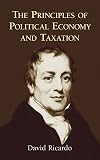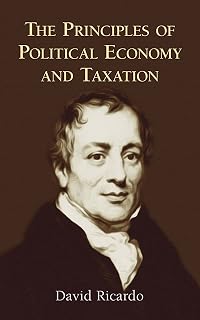
The Principles of Political Economy and Taxation
by David Ricardo
On This Page
Description
This landmark treatise of 1817 formulated the guiding principles behind the market economy. Author Ricardo, with Adam Smith, founded the classical system of political economy, a school of thought that dominated economic policies throughout the 19th century and figured prominently in the theories of John Stuart Mill and Karl Marx.Tags
Recommendations










Member Reviews
In a way Ricardo's economic theory is akin to Aristotle's physical theory, it feels a bit difficult to get a grip of it since it's presented without any mathematical or graphic aids. Nevertheless it's easy to see why this was a groundbreaking work, Ricardo's economic acumen and the explicitness of his arguments are nothing short of brilliant.
Second edition.
Ratings
Members
- Recently Added By
Lists

Works referenced in Capital in the Twenty-First Century by Thomas Piketty
62 works; 2 members

My List
302 works; 1 member

Works cited in The New Science of the Enchanted Universe by Marshall Sahlin
141 works; 1 member
Author Information

47+ Works 976 Members
Born in London, David Ricardo was the third child in a family of at least 17 children. His father, a Dutch Jew, was a successful stockbroker who had moved to London in 1760. Ricardo did not have the typical classical education afforded the children of other wealthy families, but his father supplied him with tutors, and he spent three years in an show more exclusive Jewish school in Amsterdam. At age 14 he began working in his father's brokerage business. Ricardo learned the brokerage trade well, and he would have been regarded as a rousing success by his family had he not married a Quaker and joined the Unitarian church, causing an estrangement from his father. His abilities as a stockbroker, however, were such that he quickly found other employment. Before long, he had amassed a small fortune, and, by his early forties, he was able to retire and devote time to his new interest, economics. In 1809 Ricardo published his first article, which dealt with the price of gold and the value of the British pound. This was followed by a popular pamphlet, The High Price of Bullion, a Proof of the Depreciation of Bank Notes (1810), in which he argued that the excess production of paper bank notes depreciated their value. The House of Commons became so alarmed by Ricardo's argument that it formed a committee to examine the high price of bullion and issued the famous and controversial Bullion Report. During the bullion controversy, Ricardo developed two interesting friendships. The first was with John Stuart Mill, who took it upon himself to review Ricardo's manuscript and help him develop his literary skills. The second was with Thomas Malthus, who would debate topics with Ricardo in order to help him to clarify his positions. Although Ricardo and Malthus often took opposing positions on many public issues, their differences never got in the way of their lifelong friendship. The events of the period had a strong influence on Ricardo's economic theories. England at this time was divided into two competing and hostile groups---the industrialists with their factories and the landed aristocracy who resented the new-found riches of the industrialists. The industrialists wanted low grain prices so that wages could be kept low; the landed aristocracy wanted high prices and high profits on the sale of their grain. The landowners, who held a majority in Parliament, passed the infamous Corn Laws. These laws established a sliding import tax on grain, thereby setting artificially high prices for grain in England. Ricardo saw the economic problem in terms of a distribution of income, a view expressed forcibly in his Principles of Political Economy and Taxation (1817). According to Ricardo, workers received wages for their efforts, capitalists earned profits, and landowners received rent for the use of their land. Landowners, however, were unaffected by the pressure of competition and the growth of population, so only they would benefit from future growth. In addition to Ricardo's contributions to the theory of rent and the distribution of income, he also developed a labor of value, supported free trade, and championed laissez faire. He argued for minimal taxation, the retirement of the national debt, and the abolition of relief policies for the poor on the grounds that it distorted the labor market. Ricardo died suddenly from an ear infection in 1823, barely 14 years after his article on the bullion controversy. Even so, his theories had a lasting impact on the field of economics and on English economic policies. According to John Maynard Keynes, "Ricardo conquered England as completely as the Holy Inquisition conquered Spain." (Bowker Author Biography) show less
Some Editions
Series
Belongs to Publisher Series
Common Knowledge
- Canonical title
- The Principles of Political Economy and Taxation
- Original title
- The Principles of Political Economy and Taxation
- Original publication date
- 1817
Classifications
Statistics
- Members
- 709
- Popularity
- 40,318
- Reviews
- 2
- Rating
- (3.41)
- Languages
- 12 — Danish, English, Finnish, French, German, Greek, Hungarian, Italian, Portuguese, Spanish, Swedish, Turkish
- Media
- Paper, Ebook
- ISBNs
- 71
- UPCs
- 1
- ASINs
- 21