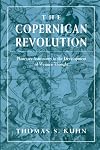
The Copernican Revolution: Planetary Astronomy in the Development of Western Thought
by Thomas S. Kuhn
On This Page
Description
"The author brings to a common focus the considered approach of the historian, the technical understanding of the scientist and the skill and experience of an able teacher. No careful reader of this well-wrought volume can fail to appreciate the nicely balanced interplay of these elements in the full explication of one of the major turning points in the evolution of scientific thought. For those concerned with the teaching of the history of science, this discussion of the issues involved in show more the Copernican revolution will prove to be indispensable, a superb analysis of the anatomy of revolution. Those drawn to the question of meaning which the historian of science can give to the evolution of ideas will find this book equally valuable, a paradigm of synthesis and interpretation." [Isis] show lessTags
Recommendations
































Member Reviews
A solid addition to the literature of science history and intellectual history. Kuhn sets out the interesting ways by which the astronomical system of Copurnicus generated the revolution named for him.
The book is interesting in detail and breadth and is fairly easily reading not compromised by philosophical obfuscation. I do not sense that Kuhn is out of his depth at any point. He exaggerates his viewpoint only somewhat. I believe it will interest any non-scientist as well as any scientist not already familiar both with the historical details presented and with their significance in a historical view reaching back to Aristotle and forward to Newton. There are some simple diagrams which require attention, but few of them need to be show more studied so long as the reader understands from the text their meaning. Similarly, no math is needed. Any layman who believes science is mostly a collection of facts must read this in order to have a sense of a type of process that science is truly about.
Importantly, the Copernican (sun-centered) astronomy, says Kuhn, resulted in no obvious overall simplification over the Ptolemaic system (with epicycles, which are moving circles within orbits and had been adopted along with other unrealities in order to describe the apparent motions of the heavens around the earth). Copernicus did not, for example, eliminate most of the epicycles. While he did simplify some matters, he rendered others more complicated. For example, in order to make his system correspond to observation, he had to add some (unreal) motion not present in Ptolemy. The primary task for Copernicus was to prove mathematically that his system was observationally consistent with Ptolemy, since the received Ptolemaic system was as accurate as current observations allowed and was, as shown by Kuhn, accurate generally to a degree which the Copernican description did not exceed. The superiority his new system was not at all clear.
(It was a problem with the calendar that likely motivated Copernicus to look for a better system. Ironically, It was a church authority who asked him whether he could resolve the problem. Furthermore, his formulation did not finally result in a solution to it.)
Why and how then did the Copernican revolution result? While its influence tends to be considered in terms of its theological and philosophical implications, the answer to the question lies elsewhere, since this was fundamentally a scientific revolution.
This question presents to the historian a challenge which Kuhn masters in this book. He shows that some of the answer lies in the historical significance of modest ad hoc evolutionary accretions made to Ptolemaic astronomy before Copernicus. (More, below.)
Much else lies in the incremental recognition by post-Copernican astronomers of various advantages of this system, quite small advantages early on. These advantages could not be seen until later (initially in large part because of improvements made in the accuracy of astronomical observations after he died). They accumulated and supported one another, along with successive theoretical modifications over time, to the extent that his system largely has been replaced. Today it can as easily be seen as more nearly Ptolemaic than as Newtonian or Einsteinian.
But similar as the views of Ptolemy and Copernicus were, the revolution would not have arisen from a Ptolemaic view, because the evolution of that view would have continued the same way it always had since the time of Ptolemy, by adding additional epicycles and other unrealities whenever necessary in order to fit new data, as indeed Ptolemy had done to the Aristotelian cosmology in order to arrive at his own. Copernicus proved that an abrupt disruption in this kind of evolutionary procession, by moving the center of the universe from earth to sun rather than adding more epicycles, could result in an equally acceptable astronomy. The change in the process itself, this fundamental difference in procedure only, became a leap more important than any immedate astronomical consequences of the new theory.
But this change could not be appreciated at first. In the larger scientific community of the decades after his death, even the sun-centered nature of the theory was largely ignored, as it contradicted the senses, tradition and religious authority. It became preferentially taught because it clearly set out in one elegant treatise the means of making mathematical calculations describing celestial observations. (The Ptolemaic formulation had passed through the centuries in often second-hand accounts and varying translations and re-translations, additions and other editing.) Only as increasingly accurate astronomical data more strongly matched the Copernican universe did the teaching of his system to other scientists become securely established.
Only later as the remaining Ptolemaic elements fell away due to more sophisticated data collection and more ingenious mathematical treatment did the best mathematicians begin to appreciate more fully the scientific value of the new and evolving system. Since the Copernican leap in process had already been proved by him to lead to a defensible scientific result, and the conception was proving even more useful over time, mathematicians were now at liberty to attempt further procedural leaps of imagination in search of better answers. Importantly, they could find increasingly general formulations (like universal gravity) in order to explain and simplify elegantly a greater number of observations, rather than further complicate matters as would result by piling on more epicycles. The revolution is named for Copernicus because he afforded this new liberty of scientific imagination which eventually proved so fruitful.
Only after the newer formulations proved their power could the wider scientific community and then the educated public begin fully to accept the revolution and attempt reasonably to assess what broader implications might be implied by this revolutionary theory. show less
The book is interesting in detail and breadth and is fairly easily reading not compromised by philosophical obfuscation. I do not sense that Kuhn is out of his depth at any point. He exaggerates his viewpoint only somewhat. I believe it will interest any non-scientist as well as any scientist not already familiar both with the historical details presented and with their significance in a historical view reaching back to Aristotle and forward to Newton. There are some simple diagrams which require attention, but few of them need to be show more studied so long as the reader understands from the text their meaning. Similarly, no math is needed. Any layman who believes science is mostly a collection of facts must read this in order to have a sense of a type of process that science is truly about.
Importantly, the Copernican (sun-centered) astronomy, says Kuhn, resulted in no obvious overall simplification over the Ptolemaic system (with epicycles, which are moving circles within orbits and had been adopted along with other unrealities in order to describe the apparent motions of the heavens around the earth). Copernicus did not, for example, eliminate most of the epicycles. While he did simplify some matters, he rendered others more complicated. For example, in order to make his system correspond to observation, he had to add some (unreal) motion not present in Ptolemy. The primary task for Copernicus was to prove mathematically that his system was observationally consistent with Ptolemy, since the received Ptolemaic system was as accurate as current observations allowed and was, as shown by Kuhn, accurate generally to a degree which the Copernican description did not exceed. The superiority his new system was not at all clear.
(It was a problem with the calendar that likely motivated Copernicus to look for a better system. Ironically, It was a church authority who asked him whether he could resolve the problem. Furthermore, his formulation did not finally result in a solution to it.)
Why and how then did the Copernican revolution result? While its influence tends to be considered in terms of its theological and philosophical implications, the answer to the question lies elsewhere, since this was fundamentally a scientific revolution.
This question presents to the historian a challenge which Kuhn masters in this book. He shows that some of the answer lies in the historical significance of modest ad hoc evolutionary accretions made to Ptolemaic astronomy before Copernicus. (More, below.)
Much else lies in the incremental recognition by post-Copernican astronomers of various advantages of this system, quite small advantages early on. These advantages could not be seen until later (initially in large part because of improvements made in the accuracy of astronomical observations after he died). They accumulated and supported one another, along with successive theoretical modifications over time, to the extent that his system largely has been replaced. Today it can as easily be seen as more nearly Ptolemaic than as Newtonian or Einsteinian.
But similar as the views of Ptolemy and Copernicus were, the revolution would not have arisen from a Ptolemaic view, because the evolution of that view would have continued the same way it always had since the time of Ptolemy, by adding additional epicycles and other unrealities whenever necessary in order to fit new data, as indeed Ptolemy had done to the Aristotelian cosmology in order to arrive at his own. Copernicus proved that an abrupt disruption in this kind of evolutionary procession, by moving the center of the universe from earth to sun rather than adding more epicycles, could result in an equally acceptable astronomy. The change in the process itself, this fundamental difference in procedure only, became a leap more important than any immedate astronomical consequences of the new theory.
But this change could not be appreciated at first. In the larger scientific community of the decades after his death, even the sun-centered nature of the theory was largely ignored, as it contradicted the senses, tradition and religious authority. It became preferentially taught because it clearly set out in one elegant treatise the means of making mathematical calculations describing celestial observations. (The Ptolemaic formulation had passed through the centuries in often second-hand accounts and varying translations and re-translations, additions and other editing.) Only as increasingly accurate astronomical data more strongly matched the Copernican universe did the teaching of his system to other scientists become securely established.
Only later as the remaining Ptolemaic elements fell away due to more sophisticated data collection and more ingenious mathematical treatment did the best mathematicians begin to appreciate more fully the scientific value of the new and evolving system. Since the Copernican leap in process had already been proved by him to lead to a defensible scientific result, and the conception was proving even more useful over time, mathematicians were now at liberty to attempt further procedural leaps of imagination in search of better answers. Importantly, they could find increasingly general formulations (like universal gravity) in order to explain and simplify elegantly a greater number of observations, rather than further complicate matters as would result by piling on more epicycles. The revolution is named for Copernicus because he afforded this new liberty of scientific imagination which eventually proved so fruitful.
Only after the newer formulations proved their power could the wider scientific community and then the educated public begin fully to accept the revolution and attempt reasonably to assess what broader implications might be implied by this revolutionary theory. show less
Excellent and accessible overview of astronomy and conceptual frameworks from antiquity to the post-Copernican luminaries like Kepler, Tycho Brahe and Galileo. The entire presentation of the development of thought in this area is a fascinating tale. One minor thing that stood out to me in this era of surprisingly lively flat earth chatter is that Aristotle and Copernicus were among the great minds that echoed the beliefs of their time that the worlds is a sphere based on basic, naked eye observation of the lunar phases, eclipses and the changing sky at different latitudes.
Apart from the scientific import of the Copernican Revolution, Kuhn's book plays an illustrative role in the still needed polemic against Christian fundamentalism. It provides (at least hints at) parallels between the fundamentalist arguments against evolution (and other science influenced practices) and the old biblical arguments against Copernicus.
(posted on my blog: davenichols.net)
Historian of science Thomas Kuhn served up this foundational and mathematical history of the Copernican Revolution, that amazing period of time which saw man's idea of a geocentric universe replaced with a more accurate heliocentric one. Copernicus himself delivered the foundational work, De revolutionibus orbium coelestium libri six ("Six Books on the Revolutions of the Heavenly Spheres"), which forever influenced the course of science's understanding of planetary motion.
Kuhn's history covers the pre-Renaissance groundwork laid down from ancient times, especially in works by Aristole and Ptolemy, and moves the story through the problems associated with these accepted models. Copernicus himself is show more largely ignored until much later in the book as Kuhn makes sure the reader understands just why Copernicus felt the need to break from tradition and put forth an alternative model.
Once De revolutionibus is published and spreads, Kuhn follows the story on through the later work of Brahe, Kepler, and Galileo, as well as explaining just why this Revolution was such a pronounced one in hindsight.
Kuhn's writing is very exact, and he can be a bit meticulous with some of the geometry. I loved this, but I recognize that some popular history of science readers might find this a bit too technical. Anyway, Kuhn is an excellent historian and presents a well-written and concise account of one of the most important periods in the history of science. Four stars. show less
Historian of science Thomas Kuhn served up this foundational and mathematical history of the Copernican Revolution, that amazing period of time which saw man's idea of a geocentric universe replaced with a more accurate heliocentric one. Copernicus himself delivered the foundational work, De revolutionibus orbium coelestium libri six ("Six Books on the Revolutions of the Heavenly Spheres"), which forever influenced the course of science's understanding of planetary motion.
Kuhn's history covers the pre-Renaissance groundwork laid down from ancient times, especially in works by Aristole and Ptolemy, and moves the story through the problems associated with these accepted models. Copernicus himself is show more largely ignored until much later in the book as Kuhn makes sure the reader understands just why Copernicus felt the need to break from tradition and put forth an alternative model.
Once De revolutionibus is published and spreads, Kuhn follows the story on through the later work of Brahe, Kepler, and Galileo, as well as explaining just why this Revolution was such a pronounced one in hindsight.
Kuhn's writing is very exact, and he can be a bit meticulous with some of the geometry. I loved this, but I recognize that some popular history of science readers might find this a bit too technical. Anyway, Kuhn is an excellent historian and presents a well-written and concise account of one of the most important periods in the history of science. Four stars. show less
Kuhn and Copernicus. Enough said.
“This book is the story of the Copernican Revolution in all three of these not quite separate meanings – astronomical, scientific, and philosophical.”
“Initiated as a narrowly technical, highly mathematical revision of classical astronomy, the Copernican theory became one focus for the tremendous controversies in religion, in philosophy, and in social theory, which, during the two centuries following the discovery of America set the tenor of the modern mind.”
“Initiated as a narrowly technical, highly mathematical revision of classical astronomy, the Copernican theory became one focus for the tremendous controversies in religion, in philosophy, and in social theory, which, during the two centuries following the discovery of America set the tenor of the modern mind.”
Members
- Recently Added By
Lists

Non-Fiction Worth Reading
1,015 works; 261 members

Lesser known books of well known authors
39 works; 17 members
Author Information

36+ Works 10,816 Members
Thomas S. Kuhn's work is best described as a normative historiography of science. He was educated at Harvard University, where in 1949 he completed a doctorate in physics. As a student, he was impressed by the differences between scientific method, as conventionally taught, and the way science actually works. Before moving to the Massachusetts show more Institute of Technology in 1979, he taught at Harvard University, the University of California at Berkeley, and Princeton University. Kuhn's most celebrated contribution to the philosophy of science is his controversial idea of paradigms and paradigm shifts. A paradigm is understood as a widely shared theoretical framework within which scientific research is conducted. According to Kuhn, science normally develops more or less smoothly within such a paradigm until an accumulation of difficulties reduces its effectiveness. The paradigm finally breaks down in a crisis, which is followed by the formation of a radically new paradigm in a so-called scientific revolution. The new paradigm is accepted, even though it might neither resolve all of the accumulated difficulties nor explain the data better than the older paradigm that it replaces. We find examples of paradigm shifts in the work of Copernicus, Galileo, Isaac Newton, Charles Darwin, and others. Since its original publication in 1962, The Structure of Scientific Revolutions undoubtedly has been the single most influential book in the philosophy of science. (Bowker Author Biography) show less
Some Editions
Series
Belongs to Publisher Series
Work Relationships
Is a study of
Common Knowledge
- Canonical title
- The Copernican Revolution: Planetary Astronomy in the Development of Western Thought
- Original title
- The Copernican Revolution: Planetary Astronomy in the Development of Western Thought
- Original publication date
- 1957
- People/Characters
- Nicolaus Copernicus
- Dedication
- To L.K. Nash
For a vehement collaboration - Blurbers
- Wolf, Harry
- Original language*
- Inglés
*Some information comes from Common Knowledge in other languages. Click "Edit" for more information.
Classifications
Statistics
- Members
- 973
- Popularity
- 27,071
- Reviews
- 13
- Rating
- (4.25)
- Languages
- 9 — English, French, German, Italian, Japanese, Polish, Portuguese, Spanish, Turkish
- Media
- Paper, Ebook
- ISBNs
- 27
- ASINs
- 14