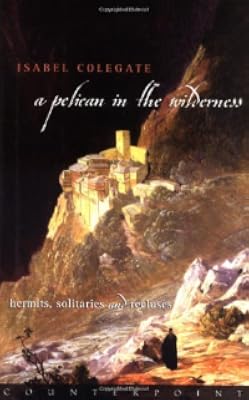
A Pelican in the Wilderness: Hermits, Solitaries, and Recluses
by Isabel Colegate
On This Page
Description
In her novels, Isabel Colegate has often explored the psychology of the seeker, the person embarked upon a search for understanding, for grace, and for perfect possession of his soul. Now, in her first work of nonfiction, she turns her attention to the archetypal seeker, the "pioneer of the spirit" who hears the call to solitude and, through self-exile from humanity, discovers not only who he or she is but, paradoxically, how to live among others. The author comes to her material not as show more scholar, not as a historian, but as a writer who herself has felt the pull of solitude. Her book is a witty, idiosyncratic personal essay that draws upon the lives, examples, and ways of those hermits and solitaries she has come to know, either through their books, books about them, or visits to their places. Some are saints and heroes, others eccentrics and frauds, but all are unforgettable. show lessTags
Recommendations






Member Reviews
I picked up this book after searching my library’s catalogue for Isabel Colegate’s works, and was curious about this non-fiction work of hers (ok I was curious about all her works as I have yet to read her fiction). This is a book about the solitary, about hermits and recluses, and I wasn’t entirely sure why I felt compelled to search it out, but I did, and I took it home and it sat on my shelf for a little while, as I sought out what I felt to be the more interesting books in my recent Library Loot. Then I finally picked up A Pelican in the Wilderness, and I was pleasantly surprised. This book is less a scholarly treatise than a collection of thoughts, a wandering, a pondering of a subject that is so obviously dear to Colegate. show more Her passion for this topic is very affecting. So while at first hesitant, I grew to understand her ardor. What makes a person leave society behind and live on their own? Why do some of these hermits naturally attract a following? What is living all alone like? Colegate delves into the lives of the well-known and the obscure, often quoting from literary sources such as Somerset Maugham, Geoffrey Chaucer and Alexander Pope. She discusses the lives of Thoreau, J.D. Salinger, Lao-Tse, St Anthony, and many more.
But if you are truly looking for answers about becoming a hermit, this isn’t exactly the book for you. Instead, this book is a little more like an exploration, a revaluation of the solitary, a kind of selection of character sketches (although character sketch doesn’t seem to be the right word – it sounds too vague). Colegate’s journey is a meandering one, and at times disjointed which can occasionally frustrate, but A Pelican in the Wilderness is a wonderful voyage through a surprisingly refreshing topic, with Colegate’s passionate voice as a rather suitable tour guide.
“The idea of the hermit’s life – simplicity, devotion, closeness to nature – lurks somewhere on the periphery of most people’s consciousness, a way glimpsed, oddly familiar, not taken. It is like one of those tracks you sometimes see as you drive along a country road, a path leading up a hill and disappearing into a wood, almost painfully inviting, so that you long to stop the car and follow it, and perhaps you take your foot off the accelerator for a couple of seconds, no more. Most of us wouldn’t like it if we did walk up the hill, we’d become bored, depressed, uncomfortable, take to drink. But the idea is still there: the path we didn’t take.” show less
But if you are truly looking for answers about becoming a hermit, this isn’t exactly the book for you. Instead, this book is a little more like an exploration, a revaluation of the solitary, a kind of selection of character sketches (although character sketch doesn’t seem to be the right word – it sounds too vague). Colegate’s journey is a meandering one, and at times disjointed which can occasionally frustrate, but A Pelican in the Wilderness is a wonderful voyage through a surprisingly refreshing topic, with Colegate’s passionate voice as a rather suitable tour guide.
“The idea of the hermit’s life – simplicity, devotion, closeness to nature – lurks somewhere on the periphery of most people’s consciousness, a way glimpsed, oddly familiar, not taken. It is like one of those tracks you sometimes see as you drive along a country road, a path leading up a hill and disappearing into a wood, almost painfully inviting, so that you long to stop the car and follow it, and perhaps you take your foot off the accelerator for a couple of seconds, no more. Most of us wouldn’t like it if we did walk up the hill, we’d become bored, depressed, uncomfortable, take to drink. But the idea is still there: the path we didn’t take.” show less
The subject of this book is of particular interest to me. Having lived a fairly solitary life and years alone in mountain wilds, I’ve been described by others as a hermit or recluse. I quite like the label and use it as an anti-definitional job-title on LinkedIn. Ironically, in 18th century England, there were contracted jobs on offer for hermits to live in grottos or fabricated rustic hermitages, as a form of garden ornament.
What you will find is a kind of Eurocentric (including USA), certainly British roundup of people who have been notable recluses; often unkempt or characterised by religious zeal, filth, suffering, and/or madness.
Although I found many passages of interest, this is a poorly designed book. Not that the binding has failed (there are a few typos indicative of a lack of care) but it's annoying to have the chapter headings omitted from the contents page, the illustrations have no captions and the alternating use of unattributed line drawings of trees and what may be a hermitage in the author’s garden (charming as they are) serves no function other than to confuse the reader.
By the end, I felt as if the author was on a kind of quest (pilgrimage) to uncover her inner solitary. She certainly travelled and read widely but without a central thesis the book tends to feel scattered and unstructured. She writes unevenly but clearly loves words, and often sent me to my dictionary for the unfamiliar: coenobitic, yashmack, eremitic, syneisaktism, apophatic, dilatory, catamite, accidie. show less
Charles Hamilton wanted a hermit who would ‘continue I the Hermitage for seven years. Where he would be provided with a Bible, optical glasses, a mat for his feet, a hassock for his pillow, an hour-glass for his time piece, water for his beverage and food from the house. He must wear a camlet robe, and never,show more
under any circumstances, must he cut his hair, beard or nails, stray beyond the limits of Mr Hamilton’s grounds, or exchange one word with the servant.’ If he lasted the full seven years he would be paid 700 guineas; if he broke the rules or left earlier he got nothing. (p.187)Jobs aside, there is a lot to say about the joys and perils of solitude. Despite Colegate’s considerable literary erudition (I have read many of the books she mentions), those looking for any critical examination of how a solitary life might be lived well, will not find much in this book. Nor will they find much about the ancient Chinese intellectual tradition of retreating from cities to the mountains and following a simple, austere pursuit of the three perfections (calligraphy, painting, poetry).
What you will find is a kind of Eurocentric (including USA), certainly British roundup of people who have been notable recluses; often unkempt or characterised by religious zeal, filth, suffering, and/or madness.
The celebrity hermit a modern phenomenon, seems to have escaped the tolerance, let alone respect, accorded to other species of solitary, being regarded instead with indignation and outrage. The reasoning behind this must be thought that no one would be a writer or an actor or a musician – or indeed be prominent in any way – unless their chief object was to be famous, and that therefore they should lay themselves down gladly as a sacrifice on the alter of human curiosity. (p. 38)There are certainly some interesting characters. Who would not be intrigued by Isabelle Eberhardt?
Half-French, half Russian, loudly and affectedly Slav in her emotional outbursts and swings of mood, small and sallow, frequently drunk or drugged, sexually promiscuous, and scornful of conventional morality, she dressed as a man and liked to sit and smoke and drink with soldiers and tribesmen from the deep Sahara. She was married to an Arab. She scandalised the army wives. She maddened authorities of all kinds. (p.88)or indeed, the wealthy William Beckford whose manifold talents (marred by sexual indiscretion) included tower building. I wondered if the privileges of the mid-18th century British upper classes who had the means to realise their eccentric imaginings was worth the darker colonial exploitations and slavery that financed them.
Although I found many passages of interest, this is a poorly designed book. Not that the binding has failed (there are a few typos indicative of a lack of care) but it's annoying to have the chapter headings omitted from the contents page, the illustrations have no captions and the alternating use of unattributed line drawings of trees and what may be a hermitage in the author’s garden (charming as they are) serves no function other than to confuse the reader.
By the end, I felt as if the author was on a kind of quest (pilgrimage) to uncover her inner solitary. She certainly travelled and read widely but without a central thesis the book tends to feel scattered and unstructured. She writes unevenly but clearly loves words, and often sent me to my dictionary for the unfamiliar: coenobitic, yashmack, eremitic, syneisaktism, apophatic, dilatory, catamite, accidie. show less
This was an interesting book. Upon picking it up I was expecting a text that centered upon what it meant to be a solitary and instead what the author writes is more about the lives of specific recluses divided up by regions time and scenery such as a desert or the forest. It is from these sketches we can draw some assumptions. Colegate's writing is wonderful and discussions of the recluses interspersed with her own travels really made this book worthwhile to me.
I did regret the lack of depth but I think I'm a bit closer on understanding solitude's draw
I did regret the lack of depth but I think I'm a bit closer on understanding solitude's draw
Repetitive, but it compelled me to do further research on some of the hermits.
An entertaining read about people who choose (whether out of religious conviction, artistic compulsion or personal preference) to live alone. Very well written, and a great book for anyone interested in or living the solitary life.
I found various stories while well written not tied together logically. It's like a set of different articles on similar subject.
Rather tedious, in all honesty. I only got around two-thirds of the way through it, but Colegate seems content to spin out endless tales of specific hermits instead of delving into the question of why people are compelled to live their lives in this manner. Some of it's interesting, but it all winds up rather samey after a while.
Members
- Recently Added By
Author Information

16+ Works 1,312 Members
Isabel Colegate is the author of thirteen previous books, including the novels The Shooting Party, The Summer of the Royal Visit and, most recently, Winter Journey. She is married with three children and lives near Bath
Classifications
- Genres
- Nonfiction, Religion & Spirituality, General Nonfiction, History, Biography & Memoir
- DDC/MDS
- 291.447 — Religion Other religions [Formerly: General Religious Topics] Religious experience, life, practice Personal Spiritual Journeying
- LCC
- BJ1499 .S65 .C65 — Philosophy, Psychology and Religion Ethics Ethics
- BISAC
Statistics
- Members
- 217
- Popularity
- 151,289
- Reviews
- 7
- Rating
- (3.52)
- Languages
- English
- Media
- Paper
- ISBNs
- 5
- ASINs
- 2