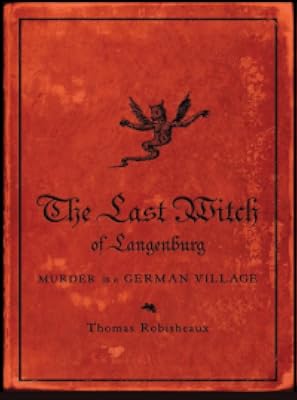
The Last Witch of Langenburg: Murder in a German Village
by Thomas Robisheaux 
On This Page
Description
Exploring one of Europe's last witch panics, historian Thomas Robisheaux brings to life the story of an entire world caught between superstition and modernity in a high-stakes drama that led to charges of sorcery and witchcraft against an entire family.Tags
Recommendations














Member Reviews
What a pot full of drama. The real account of Anna Schmeig focuses on the trial of an elderly woman accused of witch craft and murder. Well documented and well written, the story chronicles the drama that went on during her trial. Family relations, gossip, poison, jealousy, superstition and nearly anything else that can be crammed into a matter that sent shock waves across a small region of Lutheran Hamlets in Europe. Robisheaux uses a very clever narrative to paint a somber and chilling setting that will determine the fate of a family that simply cannot, does not and refuses to fit in to the society in which they live. Most of all it reminds us that none of us are immune to secrets and the weight they carry as we bear those skeletons show more throughout our lives. Toss in some religious zealotry and we have a real life tragedy. show less
The opening of this book is not what I expected. Unlike most accusations of witchcraft I've read, this one is not due to religious conflict, famine or plague, but rather murder! Anne Fessel, having recently given birth, is poisoned after eating a Shrove cake baked by one of her neighbors. Even if one didn't believe in witchcraft, the primary witnesses are right to suspect murder.
However, this isn't the modern era, but 1672, in the latter half of the witchcraze era. The suspects, quarrelsome Anna Schmieg and her daughter, Eva Kustner, are arrested. They are a milling family, so their access to rat poison (aka arsenic) is not implausible. Revealingy, Eva and Anna are not hesitant to accuse each other of the deed. The tension is palpable show more as old grudges resurface. Still, investigator von Gülchen, with an inconclusive physical examination of the body, can only prove "legal infamy", leaving witchcraft off the table unless confessed. And was Fessler actually the intended victim or a miscalculation? But public pressure reigns. More "witnesses" leads to more stories, the situation escalates and unravels. Years-old suspicions are revived and tales of previously convicted witches, like Barbara Reinhart and Turk Anna, convince the court of a conspiratorial ring of witches.
I won't give the exact details of the ending but turning on family to save your own skin? That's dark. The author does an excellent job in his examination of the trial and making it easy to follow along, even if it is repetitive at times. The backdrop of the Thirty Years War and local politics was well done. I'm also glad they included some post-trial drama, because as we know, a witch panic doesn't just vanish. It always leaves a residue. show less
However, this isn't the modern era, but 1672, in the latter half of the witchcraze era. The suspects, quarrelsome Anna Schmieg and her daughter, Eva Kustner, are arrested. They are a milling family, so their access to rat poison (aka arsenic) is not implausible. Revealingy, Eva and Anna are not hesitant to accuse each other of the deed. The tension is palpable show more as old grudges resurface. Still, investigator von Gülchen, with an inconclusive physical examination of the body, can only prove "legal infamy", leaving witchcraft off the table unless confessed. And was Fessler actually the intended victim or a miscalculation? But public pressure reigns. More "witnesses" leads to more stories, the situation escalates and unravels. Years-old suspicions are revived and tales of previously convicted witches, like Barbara Reinhart and Turk Anna, convince the court of a conspiratorial ring of witches.
I won't give the exact details of the ending but turning on family to save your own skin? That's dark. The author does an excellent job in his examination of the trial and making it easy to follow along, even if it is repetitive at times. The backdrop of the Thirty Years War and local politics was well done. I'm also glad they included some post-trial drama, because as we know, a witch panic doesn't just vanish. It always leaves a residue. show less
On Shrove Tuesday, 1672, in Langenburg, Germany, a young woman by the name of Eva Kustner brought a festive cake to her neighbor, Anna Fessler. Anna had recently given birth and as such, was still in delicate health, watched over by two other women constantly. Anna ate one of Eva’s cakes, but the rest were thrown away. Later that night, Anna began having convulsions and died. In the investigation that followed, blame fell on Anna Schmieg, Eva’s mother and the wife of the miller. Anna Schmieg had never been liked by her neighbors but had instead a reputation for alcoholism, nasty language, and cursing. It isn’t a stretch for them to accuse her of witchcraft and poisoning and throw her in prison. In this enlightening work of show more micro-history, Thomas Robisheaux explores Anna’s trial and sentencing as well as the larger political climate to give us a deeper look at accusations of witchcraft, the uncertain state of Germany after the Thirty Years’ War, and peasant culture in the late seventeenth century.
The broad concept of this book is fascinating. I had no idea that using one event to explore outlying themes was called micro-history but I love it. The trial of Anna Schmieg, as well as those of her daughter, husband, and fellow witches in other communities, was the focal point of this work, but so many interesting ideas are carefully considered. First, we are taught a little about village life. The miller was, naturally, an essential for every village, but was also rarely liked by townspeople. He could withhold grain, charge too much, or beef up his grain with sawdust and no one would ever know. He was also frequently richer than the average peasant. So suspicion falling on the miller’s wife, especially given Anna’s reputation and the coincidence of the cakes, is easily understood.
We also explore the reasons why Anna was found guilty and the potential thought process going through the heads of all the men involved, from the judge to the doctor who examined Anna Fessler’s body to the university authorities who were pulled in to pass judgement. This is all explained very carefully and I never felt lost or confused. Robisheaux explains everything he mentions and I felt that I learned a lot here about legal process, Protestantism and medical theory. It’s fascinating why people who had never seen Anna Fessler’s body decided that she’d died of arsenic poisoning and more still how the constant questions broke both Anna Schmieg and her daughter, horrible as that is, into confessing.
All of this, naturally, is wrapped up in the political struggles of The Holy Roman Empire and particular folk beliefs which caused the townspeople to react as they did. To some extent witchcraft was part of their culture and that made it even easier to single out those whose actions may have seemed entirely ordinary otherwise. With recent devastation behind them and threats on the horizon, people wanted someone to blame. Anna Schmieg was their scapegoat.
Never once does Thomas Robisheaux tell us outright his theory. Instead, he provides us with the evidence and allows us to draw our own conclusions. He doesn’t manipulate the evidence, but lays out the facts in a way that is understandable and interesting. There is no villainizing. Clearly, Anna Schmieg was not a witch, but she may have poisoned the cakes; they may have been intended for someone else, however, and not Anna Fessler. There are theories, but Robisheaux doesn’t force them on his reader. Instead we’re left with the feeling that we’ve learned something and, even better, that we want to learn more.
http://chikune.com/blog/?p=1113 show less
The broad concept of this book is fascinating. I had no idea that using one event to explore outlying themes was called micro-history but I love it. The trial of Anna Schmieg, as well as those of her daughter, husband, and fellow witches in other communities, was the focal point of this work, but so many interesting ideas are carefully considered. First, we are taught a little about village life. The miller was, naturally, an essential for every village, but was also rarely liked by townspeople. He could withhold grain, charge too much, or beef up his grain with sawdust and no one would ever know. He was also frequently richer than the average peasant. So suspicion falling on the miller’s wife, especially given Anna’s reputation and the coincidence of the cakes, is easily understood.
We also explore the reasons why Anna was found guilty and the potential thought process going through the heads of all the men involved, from the judge to the doctor who examined Anna Fessler’s body to the university authorities who were pulled in to pass judgement. This is all explained very carefully and I never felt lost or confused. Robisheaux explains everything he mentions and I felt that I learned a lot here about legal process, Protestantism and medical theory. It’s fascinating why people who had never seen Anna Fessler’s body decided that she’d died of arsenic poisoning and more still how the constant questions broke both Anna Schmieg and her daughter, horrible as that is, into confessing.
All of this, naturally, is wrapped up in the political struggles of The Holy Roman Empire and particular folk beliefs which caused the townspeople to react as they did. To some extent witchcraft was part of their culture and that made it even easier to single out those whose actions may have seemed entirely ordinary otherwise. With recent devastation behind them and threats on the horizon, people wanted someone to blame. Anna Schmieg was their scapegoat.
Never once does Thomas Robisheaux tell us outright his theory. Instead, he provides us with the evidence and allows us to draw our own conclusions. He doesn’t manipulate the evidence, but lays out the facts in a way that is understandable and interesting. There is no villainizing. Clearly, Anna Schmieg was not a witch, but she may have poisoned the cakes; they may have been intended for someone else, however, and not Anna Fessler. There are theories, but Robisheaux doesn’t force them on his reader. Instead we’re left with the feeling that we’ve learned something and, even better, that we want to learn more.
http://chikune.com/blog/?p=1113 show less
At long last, a microhistory done right! The Last Witch of Langenburg, by Thomas Robisheaux (W.W. Norton, 2009), is the rare book which manages to actually do what microhistories are supposed to do: use an individual case to "illustrate the function of the formal institutions in power and how they handle people’s affairs." In his preface Robisheaux says that he "wanted to use the narrative potential in microhistory to explore the multiple layers of experience and meaning important to understanding witchcraft" (p. 13).
Taking Anna Elisabeth Schmieg, a miller's wife accused of (and executed for) witchcraft in the German village of Hürden in the early 1670s, as his focal point, Robisheaux uses her richly-documented case to examine a show more tremendous variety of cultural and societal elements which played a role in the way she was treated by those who handled the accusations against her. Among these: the region's tense political and religious history, the role of millers in local society, local customs and superstitions, the backgrounds of local officials (including the court advisor, ministers, doctors and others), and so forth.
At the very moment when religious, legal and scientific worldviews were shifting in key ways, this case captures those changes to such an extent that it seems almost uncanny. From the court advisor's request for a "second opinion" from the law faculty of a university in another city when the first doesn't give him the answer he wants to the remote diagnosis of arsenic poisoning based solely on a description of the symptoms, Robisheaux manages to capture how these paradigm-shifts played into the Schmieg case in integral ways, shaping how the evidence was handled, how the suspect was treated at trial, and what happened after her execution.
Perhaps even more importantly, Robisheax takes the archival evidence of Schmieg's case and creates from a narrative that reads easily, like a good novel. Even the discourses of legal and scientific arcana are melded nicely into the book's narrative structure, and do not in any way take away from the flow of the story (in fact, I would go so far as to say that they enhance the book tremendously).
One of the best histories of witchcraft I've read, right up there with Mary Beth Norton's In the Devil's Snare.
http://philobiblos.blogspot.com/2009/02/book-review-last-witch-of-langenburg.htm... show less
Taking Anna Elisabeth Schmieg, a miller's wife accused of (and executed for) witchcraft in the German village of Hürden in the early 1670s, as his focal point, Robisheaux uses her richly-documented case to examine a show more tremendous variety of cultural and societal elements which played a role in the way she was treated by those who handled the accusations against her. Among these: the region's tense political and religious history, the role of millers in local society, local customs and superstitions, the backgrounds of local officials (including the court advisor, ministers, doctors and others), and so forth.
At the very moment when religious, legal and scientific worldviews were shifting in key ways, this case captures those changes to such an extent that it seems almost uncanny. From the court advisor's request for a "second opinion" from the law faculty of a university in another city when the first doesn't give him the answer he wants to the remote diagnosis of arsenic poisoning based solely on a description of the symptoms, Robisheaux manages to capture how these paradigm-shifts played into the Schmieg case in integral ways, shaping how the evidence was handled, how the suspect was treated at trial, and what happened after her execution.
Perhaps even more importantly, Robisheax takes the archival evidence of Schmieg's case and creates from a narrative that reads easily, like a good novel. Even the discourses of legal and scientific arcana are melded nicely into the book's narrative structure, and do not in any way take away from the flow of the story (in fact, I would go so far as to say that they enhance the book tremendously).
One of the best histories of witchcraft I've read, right up there with Mary Beth Norton's In the Devil's Snare.
http://philobiblos.blogspot.com/2009/02/book-review-last-witch-of-langenburg.htm... show less
 This review was written for LibraryThing Early Reviewers.
One of the best historical reads I've enjoyed in a long time. This very well-researched tome opened my eyes (and mind) to the difficulties of life in 1600's Germany. When I first started this book, I expected the usual indignant anger at the ignorance of the masses along with rage at the cruelty of the rulers of that day. Instead, I found myself looking at the situation from all viewpoints. This book is not about rulers who WANT to burn witches at the stake or true ignorance. Instead, it brings to life the realities of early Germany, reeling from war-time indignities and striving to become more modern. Who can believe that an autopsy would have been done on a supposed poison victim (killed by a witch intent on revenge) in the 1600s. show more Every step of the way the people in charge made sure that the accused got the most up-to-date investigatory and judicial tactics. What is a ruler to do when faced with unruly peasants who sincerely believe that a witch has been at work? It is not a matter that can be ignored, especially by the likes of Count Heinrich Friedrich, by all accounts a very considerate and attentive ruler.
The defendant was typical of women accused of such acts. She was not like the other women of her day, being too outspoken (given to swearing) and, I believe, an alcoholic. At times, she appears very gutsy, especially in her youth. Bitterness seemed to creep in with old age and possibly depression. This combined with the alcoholism made her a rather unlikeable person at times. At others, she seems suicidal and pitiful. I even played with the thoughts that she meant the poison for herself. There definitely is a mystery here, although I came to feel that she more than likely had nothing to do with it.
My money was on her daughter, who was so gung-ho on leaving behind the hostility of the town and her mother. While reading this book, I had viewed a true mystery show where a woman was poisoned. The description of the results of this present day autopsy matched so well with the description of the autopsy in this book, that I sincerely believe the victim WAS poisoned! This threw me into a tailspin. Prior to this, I was sure the woman must have died of complications from the early childbirth. It is a puzzle now that haunts me. This whole book haunts me. I find myself wanting to know more about a time period I never really cared about in a country that I would not have thought so intriguing in that era. Kudos, to the author. I find myself wanting to seek out his other book on this time period in Germany. There is so much more I want to know now. That to me is the sign of a good author! show less
The defendant was typical of women accused of such acts. She was not like the other women of her day, being too outspoken (given to swearing) and, I believe, an alcoholic. At times, she appears very gutsy, especially in her youth. Bitterness seemed to creep in with old age and possibly depression. This combined with the alcoholism made her a rather unlikeable person at times. At others, she seems suicidal and pitiful. I even played with the thoughts that she meant the poison for herself. There definitely is a mystery here, although I came to feel that she more than likely had nothing to do with it.
My money was on her daughter, who was so gung-ho on leaving behind the hostility of the town and her mother. While reading this book, I had viewed a true mystery show where a woman was poisoned. The description of the results of this present day autopsy matched so well with the description of the autopsy in this book, that I sincerely believe the victim WAS poisoned! This threw me into a tailspin. Prior to this, I was sure the woman must have died of complications from the early childbirth. It is a puzzle now that haunts me. This whole book haunts me. I find myself wanting to know more about a time period I never really cared about in a country that I would not have thought so intriguing in that era. Kudos, to the author. I find myself wanting to seek out his other book on this time period in Germany. There is so much more I want to know now. That to me is the sign of a good author! show less
This review was written for LibraryThing Early Reviewers.In The Last Witch of Langenburg: Murder in a German Village, Thomas Robisheaux recounts the case of Anna Schmieg, accused of poisoning her neighbor and being a witch in 1672. Robisheaux uses the case to examine the socio-political workings of the justice system in the early-modern Holy Roman Empire, which strove to balance the new Carolina legal code with Lutheran beliefs and a medical system that increasingly relied on physical evidence while still ascribing to Galenic philosophy. Add to this the changing political realities in the Holy Roman Empire’s states imposed through the Peace of Westphalia, the levels of bureaucracy at work in investigating and prosecuting the crime, previous witchcraft panics, village gossip, and the show more solicited opinions of contemporary medical and legal scholars, all of which add up to a multifaceted narrative that speaks volumes about early modern European life. Robisheaux draws upon all of these records, dramatically recounting events that contemporaries had recorded in detail and which he uncovered, contextualized, and shared with the scholarly community. A great read for scholars and lay-readers interested in the topics of Robisheaux’s study. show less
B.A.B.A.E.L.
The Last Witch of Langenburg is a fascinating look at the mechanics of witch trials as well as an interesting account of one of the latest convictions of a woman for witchcraft. Perhaps one of the more interesting things, and a blessing for readers, is how well-documented the trial is and author Thomas Robisheaux delivers this bounty of information in a very engaging narrative. While it is historical non-fiction, it reads, at times, like an historical thriller.
Robisheaux makes the smart move of diving immediately into the story, beginning with the miller's daughter, Eva Küstner traveling around her village delivering small cakes for the holiday of Shrove Tuesday, Mardi Gras' more tame cousin. From court testimony, we learn show more of her neighbor's deep suspicions about the delivery of the cakes, which will help lead to the accusation of witchcraft. Then the dramatic death of villager Anna Fessler the evening after eating one of her cakes seals the deal. It is only then that Robisheaux goes into some of the more dry background details of the holiday of Shrove Tuesday, the tradition of baking cakes for it, and why witchcraft, rather than simple murder by poisoning, was Küstner's neighbors' conclusion. A wise decision, I think, to begin with the dramatic, involving the reader before moving on to some of the more academic material.
Robisheaux continues in this vein, giving the reader a bit of the story and a bit of the background as the town's leaders and citizens become embroiled in the investigation of witchcraft. Most fascinating to the modern reader is the contrast between the rising notion of justice, fair trials, forensics, and the consultation of scientific experts, versus the almost medieval notion of witchcraft. How the contemporary town leaders reconciled the two makes for a great narrative and one that Robisheaux explores to its fullest. Luckily for the reader, it is also this commitment to the proper legal process that produces all the documents that make this account such a full story. Rather than relying on speculation and reconstruction based on typical attitudes of the time, we get to hear the opinions and statements of the persons involved in their own words, a treat not often found in accounts of persons not royal of very famous in their times.
I also appreciate that Robisheaux mostly sticks to information relevant to the case. Although some of the information about the Thirty Years War, for instance, was a little dry, it was also very necessary background information. However, because of this, I would not recommend this book to anyone who does not usually enjoy reading historical non-fiction. While as a reader of both historical fiction and nonfiction I appreciated the narrative portions of the story and the attempt to create a more dramatic development, this book is firmly rooted in the world of practical, academic information. However, for those who are interested in history, witchcraft, the justice system, or simply looking for a great history book, The Last Witch of Langenburg is a very satisfying story that will certainly fit the bill. show less
The Last Witch of Langenburg is a fascinating look at the mechanics of witch trials as well as an interesting account of one of the latest convictions of a woman for witchcraft. Perhaps one of the more interesting things, and a blessing for readers, is how well-documented the trial is and author Thomas Robisheaux delivers this bounty of information in a very engaging narrative. While it is historical non-fiction, it reads, at times, like an historical thriller.
Robisheaux makes the smart move of diving immediately into the story, beginning with the miller's daughter, Eva Küstner traveling around her village delivering small cakes for the holiday of Shrove Tuesday, Mardi Gras' more tame cousin. From court testimony, we learn show more of her neighbor's deep suspicions about the delivery of the cakes, which will help lead to the accusation of witchcraft. Then the dramatic death of villager Anna Fessler the evening after eating one of her cakes seals the deal. It is only then that Robisheaux goes into some of the more dry background details of the holiday of Shrove Tuesday, the tradition of baking cakes for it, and why witchcraft, rather than simple murder by poisoning, was Küstner's neighbors' conclusion. A wise decision, I think, to begin with the dramatic, involving the reader before moving on to some of the more academic material.
Robisheaux continues in this vein, giving the reader a bit of the story and a bit of the background as the town's leaders and citizens become embroiled in the investigation of witchcraft. Most fascinating to the modern reader is the contrast between the rising notion of justice, fair trials, forensics, and the consultation of scientific experts, versus the almost medieval notion of witchcraft. How the contemporary town leaders reconciled the two makes for a great narrative and one that Robisheaux explores to its fullest. Luckily for the reader, it is also this commitment to the proper legal process that produces all the documents that make this account such a full story. Rather than relying on speculation and reconstruction based on typical attitudes of the time, we get to hear the opinions and statements of the persons involved in their own words, a treat not often found in accounts of persons not royal of very famous in their times.
I also appreciate that Robisheaux mostly sticks to information relevant to the case. Although some of the information about the Thirty Years War, for instance, was a little dry, it was also very necessary background information. However, because of this, I would not recommend this book to anyone who does not usually enjoy reading historical non-fiction. While as a reader of both historical fiction and nonfiction I appreciated the narrative portions of the story and the attempt to create a more dramatic development, this book is firmly rooted in the world of practical, academic information. However, for those who are interested in history, witchcraft, the justice system, or simply looking for a great history book, The Last Witch of Langenburg is a very satisfying story that will certainly fit the bill. show less
This review was written for LibraryThing Early Reviewers.Members
- Recently Added By
Lists

All Things Germany
321 works; 4 members
Author Information

2 Works 182 Members
Thomas Robisheaux is a LibraryThing Author, an author who lists their personal library on LibraryThing.
Common Knowledge
- Original publication date
- 2009
- People/Characters
- Eva Kustner; Hans Barthel Walther; Appolonia Huebmann; Michel Fessler; Anna Fessler; Barbara Truckenmuller (show all 33); Turk Anna; Margaretha Kustner; Hans Albrecht Unfug; Anna Heinckelin; Georg Heinckelin; Anna Schmeig; Georg Friedrich Assum; Johann Georg Waldman; Dr. Andreas Thym; Werner Daniel Sennert; Dr. Tobias Ulrich von Gulchen; Hans Barthel Walther; Count Heinrich Friedrich; Count Pastor Ludwig Casimir Dietzel; Sebastian Lampert; Georg Kefer; Hans Haffner; Hans Schmeig; Johann Conrad Hohenbuch; Master Endris Fuchs; Daniel Hauff; Barbara Reinhart; Philip Kustner; Ernst Cregel; Johann Christoph Wagenseil; Johann Wolfgang Textor; Barbara Fleisch
- Important places
- Bachlingen, Schwäbisch Hall, Baden-Württemberg, Germany; Langenburg, Schwäbisch Hall, Baden-Württemberg, Germany; Unterregenbach, Schwäbisch Hall, Baden-Württemberg, Germany; Hohenlohe-Langenburg, Baden-Württemberg, Germany; Amlishagen, Gerabronn, Schwäbisch Hall, Baden-Württemberg, Germany; Esslingen, Landkreis, Baden-Württemberg, Germany (show all 8); University of Altdorf, Altdorf bei Nürnberg, Germany; Hurden, Freienbach, Schwyz, Switzerland
- Important events
- Hohenlohe Police Ordinance (1588); Thirty Years' War (1618 | 1648); Peace of Westphalia (24-10-1648)
- Epigraph
- How much can we ever know about the love and pain in another's heart? How much can we hope to understand those who have suffered deeper anguish, greater deprivation, and more crushing disappointments than we ourselves have k... (show all)nown? Even if the world's rich and powerful were to put themselves in the shoes of the rest, how much would they really understand the wretched millions suffering around them? - Orhan Pamuk, Snow * When have I last looked on The round green eyes and the long wavering bodies Of the dark leopards of the moon? All the wild witches, those most noble ladies, For all their broom-sticks and their tears, Their angry tears, are gone. The holy centaurs of the hills are vanished... - W.B. Yeats, Lines Written in Dejection * These days the names of the dead cast long shadows across our memories, and the silence of a lonely God can be heard in the whispering of the wind. - Gottlob Haag, Lieft ein Dorf in Hohenlohe
- Dedication
- For Lea Pierre Angelique, my Luxembourgish rose
- First words
- I first heard about the "witch of Hurden" in the summer of 1994.
- Quotations
- You can't sit on everyone's mouth. People will say whatever they want. - Anna Schmeig
- Last words
- (Click to show. Warning: May contain spoilers.)She was "the witch of Hurden," a vague memory of the woman who once lived at the mill.
- Blurbers
- Boyer, Paul
Classifications
- Genres
- Nonfiction, History, Religion & Spirituality, General Nonfiction
- DDC/MDS
- 133.10943471 — Philosophy & psychology Parapsychology & occultism Specific topics in parapsychology and occultism Apparitions Europe
- LCC
- BF1583 .R63 — Philosophy, Psychology and Religion Psychology Occult sciences Witchcraft
- BISAC
Statistics
- Members
- 173
- Popularity
- 189,788
- Reviews
- 16
- Rating
- (4.02)
- Languages
- English
- Media
- Paper, Ebook
- ISBNs
- 3
- ASINs
- 4