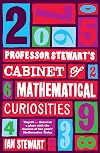
On This Page
Description
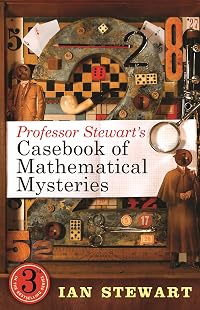
A collection of intriguing mathematical games, puzzles, stories, and factoids that reveal hidden gems of logic, geometry, and probability.Tags
Recommendations










Member Reviews
Unfortunately this book tries to be a lot of things and fails, unlike many other excellent books by Prof. Stewart. If you want to read good and inspiring biographies of mathematicians there are very good books focused on that topic, if you are into recreational mathematics then you can easily consult excellent volumes e.g. the ones from Martin Gardner and if you want to read mathematical jokes... well, I'm sure you don't need a book for that (do you?). The level of topics discussed vary wildly, from high school algebra to university-level calculus and complex analysis. Even the author himself admits in some pages that the current topic is too technical to describe in a few sentences, so why start to talk about it in the first place? I show more do not regret having bought and read this book even though I came very close to thinking so. show less
there's no end of science/history/philosophy/[insert academic subject here] books that breathes life into these otherwise tedious fields of knowledge, essentially bringing them closer to the general populace by highlighting their more interesting facets. on the other hand, there seem to be a shortage of such books for maths...one that will not only make maths curious, but also enjoyable (albeit it took me nearly 6 months to finish enjoying this short book).
professor stewart's cabinet of mathematical curiosities accomplishes that for me. it makes maths wonderful, more like puzzles with solutions that fit so nicely they make you smile even if you had to cheat and see the answer at the end of the book after pondering the problem yourself show more for all of 5 minutes, and less than the most hated and feared subject back in high school (and beyond). it is also littered with math-themed tidbits one would most likely never have the opportunity (or reason) to look up even during the most lethargic days (A Game Of Life, anyone? ).
now i've finally put paid on this book, i have of course forgotten 98.2% of what it was all about, or what it talked about for 250 pages...but i still have that lingering 'smart' feeling one gets after reading a book with 'math' in the title. show less
professor stewart's cabinet of mathematical curiosities accomplishes that for me. it makes maths wonderful, more like puzzles with solutions that fit so nicely they make you smile even if you had to cheat and see the answer at the end of the book after pondering the problem yourself show more for all of 5 minutes, and less than the most hated and feared subject back in high school (and beyond). it is also littered with math-themed tidbits one would most likely never have the opportunity (or reason) to look up even during the most lethargic days (A Game Of Life, anyone? ).
now i've finally put paid on this book, i have of course forgotten 98.2% of what it was all about, or what it talked about for 250 pages...but i still have that lingering 'smart' feeling one gets after reading a book with 'math' in the title. show less
It is a curious thing about most journalists that although many of them are excessively well educated [it’s the perfect profession for professional students who don’t want to teach] few have much proficiency in the sciences.
My maths teacher told me mathematics was a subject I would use all my life: I am happy to report that while I use my old friend arithmetic every day, I have not crossed paths with his complex younger brother since matric.
I loved Maths – alas the love was unrequited – so any book that states in the introduction: ‘The maths you did at school is not all of it’ is bound to grab my attention, especially when it continues ‘the maths you didn’t do at school is interesting. In fact, a lot of it is fun.’
An show more essential read for all those who need numbers, love logic, pursue puzzles and adore order – but were mathematical morons: no extensive knowledge of theorems and formulas is required, just common sense and a methodical mind-set.
Ian Stewart, a prolific writer and professor of Mathematics at the University of Warwick, is best known for making maths accessible and popular: when he was 14 he started a notebook detailing every interesting thing he could find out about maths.
Over the years his notebook grew into a series of six then expanded to fill an entire filing cabinet: “‘Curiosities’ is a sample from my cabinet, a miscellany of intriguing mathematical games, puzzles, stories and factoids.”
The book takes the form of a long series of puzzles and stories, followed at the end by an answer section. The earlier questions are not too difficult but as the pages turn so the riddles become more challenging.
The author’s stated intention is to ‘excite your imagination by showing you lots of amusing and intriguing pieces of mathematics. I want you to have fun…’
Definitions of fun vary of course and what might cause waves of hilarity to envelop a maths geek pretty much left me cold – my maths simply wasn’t good enough for me to get the joke. I enjoyed the book however and recommend it highly.
Maths riddle: The Emperor Scrumptius was born in 35BC and died on his birthday in 35AD. What was his age when he died?
Maths puzzle: place a standard mathematical symbol between four and five to get a number greater than four but less than five.
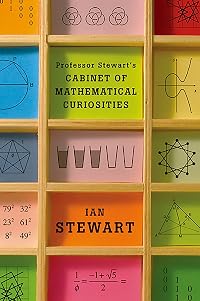
Maths brainteaser: I have five glasses in a row. The first three are full and the other two empty. How can I arrange them so they are alternately full and empty by moving only one glass?
But enough serious stuff – let’s move onto the ‘funnies’.
Maths joke: only an elephant or a whale gives birth to a creature that weighs more than 100 kilograms. President Zuma weighs more than 100 kilograms, therefore…
Another maths joke: Why did the chicken cross the Mobius band?
To get to the other… um…
Wipe away the tears of laughter because I’ve saved the best for last: There are 10 kinds of people in the world: those who understand binary numerals, and those who don’t.
And finally: There are three kinds of people in the world:
Those who can count,
And those who can’t. show less
My maths teacher told me mathematics was a subject I would use all my life: I am happy to report that while I use my old friend arithmetic every day, I have not crossed paths with his complex younger brother since matric.
I loved Maths – alas the love was unrequited – so any book that states in the introduction: ‘The maths you did at school is not all of it’ is bound to grab my attention, especially when it continues ‘the maths you didn’t do at school is interesting. In fact, a lot of it is fun.’
An show more essential read for all those who need numbers, love logic, pursue puzzles and adore order – but were mathematical morons: no extensive knowledge of theorems and formulas is required, just common sense and a methodical mind-set.
Ian Stewart, a prolific writer and professor of Mathematics at the University of Warwick, is best known for making maths accessible and popular: when he was 14 he started a notebook detailing every interesting thing he could find out about maths.
Over the years his notebook grew into a series of six then expanded to fill an entire filing cabinet: “‘Curiosities’ is a sample from my cabinet, a miscellany of intriguing mathematical games, puzzles, stories and factoids.”
The book takes the form of a long series of puzzles and stories, followed at the end by an answer section. The earlier questions are not too difficult but as the pages turn so the riddles become more challenging.
The author’s stated intention is to ‘excite your imagination by showing you lots of amusing and intriguing pieces of mathematics. I want you to have fun…’
Definitions of fun vary of course and what might cause waves of hilarity to envelop a maths geek pretty much left me cold – my maths simply wasn’t good enough for me to get the joke. I enjoyed the book however and recommend it highly.
Maths riddle: The Emperor Scrumptius was born in 35BC and died on his birthday in 35AD. What was his age when he died?
Maths puzzle: place a standard mathematical symbol between four and five to get a number greater than four but less than five.
Maths brainteaser: I have five glasses in a row. The first three are full and the other two empty. How can I arrange them so they are alternately full and empty by moving only one glass?
But enough serious stuff – let’s move onto the ‘funnies’.
Maths joke: only an elephant or a whale gives birth to a creature that weighs more than 100 kilograms. President Zuma weighs more than 100 kilograms, therefore…
Another maths joke: Why did the chicken cross the Mobius band?
To get to the other… um…
Wipe away the tears of laughter because I’ve saved the best for last: There are 10 kinds of people in the world: those who understand binary numerals, and those who don’t.
And finally: There are three kinds of people in the world:
Those who can count,
And those who can’t. show less
This book includes a random hodge-podge of different articles from a few lines to a few pages, all connected by some link (occasionally a little tenuous) with mathematics. There are mainly wordy logic-type puzzles, as you'd find in a puzzle book (for instance, how do you ferry 3 couples across a river with one boat, without leaving any woman with an unmarried man), and some jokes, but there are also interesting titbits, anecdotes and some more weighty articles on central mathematical themes. In some ways this is the ideal toilet book (meant as a compliment!), because so many of the articles are bitesize and unconnected with the others, but keep you entertained for a few head-scratching minutes.
What this book does very well is whet the show more appetite of someone afraid of, or new to mathematics outside of school lessons. But if you've read Ian Stewarts other books before, you might find quite a few passages or topics sound rather familiar. And the very unstructured nature of the book doesn't make for satisfying reading for anyone wanting an overview of maths, or seeking the central themes in the field. I also found, on occasion, the articles unsatisfying because the puzzles were infuriating, or the explanations had to go into maths way beyond a layperson's viewpoint.
On the whole, though, it was fun, light, entertaining stuff, and I'm looking forward to the sequel, which will be a welcome sight whenever I go to the loo! show less
What this book does very well is whet the show more appetite of someone afraid of, or new to mathematics outside of school lessons. But if you've read Ian Stewarts other books before, you might find quite a few passages or topics sound rather familiar. And the very unstructured nature of the book doesn't make for satisfying reading for anyone wanting an overview of maths, or seeking the central themes in the field. I also found, on occasion, the articles unsatisfying because the puzzles were infuriating, or the explanations had to go into maths way beyond a layperson's viewpoint.
On the whole, though, it was fun, light, entertaining stuff, and I'm looking forward to the sequel, which will be a welcome sight whenever I go to the loo! show less
A few short items -- on the four-color theorem, Fermat's Last Theorem, Fibonacci numbers, chaos theory, the Poincaré Conjecture, fractals, the Riemann Hypothesis, the game of Life, the Kepler problem, complexity science -- afloat in a large sea of *really* short items. Stewart never writes a dull book.
Great fun.
Silly, serious and everything in between to do with Maths. Dip into it or, if you are sad like me, read it cover to cover.
No maths ability required.
Silly, serious and everything in between to do with Maths. Dip into it or, if you are sad like me, read it cover to cover.
No maths ability required.
Professor Stewart speaks of a number of mathematical curiosities and puzzles with solutions. Among them are the Monty Hall Problem, the Riemann Hypothesis and other things that are interesting. While it is heavy on math, some of the problems only require simple logic to figure out. Just a disclaimer, it doesn't solve the Riemann Hypothesis, it only discusses it.
Members
- Recently Added By
Lists

HS Mathematics class library
79 works; 6 members
Author Information

89+ Works 20,241 Members
Ian Stewart is a professor emeritus of mathematics at the University of Warwick. The author of numerous books on math, he has written for New Scientist, Discover, and Scientific American, among other publications in the United Kingdom and the United States. He lives in Coventry, England.
Some Editions
Awards and Honors
Notable Lists
Series

Common Knowledge
- Canonical title
- Professor Stewart's Cabinet of Mathematical Curiosities
- Original title
- Professor Stewart's cabinet of mathematical curiosities
- Original publication date
- 2008
- First words
- There are three kinds of people in the world: those who can count, and those who can't.
Classifications
Statistics
- Members
- 751
- Popularity
- 37,471
- Reviews
- 11
- Rating
- (3.66)
- Languages
- 10 — Czech, Dutch, English, French, German, Italian, Polish, Portuguese, Spanish, Turkish
- Media
- Paper, Ebook
- ISBNs
- 26
- ASINs
- 6