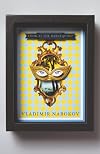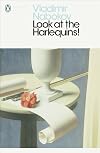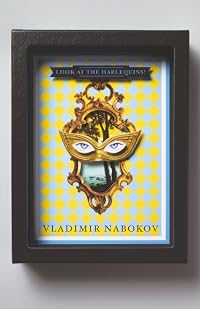
Look at the Harlequins!
by Vladimir Nabokov
On This Page
Description
As intricate as a house of mirrors, Nabokov's last novel is an ironic play on the Janus-like relationship between fiction and reality. It is the autobiography of the eminent Russian-American author Vadim Vadimovich N. (b. 1899), whose life bears an uncanny resemblance to that of Vladimir Vladimirovich Nabokov, though the two are not to be confused (?). Focusing on the central figures of his life -- his four wives, his books, and his muse, Dementia -- the book leads us to suspect that the show more fictions Vadim has created as an author have crossed the line between his life's work and his life itself, as the worlds of reality and literary invention grow increasingly indistinguishable. One of the twentieth century's master prose stylists, Vladimir Nabokov was born in St. Petersburg in 1899. He studied French and Russian literature at Trinity College, Cambridge, then lived in Berlin and Paris, where he launched a brilliant literary career. In 1940 he moved to the United States, and achieved renown as a novelist, poet, critic, and translator. He taught literature at Wellesley, Stanford, Cornell, and Harvard. In 1961 he moved to Montreux, Switzerland, where he died in 1977. "One of the greatest masters of prose since Conrad." -- Harper's show lessTags
Recommendations







Member Reviews
Nabokov's last novel is such an twisting, intriguing maze of a text, and one that benefits so strongly from having read his entire catalog of novels, that it is a fitting coda to a distinguished career.
The conceit of the novel -- that it is the autobiography of an author whose works end up resembling, in increasingly disturbing ways, those of Vladimir Nabokov himself -- appears at first like it is the only thing that would drive the work, that without that gimmick the novel would have little substance. Yet the unspoken Nabokov's obvious presence is so limited that we allow ourselves, as readers, to be legitimately drawn into Vadim Vadimovich's world.
VV's story is surprisingly compelling, tracing a lifetime of assorted writings and show more loves, and as the novel progresses, and more obvious gestures are made towards Nabokov's works, the mental challenge of separating the real from the fictional (or even just determining which is which) becomes part of the fun. The long sequence regarding VV's relationship with his daughter Bel, and her inspiration for his novel A Kingdom by the Sea is exceptionally inspired.
By the end, even though the reader may need to look the text over a few times to figure out what is actually happening, the challenge of the text has been so well wrought-out that it feels less like undue frustration or a cheater's way out than it does the work of a master manipulating his readers in specific, calculated ways.
The benefits of this novel increase exponentially if you've read lots of Nabokov before this, but even without that knowledge, this is a multilayered, metaphysical novel filled with erudition, humor, and narrative tricks to savor. show less
The conceit of the novel -- that it is the autobiography of an author whose works end up resembling, in increasingly disturbing ways, those of Vladimir Nabokov himself -- appears at first like it is the only thing that would drive the work, that without that gimmick the novel would have little substance. Yet the unspoken Nabokov's obvious presence is so limited that we allow ourselves, as readers, to be legitimately drawn into Vadim Vadimovich's world.
VV's story is surprisingly compelling, tracing a lifetime of assorted writings and show more loves, and as the novel progresses, and more obvious gestures are made towards Nabokov's works, the mental challenge of separating the real from the fictional (or even just determining which is which) becomes part of the fun. The long sequence regarding VV's relationship with his daughter Bel, and her inspiration for his novel A Kingdom by the Sea is exceptionally inspired.
By the end, even though the reader may need to look the text over a few times to figure out what is actually happening, the challenge of the text has been so well wrought-out that it feels less like undue frustration or a cheater's way out than it does the work of a master manipulating his readers in specific, calculated ways.
The benefits of this novel increase exponentially if you've read lots of Nabokov before this, but even without that knowledge, this is a multilayered, metaphysical novel filled with erudition, humor, and narrative tricks to savor. show less
The two-star rating here is disingenuous: I enjoyed reading this a lot more than I enjoyed reading most of the two-star books on my shelf. Nonetheless, more than two stars wouldn't seem right. Here's why.
Saul Maloff concludes his review of LATH! thus:
But novels are not composed of beautiful sentences. Occasionally--perhaps especially when he has stunned us with his performance in sentence after sentence--we long for a huge, lumbering, sweating, grunting workhorse of a sentence that will ploddingly perfom the brute labor of bearing its terrible, necessary burden from here to there. But of course getting "there" is not the point of Vadim's [LATH!'s narrator's] novel; the point lies in the elaboration of fantastic, fugal designs, gorgeous show more patterns and textures, all with contemptuous grace and virtuosity. Such art is in the essence and by disdainful intention decadent, flung in the faces of the "facetious criticules in the Sunday papers" who charge him with "aristocratic obscurity." Nabokov is our great decadent, our reigning mandarin and eccentric, a supreme, determinedly minor artist whom major ones might well envy while criticules continue to carp and gnash the stubs of their teeth.
Here's the Nabokov problem in a nutshell: how to square his "determinedly minor" nature with the apparently major ambition and, arguably, quality of much of his work. On one side there's Nabokov the nerd, the pedant, the crank -- the funny little man, "mandarin and eccentric," who insists on reminding us again and again of his funny little obsessions, his chess problems, his distaste for Freud and (bafflingly) Einstein, his vague mystical theories of time and space, his opinions about translation, etc. On the other side there's Nabokov the great novelist -- the guy who wrote Lolita, which might well be the prototypical Great Modern Novel. Nabokov the nerd says that morality does not concern him; Nabokov the great novelist writes the perfect (too perfect) subject matter for undergraduate essays on morality and irony (I don't mean that derisively). Nabokov the great novelist plucks the heartstrings with practically unequalled virtuosity; Nabokov the nerd, when confronted, denies any responsibility for his double's behavior and warms up that old, very old, very tedious lecture on how it's not the heart that is affected by great literature, and not the brain either, but the spine. . . .
Both sides, "major" and "minor," are present (in various mixtures and dialectical arrangements) in all his work, though the minor side dominates in the interviews and essays, which confuses matters greatly. For me -- just speaking personally -- the appeal of the Nabokov brand lies not in either side, but precisely in the mottled mixture of the two, the music made by the interleaving of major and minor. The great novelist brings in all his heavy weaponry, but just as his glorious gun show is really getting started, the deafening sound of the shots vanishes and is replaced by the quiet, smug little voice of the nerd, telling you about his latest chess move, about a butterfly that pretends to be another butterfly, about bad translations of Eugene Onegin. Soaring passages run aground, caught in sudden unexpected eddies of arcana. This isn't a defect -- the fun is precisely in seeing someone so very good get away with so much mischief. The nerd conquers the literary world and puts up banners everywhere reminding people of his fiddly obsessions. The reader smiles, and wants to say: if you can't beat him, join him. One can certainly imagine less endearing world-conquerors.
For me the height of this act is the very long and odd Ada, the simultaneous climax (given the novel in question the innuendo is not gratuitous) of the major and minor Nabokovs. It's undoubtedly major -- it aspires to be a parodic-romantic-horrific-lyrical capstone on the whole history of the novel -- and yet defiantly, absurdly, hilariously minor, treating at unprecedented length and with unprecedented indulgence the nerd's fixations. The revenge of the nerds! A lot of people, though, see Ada as the point where Nabokov finally went off the rails completely. Where I see a subtle and devious wreathing of the major and minor, they see the submission of the former to the cancerous growth of the latter. It's this disagreement that led me to LATH!, which by every account is a lesser ("minor"?) Nabokov novel, his last, the end of the road to nowhere he began treading with Ada. Given how much I'd previously enjoyed following Nabokov down that road, LATH! seemed at least worth a try.
At this point, the problem with LATH! is easy to state: it's all minor. It's a pile of Nabokov fanboy trivia and ephemera, with no grand ambition (when it's only in the context of grand ambition that the trivia becomes fun). The book is a first-person account of the life of a novelist named Vadim, and the whole thing is a comedic riff on Nabokov's own life. Vadim's own books are mirror-universe versions of Nabokov's own (where N's first English novel is The Real Life of Sebastian Knight, Vadim's is "See Under Real," which sounds from his description like a hybrid of RLSK and Pale Fire). Vadim's life is little but a series of injokes about Nabokov's books, and about the speculations that have been made about his life on the basis of his books. Like many Nabokov protagonists, Vadim is insane. Unlike most of his predecessors, he knows he's insane, and makes a point of delivering a long speech about his condition to any woman who might consider marrying him. The joke is that Vadim's condition -- an Oliver Sacksian quirk of visual imagination that leads him unable to imagine performing an about face -- is so trivial and uninteresting that these speeches are pointless. In terms of dramatic potential, we're a long way from Cincinnatus or Kinbote. (And in that difference we can glimpse the smirk of the nerd. "Who cares about dramatic potential? I write what I write, and either you feel it in your spine or you don't.")
A few good jokes, a few good lines . . . but even the writing style is dimming here. Too much reliance, for instance, on unexpected reversals of conventional phrases. On page 85: "I consistently try to dwell as lightly as inhumanly possible . . . " Only three pages later: ". . . on that particular night on the fourth or fifth or fiftieth anniversary of my darling's death . . . " These little twists, trapdoors of prose, can induce a heady vertigo when used judiciously, when there is some sort of solid ground for them to undermine. Here, there's no reason to care. So what if Vadim is unreliable or inhuman or I don't know what? What is there here to be reliable about?
The book's title first appears in the text in this wonderful passage, which I'm sure will remain in my memory when everything else about LATH! has faded:
An extraordinary grand-aunt, Baroness Bredow, born Tolstoy, amply replaced closer blood. As a child of seven or eight, already harboring the secrets of a confirmed madman, I seemed even to her (who also was far from normal) unduly sulky and indolent; actually, of course, I kept daydreaming in a most outrageous fashion.
"Stop moping!" she would cry: "Look at the harlequins!"
"What harlequins? Where?"
"Oh, everywhere. All around you. Trees are harlequins, words are harlequins. So are situations and sums. Put two things together -- jokes, images -- and you get a triple harlequin. Come on! Play! Invent the world! Invent reality!"
I did. By Jove, I did. I invented my grand-aunt in honor of my first daydreams, and now, down the marble steps of memory's front porch, here she slowly comes, sideways sideways, the poor lame lady, touching each step edge with the rubber tip of her black cane.
"Stop moping! Look at the harlequins!": a good mantra, and a reminder of the comfort that minorness can provide in a sometimes oppressively major world. But as for this novel? A reader interested in obeying the injunction should probably look elsewhere. show less
Saul Maloff concludes his review of LATH! thus:
But novels are not composed of beautiful sentences. Occasionally--perhaps especially when he has stunned us with his performance in sentence after sentence--we long for a huge, lumbering, sweating, grunting workhorse of a sentence that will ploddingly perfom the brute labor of bearing its terrible, necessary burden from here to there. But of course getting "there" is not the point of Vadim's [LATH!'s narrator's] novel; the point lies in the elaboration of fantastic, fugal designs, gorgeous show more patterns and textures, all with contemptuous grace and virtuosity. Such art is in the essence and by disdainful intention decadent, flung in the faces of the "facetious criticules in the Sunday papers" who charge him with "aristocratic obscurity." Nabokov is our great decadent, our reigning mandarin and eccentric, a supreme, determinedly minor artist whom major ones might well envy while criticules continue to carp and gnash the stubs of their teeth.
Here's the Nabokov problem in a nutshell: how to square his "determinedly minor" nature with the apparently major ambition and, arguably, quality of much of his work. On one side there's Nabokov the nerd, the pedant, the crank -- the funny little man, "mandarin and eccentric," who insists on reminding us again and again of his funny little obsessions, his chess problems, his distaste for Freud and (bafflingly) Einstein, his vague mystical theories of time and space, his opinions about translation, etc. On the other side there's Nabokov the great novelist -- the guy who wrote Lolita, which might well be the prototypical Great Modern Novel. Nabokov the nerd says that morality does not concern him; Nabokov the great novelist writes the perfect (too perfect) subject matter for undergraduate essays on morality and irony (I don't mean that derisively). Nabokov the great novelist plucks the heartstrings with practically unequalled virtuosity; Nabokov the nerd, when confronted, denies any responsibility for his double's behavior and warms up that old, very old, very tedious lecture on how it's not the heart that is affected by great literature, and not the brain either, but the spine. . . .
Both sides, "major" and "minor," are present (in various mixtures and dialectical arrangements) in all his work, though the minor side dominates in the interviews and essays, which confuses matters greatly. For me -- just speaking personally -- the appeal of the Nabokov brand lies not in either side, but precisely in the mottled mixture of the two, the music made by the interleaving of major and minor. The great novelist brings in all his heavy weaponry, but just as his glorious gun show is really getting started, the deafening sound of the shots vanishes and is replaced by the quiet, smug little voice of the nerd, telling you about his latest chess move, about a butterfly that pretends to be another butterfly, about bad translations of Eugene Onegin. Soaring passages run aground, caught in sudden unexpected eddies of arcana. This isn't a defect -- the fun is precisely in seeing someone so very good get away with so much mischief. The nerd conquers the literary world and puts up banners everywhere reminding people of his fiddly obsessions. The reader smiles, and wants to say: if you can't beat him, join him. One can certainly imagine less endearing world-conquerors.
For me the height of this act is the very long and odd Ada, the simultaneous climax (given the novel in question the innuendo is not gratuitous) of the major and minor Nabokovs. It's undoubtedly major -- it aspires to be a parodic-romantic-horrific-lyrical capstone on the whole history of the novel -- and yet defiantly, absurdly, hilariously minor, treating at unprecedented length and with unprecedented indulgence the nerd's fixations. The revenge of the nerds! A lot of people, though, see Ada as the point where Nabokov finally went off the rails completely. Where I see a subtle and devious wreathing of the major and minor, they see the submission of the former to the cancerous growth of the latter. It's this disagreement that led me to LATH!, which by every account is a lesser ("minor"?) Nabokov novel, his last, the end of the road to nowhere he began treading with Ada. Given how much I'd previously enjoyed following Nabokov down that road, LATH! seemed at least worth a try.
At this point, the problem with LATH! is easy to state: it's all minor. It's a pile of Nabokov fanboy trivia and ephemera, with no grand ambition (when it's only in the context of grand ambition that the trivia becomes fun). The book is a first-person account of the life of a novelist named Vadim, and the whole thing is a comedic riff on Nabokov's own life. Vadim's own books are mirror-universe versions of Nabokov's own (where N's first English novel is The Real Life of Sebastian Knight, Vadim's is "See Under Real," which sounds from his description like a hybrid of RLSK and Pale Fire). Vadim's life is little but a series of injokes about Nabokov's books, and about the speculations that have been made about his life on the basis of his books. Like many Nabokov protagonists, Vadim is insane. Unlike most of his predecessors, he knows he's insane, and makes a point of delivering a long speech about his condition to any woman who might consider marrying him. The joke is that Vadim's condition -- an Oliver Sacksian quirk of visual imagination that leads him unable to imagine performing an about face -- is so trivial and uninteresting that these speeches are pointless. In terms of dramatic potential, we're a long way from Cincinnatus or Kinbote. (And in that difference we can glimpse the smirk of the nerd. "Who cares about dramatic potential? I write what I write, and either you feel it in your spine or you don't.")
A few good jokes, a few good lines . . . but even the writing style is dimming here. Too much reliance, for instance, on unexpected reversals of conventional phrases. On page 85: "I consistently try to dwell as lightly as inhumanly possible . . . " Only three pages later: ". . . on that particular night on the fourth or fifth or fiftieth anniversary of my darling's death . . . " These little twists, trapdoors of prose, can induce a heady vertigo when used judiciously, when there is some sort of solid ground for them to undermine. Here, there's no reason to care. So what if Vadim is unreliable or inhuman or I don't know what? What is there here to be reliable about?
The book's title first appears in the text in this wonderful passage, which I'm sure will remain in my memory when everything else about LATH! has faded:
An extraordinary grand-aunt, Baroness Bredow, born Tolstoy, amply replaced closer blood. As a child of seven or eight, already harboring the secrets of a confirmed madman, I seemed even to her (who also was far from normal) unduly sulky and indolent; actually, of course, I kept daydreaming in a most outrageous fashion.
"Stop moping!" she would cry: "Look at the harlequins!"
"What harlequins? Where?"
"Oh, everywhere. All around you. Trees are harlequins, words are harlequins. So are situations and sums. Put two things together -- jokes, images -- and you get a triple harlequin. Come on! Play! Invent the world! Invent reality!"
I did. By Jove, I did. I invented my grand-aunt in honor of my first daydreams, and now, down the marble steps of memory's front porch, here she slowly comes, sideways sideways, the poor lame lady, touching each step edge with the rubber tip of her black cane.
"Stop moping! Look at the harlequins!": a good mantra, and a reminder of the comfort that minorness can provide in a sometimes oppressively major world. But as for this novel? A reader interested in obeying the injunction should probably look elsewhere. show less
Autobiography or paraody? Does it matter when it's Nabokov? If you know your N, you won't trust him as a narrator. Not as freewheelingly wonderful as _Ada_ which I believe is also fairly autobiographical.
I hesitate to write a review after reading it only once. It's astonishing how so funny a book can have so heartbreaking an end. Unimaginably intricate--there's a great website that connects some of the puzzles. An amazing novel that I will surely reread soon.
63. Look at the Harlequins! by Vladimir Nabokov
published: 1974
format: 253-page paperback
acquired: December 12
read: Dec 15-21
time reading: 10:08, 2.4 mpp
rating: 3
locations: Cambridge England. the French Riviera (or Cote de Azure), Paris, sort of Massachusetts etc.
about the author: 1899 – 1977. Russia born, educated at Trinity College in Cambridge, 1922. Lived in Berlin (1922-1937), Paris, the US (1941-1961) and Montreux, Switzerland (1961-1977).
This was a tough read. It seemed clear until I realized I was getting lost. (I stopped at page 30 and re-read from page 1...and it didn't help). Most of it is a narrator talking crazy, which gets tiresome. There is complexity and it calms down in the last 100 pages. But, i was happy to be show more done.
One of the interesting things about this novel is how Nabokov writes about himself in variations of apparent integrity and apparent opposition. The narrator here has a number of parallels with the real VN, including a set of parallel novels in Russian and English. He's also crazy and in other ways directly counter to Nabokov. But, not entirely crazy. The counter-real-VN stuff is also revealing about the author...and interesting if you are trying to understand him....but not if you're not.
This was his 17th and last novel. He was working on another when his health very suddenly declined. I have now read all of his novels, plus a novella, a kind of autobiography ([Speak, Memory]), a small biography and a longer one of his wife - and that may be my favorite of all this. Anyway, closing this chapter.
2021
https://www.librarything.com/topic/333774#7689534 show less
published: 1974
format: 253-page paperback
acquired: December 12
read: Dec 15-21
time reading: 10:08, 2.4 mpp
rating: 3
locations: Cambridge England. the French Riviera (or Cote de Azure), Paris, sort of Massachusetts etc.
about the author: 1899 – 1977. Russia born, educated at Trinity College in Cambridge, 1922. Lived in Berlin (1922-1937), Paris, the US (1941-1961) and Montreux, Switzerland (1961-1977).
This was a tough read. It seemed clear until I realized I was getting lost. (I stopped at page 30 and re-read from page 1...and it didn't help). Most of it is a narrator talking crazy, which gets tiresome. There is complexity and it calms down in the last 100 pages. But, i was happy to be show more done.
One of the interesting things about this novel is how Nabokov writes about himself in variations of apparent integrity and apparent opposition. The narrator here has a number of parallels with the real VN, including a set of parallel novels in Russian and English. He's also crazy and in other ways directly counter to Nabokov. But, not entirely crazy. The counter-real-VN stuff is also revealing about the author...and interesting if you are trying to understand him....but not if you're not.
This was his 17th and last novel. He was working on another when his health very suddenly declined. I have now read all of his novels, plus a novella, a kind of autobiography ([Speak, Memory]), a small biography and a longer one of his wife - and that may be my favorite of all this. Anyway, closing this chapter.
2021
https://www.librarything.com/topic/333774#7689534 show less
I have stopped reading this, a little over halfway through. I can't believe I am saying this, but I find it tedious. Rather than echoing themes from other Nabokov books I've read, it just seems repetitive and lacks his usual wit. I feel guilty for not liking it but I don't think I'm the only one. Oh well.
Nabokov's last finished novel is witty, allusive and very imaginative, an alternate life of the author.
Members
- Recently Added By
Lists

20th Century Literature
1,161 works; 55 members

2015 Reading challenge
18 works; 1 member

National Book Award Finalists - Fiction
377 works; 12 members
Author Information

434+ Works 96,433 Members
Vladimir Vladimirovich Nobokov was born April 22, 1899 in St. Petersburg, Russia to a wealthy family. He attended Trinity College, Cambridge. When he left Russia, he moved to Paris and eventually to the United States in 1940. He taught at Wellesley College and Cornell University. Nobokov is revered as one of the great American novelists of the show more 20th Century. Before he moved to the United States, he wrote under the pseudonym Vladimir Serin. Among those titles, were Mashenka, his first novel and Invitation to a Beheading. The first book he wrote in English was The Real Life of Sebastian Knight. He is best know for his work Lolita which was made into a movie in 1962. In addition to novels, he also wrote poetry and short stories. He was a finalist for the National Book Award for Fiction seven times, but never won it. Nabokov died July 2, 1977. show less
Some Editions
Awards and Honors
Awards
Series
Belongs to Publisher Series
Work Relationships
Common Knowledge
- Canonical title
- Look at the Harlequins!
- Original title
- Look at the Harlequins!
- Original publication date
- 1972
- People/Characters*
- Vadim Vadimirowitsj
- Dedication
- To Véra
- First words
- I met the first of my three or four successive wives in somewhat odd circumstances, the development of which resembled a clumsy conspiracy, with nonsensical details and a main plotter who not only knew nothing of its real obj... (show all)ect but insisted on making inept moves that seemed to preclude the slightest possibility of success.
- Original language*
- Engels
*Some information comes from Common Knowledge in other languages. Click "Edit" for more information.
Classifications
Statistics
- Members
- 744
- Popularity
- 38,057
- Reviews
- 13
- Rating
- (3.69)
- Languages
- 11 — Dutch, English, Finnish, French, German, Hungarian, Italian, Japanese, Polish, Romanian, Spanish
- Media
- Paper, Audiobook, Ebook
- ISBNs
- 39
- ASINs
- 14