77 Members (3.43)
On This Page
Description
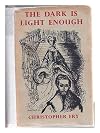
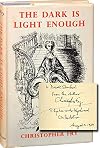
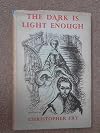
"The play revolves around a dramatic incident in the Hungarian revolution against the Austro-Hungarian Empire in 1848-9 ..."--Dust coverTags
Recommendations





















Member Reviews
Members
- Recently Added By
Author Information

49+ Works 1,337 Members
Success came to Christopher Fry after 38 years of living close to poverty. He was born in Bristol, where his father, a poor architect, turned to lay missionary work in the slums. In 1940, after alternating between teaching and acting, Fry became the director of the excellent Oxford Playhouse. As a Quaker conscientious objector, he refused to bear show more arms in World War II. He was first discovered by critics and connoisseurs in 1946, when a small London theater staged A Phoenix Too Frequent, his version of the perennial story of the widow who accepts a new lover while mourning beside her husband's grave. Three years later, John Gielgud's production of The Lady's Not for Burning (1949) brought Fry popular success in London and the provinces. This clever medieval conceit was produced in New York, and received the Drama Critics Circle Award for 1950. Sir Laurence Olivier commissioned Venus Observed (1950), a play about middle age, the autumn section of what has come to be a cycle of seasonal plays. The winter play, The Dark Is Light Enough (1954), followed two years later. Set in 1848, during the Hungarian revolution against the Austrian empire, it takes a moral stand against any use of violence. (An antiwar morality play, A Sleep of Prisoners, had been produced in 1951.) It was more than a decade before Fry's summer comedy, A Yard of Sun (1970), was published. Fry's relation to T. S. Eliot is interesting. Like him, Fry is a Christian verse dramatist. He has set a play (like Eliot) in a church (A Sleep of Prisoners); he has written a historical study of Becket and Henry II (Curtmantle, 1962). And, like Eliot, Fry has achieved a loose, speakable verse. Yet their differences are equally instructive. Fry's verse, unlike Eliot's functional amble, strives to be poetic, with flamboyant energy and arresting wit. The same theatricality is evident in, say, his Becket play, in which he replaces the introspection of Eliot's martyr with the strong clash of personalities. The Lady's Not for Burning ---which was performed alongside Eliot's The Cocktail Party (1949) in 1949---is a downright, if intellectual, comedy, unlike the dry drawing-room enigma of Eliot. As a translator-adaptor, Fry seems almost single-handedly responsible for the postwar English vogue of modern French writers. His version of Jean Giraudoux's The Trojan War Will Not Take Place (a transatlantic success in 1959, when it was retitled Tiger at the Gates) was revived at the National Theatre in 1984, directed by Harold Pinter. Fry is also a screenwriter (John Huston's The Bible, William Wyler's Ben Hur) and composer. (Bowker Author Biography) show less
Series

Work Relationships
Common Knowledge
- Canonical title
- The Dark is Light Enough
- Original publication date
- 1954
Classifications
Statistics
- Members
- 77
- Popularity
- 412,431
- Rating
- (3.43)
- Languages
- Danish, English, German
- Media
- Paper
- ISBNs
- 4
- ASINs
- 8