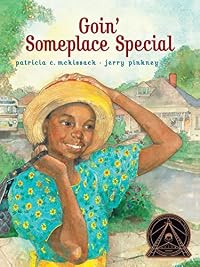
Goin' Someplace Special
by Patricia C. Mckissack
On This Page
Description
In segregated 1950s Nashville, a young African American girl braves a series of indignities and obstacles to get to one of the few integrated places in town: the public library.Tags
Recommendations

Member Reviews
A poignant tale from author Patricia McKissack's childhood, Goin' Someplace Special is a record of a time of great injustice, when racial segregation was a fact of life in her hometown of Nashville, Tennessee; but it is also a tribute to the resilience and courage of those effected by that injustice, and a pean to the hope offered by that special "someplace" mentioned in the title. Setting out on her own, for the very first time, young 'Tricia Ann makes her way through Nashville, encountering both hostility and help from those around her, as she makes her way to the one desegregated place in town, where all are welcome on equal terms: the public library.
I was quite interested to learn, from McKissack's afterward, that Nashville's public show more library board had voted to integrate all their facilities in the late 1950s, before any outside force or law compelled them to. Having just recently read another tale concerning segregation and the library - Ron's Big Mission tells the story of astronaut Ron McNair's determination to gain a library card of his own as a child, in his segregated South Carolina town, where African-Americans weren't allowed to officially use the library - I found the parallels fascinating! Any books which speaks to the power for good of the public library, its role as a refuge in troubled times, is pretty much guaranteed to be OK in my book, but 'Tricia Ann's tale is even more appealing, in that it also opens a window into a troubling aspect of our history, and highlights how family love, and friendship, helped people to survive that time. Highly recommended, to all young library lovers, and to anyone searching for children's stories that can be used to introduce children to the realities of segregation. show less
I was quite interested to learn, from McKissack's afterward, that Nashville's public show more library board had voted to integrate all their facilities in the late 1950s, before any outside force or law compelled them to. Having just recently read another tale concerning segregation and the library - Ron's Big Mission tells the story of astronaut Ron McNair's determination to gain a library card of his own as a child, in his segregated South Carolina town, where African-Americans weren't allowed to officially use the library - I found the parallels fascinating! Any books which speaks to the power for good of the public library, its role as a refuge in troubled times, is pretty much guaranteed to be OK in my book, but 'Tricia Ann's tale is even more appealing, in that it also opens a window into a troubling aspect of our history, and highlights how family love, and friendship, helped people to survive that time. Highly recommended, to all young library lovers, and to anyone searching for children's stories that can be used to introduce children to the realities of segregation. show less
This book was incredibly deep and heartfelt; this author did a wonderful job discussing the segregation era of Jim Crowe laws through this fictional story. The few elements that really stuck out to me were the illustrations, the language, and the repetitiveness of the motif/theme throughout the story. First, the illustrations were paintings using watercolors. The pages are completely filled with beautiful drawings and colorful imagery. In the background of one particular page (when Tricia Ann was getting off the bus), was dull and grey, but the bus and Tricia Ann was colorful and bright which greatly contrasts the mono-colored scheme. In every page, there are some parts watered down a bit so that the focus of the illustrations show more (typically Tricia Ann and the people she’s interacting with) points to the protagonist and the main event. This tactic truly draws out the importance of the book. I also loved the descriptive language the author had used in the story which paints a more realistic image in the readers’ head to get a better sense of the surrounding setting, “At the corner, a green and white bus came to a jerky stop and hissed”. Lastly, the same thing occurs throughout the book: Tricia Ann wants to visit Someplace Special, but she’s encountering racial tension and segregation along the way. She feels hurt and rejected, but every time she’s down, she runs into a friend that reminds her of the truth: that she’s not alone, and the signs don’t dictate how she feels about herself or deplete the enjoyment of her life. This happens several time throughout the story as she gets on the bus and is forced to sit in the colored section, or she can’t sit on a bench at the park for whites only, or even enter certain buildings that are too high class for her. She runs into these troubles, but the main theme is repeated enough so that the readers, who feel her disappointment, can also see how she grows from each experience. The main idea of this story is to keep going in the midst of hardships and prejudice because as her grandmother said, “You are somebody, a human being – no better, no worse than anybody else in this world”. It’s knowing your worth and not allowing other people to determine that for you regardless of what society may throw at you. show less
Tricia Ann is a black girl in the 50s dealing with the injustices of segregation in her town. She sets out on her own to make it to the only place she knows where all are welcome, the library! As she goes through the town she is faced with realities that try to tear her down, but through the wisdom of her Grandmother and people in her community she gains the strength to get through it and make it to her "somewhere special".
The end of this story was very heartwarming as the little girl found her way to "someplace special", also known as, the library. The little girl goes through many struggles while venturing out into the world for her first time alone in a segregated southern town in the 1950s. She is forced to stand in the back of the bus when there are open seats in the front. When she feels lost and helpless, she comes across an older woman named Blooming Mary who symbolized her grandmother's character. She tells the girl, "you are somebody, a human being--no better, no worse than anybody else in this world. Gettin someplace special is not an easy route. But don't study of quittin, just keep walking straight ahead--and you'll make it".
This story show more allows students to learn about segregation in the 1950s and lets them really feel what it would feel like to be an African American during that time. The message of the story is influential because it proves that the public library is the one place where everyone was allowed to go, making it seem to the readers "someplace special" as well. This is a wonderful example of a multicultural book. Reading this book to a class can help educate students on what it felt like to be segregated in the United States. show less
This story show more allows students to learn about segregation in the 1950s and lets them really feel what it would feel like to be an African American during that time. The message of the story is influential because it proves that the public library is the one place where everyone was allowed to go, making it seem to the readers "someplace special" as well. This is a wonderful example of a multicultural book. Reading this book to a class can help educate students on what it felt like to be segregated in the United States. show less
There's a place in this 1950s southern town where all are welcome, no matter what their skin color...and 'Tricia Ann knows exactly how to get there. To her, it's someplace special and she's bursting to go by herself.
When her grandmother sees that she's ready to take such a big step, 'Tricia Ann hurries to catch the bus heading downtown. But unlike the white passengers, she must sit in the back behind the Jim Crow sign and wonder why life's so unfair.
Still, for each hurtful sign seen and painful comment heard, there's a friend around the corner reminding 'Tricia Ann that she's not alone. And even her grandmother's words -- "You are somedbody, a human being -- no better, no worse than anybody else in this world" -- echo in her head, show more lifting her spirits and pushing her forward.
Patricia C. McKissack's poignant story of growing up in the segregated South and Jerry Pinkney's rich, detailed watercolors lead readers to the doorway of freedom. show less
When her grandmother sees that she's ready to take such a big step, 'Tricia Ann hurries to catch the bus heading downtown. But unlike the white passengers, she must sit in the back behind the Jim Crow sign and wonder why life's so unfair.
Still, for each hurtful sign seen and painful comment heard, there's a friend around the corner reminding 'Tricia Ann that she's not alone. And even her grandmother's words -- "You are somedbody, a human being -- no better, no worse than anybody else in this world" -- echo in her head, show more lifting her spirits and pushing her forward.
Patricia C. McKissack's poignant story of growing up in the segregated South and Jerry Pinkney's rich, detailed watercolors lead readers to the doorway of freedom. show less
"Goin Someplace Special" is one of those books that makes you feel like you can accomplish anything. As a black girl dealing with modern racism and daily stereotypes, this book speaks volumes to me. With colorful illustrations that further enhance the stories beautiful message of the comfort of books and captivating story line and a well timed plot twist, this book deserves every star given. It honestly made me shed a tear to read this story and see a young girl in the prime of very real racism and discrimination conquer it with class and dignity. I feel as if this book is timeless and can be read to any age along with any race to be encouraged in the face of discrimination
Goin’ Someplace Special is a powerful book that follows the brave ‘Tricia Ann on her solo journey to someplace special in a 1950’s southern town. Along the way, she comes face to face with the Jim Crow laws of that time. Friends help ‘Tricia Ann at each stop remember who she is and remind her that she can do this alone.
McKissack writes a beautiful picture book told from a young adult’s perspective. ‘Tricia Ann’s thoughts are both heartbreaking and powerful. She is a testament to empowerment and perseverance. I also found it enjoyable to infer about where “someplace special” was and was delighted at the end of the book when ‘Tricia Ann arrived at her destination.
McKissack writes a beautiful picture book told from a young adult’s perspective. ‘Tricia Ann’s thoughts are both heartbreaking and powerful. She is a testament to empowerment and perseverance. I also found it enjoyable to infer about where “someplace special” was and was delighted at the end of the book when ‘Tricia Ann arrived at her destination.
Members
- Recently Added By
Lists

At the Library ::: Children's Picture Books about Libraries
103 works; 6 members

Picture Books About Civil Rights
51 works; 4 members
Author Information

152+ Works 26,651 Members
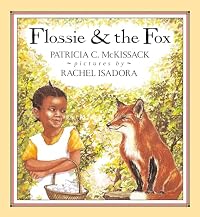
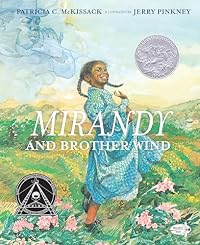
Patricia C. McKissack was born in Smyrna, Tennessee on August 9, 1944. She received a bachelor's degree in English from Tennessee State University in 1964 and a master's degree in early childhood literature and media programming from Webster University in 1975. After college, she worked as a junior high school English teacher and a children's book show more editor at Concordia Publishing. Since the 1980's, she and her husband Frederick L. McKissack have written over 100 books together. Most of their titles are biographies with a strong focus on African-American themes for young readers. Their early 1990s biography series, Great African Americans included volumes on Frederick Douglass, Marian Anderson, and Paul Robeson. Their other works included Black Hands, White Sails: The Story of African-American Whalers and Days of Jubilee: The End of Slavery in the United States. Over their 30 years of writing together, the couple won many awards including the C.S. Lewis Silver Medal, a Newbery Honor, nine Coretta Scott King Author and Honor awards, the Jane Addams Peace Award, and the NAACP Image Award for Sojourner Truth: Ain't I a Woman?. In 1998, they received the Coretta Scott King-Virginia Hamilton Award for Lifetime Achievement. She also writes fiction on her own. Her book included Flossie and the Fox, Stitchin' and Pullin': A Gee's Bend Quilt, A Friendship for Today, and Let's Clap, Jump, Sing and Shout; Dance, Spin and Turn It Out! She won the Newberry Honor Book Award and the King Author Award for The Dark Thirty: Southern Tales of the Supernatural in 1993 and the Caldecott Medal for Mirandy and Brother Wind. She dead of cardio-respiratory arrest on April 7, 2017 at the age of 72. (Bowker Author Biography) show less
All Editions
Awards and Honors
Awards
Distinctions
Common Knowledge
- Canonical title
- Goin' Someplace Special
- Dedication
- In memory of Frances Oldham, my grandmother. -P.C.M.
For my brother, Billy -J.P. - First words
- 'Tricia Ann was about to burst with excitement.
- Last words
- (Click to show. Warning: May contain spoilers.)Before bounding up the the steps and through the front door, 'Tricia Ann stopped to look up at the message chiseled in stone across the front facing: PUBLIC LIBRARY: ALL ARE WELCOMED.
Classifications
Statistics
- Members
- 1,461
- Popularity
- 15,904
- Reviews
- 84
- Rating
- (4.35)
- Languages
- English, Japanese
- Media
- Paper, Ebook
- ISBNs
- 13
- ASINs
- 5