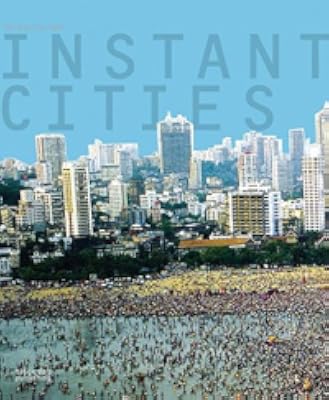
Instant Cities
by Herbert Wright
On This Page
Description
Assesses the stratospheric rise of the city throughout history, surveying the exploding megacities in China, India, South America and elsewhere to the continuous remodeloing of Western cityscapes and the socialist experiments of the twentieth century.Tags
Recommendations
Member Recommendations
Member Reviews
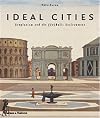
Instant Cities is richly illustrated and explores contemporary urbanism and metropolitan development. As the book says, "the term 'instant city' itself should not be taken too literally". Rather, the term acts as an umbrella for several dichotomous themes: Growth/Masterplan, Utopia/Dystopia, Fantasy/Reality, Nuclear/Distributed, Nomadic/Rooted, Global/Local, Humanity/Environment. Through these themes, many diverse topics are explored including, Dubai, Thames Town (in China), Second Life (the online game), architecture in film, and refugees in Nairobi, to name a few.
It is not necessary to read the book start to finish as you can easily read one section as a stand alone. The images selected are fascinating and survey some of the most show more cutting edge architecture, as well as notable plans and designs from the past.
Given the diversity of the topics, it is not surprising that the writing is to the point and mostly summary. The terminology and lack of embellishment put the discussion a bit beyond the average reader who is unfamiliar with architecture and planning concepts. That said, accompanying illustrations go a long way in explaining things.
One complaint: despite the high quality of production, the text was very small compared to the page size (coffee table book sized), and got even smaller in some of the subsections. Perhaps this was done for visual reasons but it did not make reading it any easier.
Overall a beautiful book that provides interesting examples of contemporary urban development around the world. show less
It is not necessary to read the book start to finish as you can easily read one section as a stand alone. The images selected are fascinating and survey some of the most show more cutting edge architecture, as well as notable plans and designs from the past.
Given the diversity of the topics, it is not surprising that the writing is to the point and mostly summary. The terminology and lack of embellishment put the discussion a bit beyond the average reader who is unfamiliar with architecture and planning concepts. That said, accompanying illustrations go a long way in explaining things.
One complaint: despite the high quality of production, the text was very small compared to the page size (coffee table book sized), and got even smaller in some of the subsections. Perhaps this was done for visual reasons but it did not make reading it any easier.
Overall a beautiful book that provides interesting examples of contemporary urban development around the world. show less
Members
- Recently Added By
Author Information
3 Works 64 Members
Common Knowledge
- First words
- Ever since the Archigram group took on the notion of the instant city in the 1960s the concept has been reinterpreted by architects, developers, artists, designers and filmakers alike: producing results that are both inspirin... (show all)g and disparaging in equal measure.
Classifications
- Genres
- Sociology, Nonfiction, Art & Design, Economics
- DDC/MDS
- 307.76 — Society, government, & culture Social sciences, sociology & anthropology Communities Specific kinds of communities Urban communities
- LCC
- HT153 .W75 — Social sciences Communities. Classes. Races Communities. Classes. Races Urban groups. The city. Urban sociology
- BISAC
Statistics
- Members
- 14
- Popularity
- 1,678,624
- Reviews
- 1
- Rating
- (3.50)
- Languages
- English
- Media
- Paper
- ISBNs
- 1
- ASINs
- 1