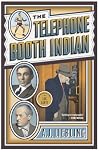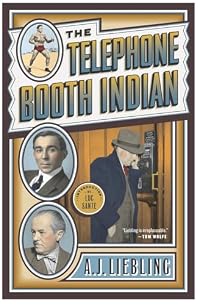
The Telephone Booth Indian
by A. J. Liebling
On This Page
Description
A classic work on Broadway sharpers, grifters, and con men by the late, great New Yorker journalist A. J. Liebling. Often referred to as "Liebling lowlife pieces," the essays in The Telephone Booth Indian boisterously celebrate raffishness. A. J. Liebling appreciated a good scam and knew how to cultivate the scammers. Telephone Booth Indians (entrepreneurs so impecunious that they conduct business from telephone booths in the lobbies of New York City office buildings) and a host of other show more petty nomads of Broadway--with names like Marty the Clutch and Count de Pennies--are the protagonists in this incomparable Liebling work. In The Telephone Booth Indian, Liebling proves just why he was the go-to man on New York lowlife and con culture; this is the master at the top of his form, uncovering scam after scam and writing about them with the wit and charisma that established him as one of the greatest journalists of his generation and one of New York's finest cultural chroniclers. show lessTags
Recommendations







































Member Reviews
American Penguin with bright cover on yellow background. I haven't read them but these are said to be hilarious, true stories of Broadway.
Ratings
Members
- Recently Added By
Author Information

34+ Works 2,432 Members
A. J. Liebling was an urbane and prolific journalist whose style, incorporating first-person narrative, street talk, and exuberant metaphor, became a model for the New Journalism of the 1960's and later. Although he came from a genteel New York family, he was fascinated by the irreverent underworld all his life and made it his special subject. show more After being expelled from Dartmouth College for refusing to attend chapel, Liebling graduated from Columbia University's Pulitzer School of Journalism in 1925 and then worked for various newspapers, including The New York Times, which fired him, and the New York World, before he found his metier at The New Yorker magazine in 1935. It was there that he developed his signature style and did his best work, writing about a wide range of subjects, from the city's characters to gastronomy to boxing to the London Blitz and the Normandy invasion. A born raconteur with a fertile imagination, Liebling carved out a territory between objective reporting and fiction, which so many other journalists have mined since. Yet he could also produce straight war reportage fine enough to merit receiving the Legion of Honor from a grateful France in 1952. Starting in 1945, Liebling wrote a widely admired column for The New Yorker called "The Wayward Pressman," in which he criticized American journalism's priorities and performance. This was probably the first such column in U.S. journalism. During the 1950s and 1960s, he also wrote book reviews for Esquire. Besides his massive newspaper and magazine output, Liebling wrote about 20 books. He was married three times, the last time to the writer Jean Stafford. (Bowker Author Biography) show less
Awards and Honors
Notable Lists
Common Knowledge
- Canonical title
- The Telephone Booth Indian
- First words
- Unless you think it stands for a slightly tarnished category of theatrical entertainment, you are probably under the impression that Broadway is merely a street. That street is either the original model, which begins at the f... (show all)oot of Manhattan and runs up to somewhere near the Canadian border, or one of its lesser replicants, the kind Wilson Pickett found in every burg, each of them invariably containing a bar, each bar containing a woman. The idea of "main stem" is still attached to Broadway, but that is the last vestige of its former glory. "Broadway" was once a culture unto itself, with its own tribes, castes, customs, and language. It was somehow connected to the entertainment industry, but its compass was broad, extending well past the theaters. It took in costumers' ateliers and actors' boardinghouses, trade-paper publishers and vaudeville agencies, flea circuses and pokerino parlors, pawnshops and cafeterias, hair salons and painless dentists that catered to chorines and voice coaches and supper-club magicians and itinerant Swiss bell-ringing troupes. It also sheltered a substantial parasitic population, of chiselers and percentage players and seekers after the main chance, of all degrees of probity or lack thereof and at all stages on the road of life. Even dine-and-dash specialists and storm-drain fishermen and people wh spent their waking hours sitting in hotel lobbies had a purpose, however, in that complex ecosystem. -Introduction, Luc Sante
There was once a French-Canadian whose name I cannot at present recall but who had a window in his stomach. It was due to this fortunate circumstance, however unlikely, that a prying fellow of a doctor was able to study the m... (show all)an's inner workings, and that is how we came to know all about gastric juices, as I suppose we do. The details are not too clear in my mind, as I read the story in a hygiene reader which is formed part of the curriculum of my fourth year in elementary school, but I have no doubt that it is essentially correct. -Preface
One of the most distinctive periodicals published in the land of the Telephone Booth Indians is called the Greater Show World, a trade paper for outdoor showmen. It is edited in one room of the Gaiety Building, which i... (show all)s not a fictional edifice, by a man name Johnny J. Kline who has five typewriters in his office and usually has a sheet of copy paper in each of them When he sits at one typewriter he is editor-in-chief, at another he is business manager, and at a third a gossip columnist. He writes under different by-lines as two other reporters at the remaining typewriters. The magazine which he gets out all by himself every month is just as big as the New Yorker, he reminds me whenever I see him, and he says he wonders what the hell the New Yorker staff does for a living. -Masters of the Midway - Quotations
- Among the shows on the World's Fair midway presented by the firm of Dufour & Rogers, one, "We Humans," illustrated the grand strategy of evolution in a somewhat macabre fashion. A reverent, three-dimensional presentation of D... (show all)a Vinci's "Last Supper," with life-sized models of the apostles, trick lighting effects, and a musical background of Gregorian chants supplied by a phonograph with an electrical record-changing device, was to have been another Dufour & Rogers offering.
- Canonical DDC/MDS
- 338.04
- Canonical LCC
- HC108 .L54
Classifications
Statistics
- Members
- 138
- Popularity
- 236,252
- Reviews
- 1
- Rating
- (3.92)
- Languages
- English
- Media
- Paper, Ebook
- ISBNs
- 3
- ASINs
- 5