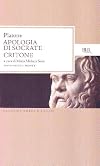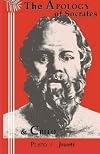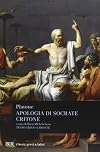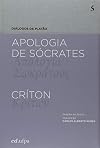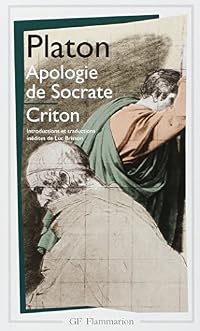
Apology ; Crito (Greek text)
by Plato
On This Page
Description
The Athenian court has found Socrates guilty and sentenced him to death. While he is waiting to be executed, his friend, Crito, comes to the prison to persuade him to escape and go into exile. Socrates responds by examining the essence of law and community, probing the various kinds of law and making distinctions that go far beyond the particular issue of whether or not Socrates should escape.Tags
Recommendations















Member Reviews
Edition: Text Edition // Descr: 50 p. 20 cm. // Series: College Series of Greek Authors Call No. { 888.4 A3dy } Series Edited under the Supervision of John Williams White and Thomas Day Seymour Edited on the Basis of Cron's Edition by Louis Dyer. // //
Nel momento in cui ricomincia il mio processo decido di leggere l’apologia di Socrate, tutt’altro processo, ma alla fine la storia si ripete. L’apologia di Socrate ed il Critone vengono proposti in quest’edizione con il testo in greco a lato originale e sono corredati dalle ottime note di Maria Michela Sassi che ha scritto anche l’introduzione, fondamentale per collocare l’opera. La capacità di Socrate di affrontare un processo infamante e la ovvia condanna mi mortificano per la mia assenza di coraggio. In realtà sarebbe bello andare al mio, di processo, e senza boria, senza originalità, fare una lunga deposizione spontanea leggendo l’apologia, senza aggiunte, senza variazioni, così come è scritta. Perché in questo show more formidabile scritto di Platone, ad un uomo viene consentito di fare un lungo, perfetto passaggio, circa le miserie e le virtù dell’uomo, circa il concetto di giustizia e di legge, non come un contratto sociale, ma come un sistema di valori individuali. Nel Critone Socrate spiega all’amico per quali ragioni è necessario accettare le sentenze, per quanto le stesse non rispondano ad alcun principio di giustizia; ma è nell’apologia che si legge uno dei passi fondamentali del pensiero dell’uomo. La dialettica di Socrate, il suo utilizzo della maieutica, attraverso discorsi brevi e basati sulle contraddizioni delle affermazioni dell’interlocutore sono strumenti di conoscenza e cultura necessari. Una lettura non solo necessaria, ma bella. show less
Dec 2, 2016Italian
FG-5
Oct 24, 2020Catalan
184 PLA
Apr 20, 2020Italian
""
Sep 2, 2015French
Recenziita de W.J. Downes en La Brita Esperantisto, N-ro 844 (Januaro-Februaro 1982).
Jul 13, 2014Esperanto
Ratings
Members
- Recently Added By
Author Information

2,715+ Works 100,320 Members
Plato was born c. 427 B.C. in Athens, Greece, to an aristocratic family very much involved in political government. Pericles, famous ruler of Athens during its golden age, was Plato's stepfather. Plato was well educated and studied under Socrates, with whom he developed a close friendship. When Socrates was publically executed in 399 B.C., Plato show more finally distanced himself from a career in Athenian politics, instead becoming one of the greatest philosophers of Western civilization. Plato extended Socrates's inquiries to his students, one of the most famous being Aristotle. Plato's The Republic is an enduring work, discussing justice, the importance of education, and the qualities needed for rulers to succeed. Plato felt governors must be philosophers so they may govern wisely and effectively. Plato founded the Academy, an educational institution dedicated to pursuing philosophic truth. The Academy lasted well into the 6th century A.D., and is the model for all western universities. Its formation is along the lines Plato laid out in The Republic. Many of Plato's essays and writings survive to this day. Plato died in 347 B.C. at the age of 80. (Bowker Author Biography) show less
Some Editions
Series
Belongs to Publisher Series
Work Relationships
Common Knowledge
- Canonical title
- Apology ; Crito [Translation]; Apology ; Crito (Greek text) (Greek text)
- First words
- How have you felt, O Athenians, at hearing the speeches of my
accusers, I cannot tell; but I know that their persuasive words almost
made me forget who I was, such was the effect of them; and yet they
have hardly spo... (show all)ken a word of truth. But many as their falsehoods
were, there was one of them which quite amazed me: I mean when they
told you to be upon your guard, and not to let yourselves be deceived
by the force of my eloquence. - Quotations
- The hour of departure has arrived, and we go our ways—I to die,
and you to live. Which is better God only knows. - Last words
- (Click to show. Warning: May contain spoilers.)(Socrates relating the voice of Athens)
Now you depart in innocence, a sufferer and not a doer of evil; a
victim, not of the laws, but of people. But if you go forth, returning evil
for evil, and injury for injury, breaking the covenants and agreements
which you have made with us, and wronging those whom you ought
least to wrong, that is to say, yourself, your friends, your country,
and us, we shall be angry with you while you live, and our brethren,
the laws in the world below, will receive you as an enemy; for they
will know that you have done your best to destroy us.
(Socrates in his own voice)
Listen, then,
to us and not to Crito.
This is the voice which I seem to hear murmuring in my ears, like
the sound of the flute in the ears of the mystic; that voice, I say, is
humming in my ears, and prevents me from hearing any other. And I
know that anything more which you may say will be vain. Yet speak,
if you have anything to say.
Crito: I have nothing to say, Socrates.
Socrates: Then let me follow the intimations of the will of God. - Original language*
- Grec (Ancien) (Ancien)
- Disambiguation notice
- Please separate and combine only LT works having substantially the same content. For example, this LT work includes two of Plato's dialogues: The Apology (a.k.a. The Defense of Socrates) and Crito. Thank ... (show all)you.
*Some information comes from Common Knowledge in other languages. Click "Edit" for more information.
Classifications
- Genres
- Philosophy, Nonfiction, General Nonfiction
- DDC/MDS
- 183.2 — Philosophy and Psychology Ancient, medieval & eastern philosophy Sophistic, Socratic, related Greek philosophies Socrates
- LCC
- PA3411 .C7 .P72 — Language and Literature Greek language and literature. Latin language and literature Greek literature Collections
- BISAC
Statistics
- Members
- 470
- Popularity
- 64,460
- Reviews
- 6
- Rating
- (3.82)
- Languages
- 14 — Catalan, Dutch, English, Esperanto, Finnish, French, German, Greek (Ancient), Greek, Hungarian, Italian, Japanese, Portuguese, Spanish
- Media
- Paper, Ebook
- ISBNs
- 33
- ASINs
- 11