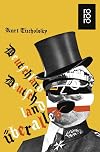
Deutschland, Deutschland über alles. Ein Bilderbuch v. Kurt Tucholsky und vielen Fotografen
by Kurt Tucholsky
On This Page
Description
Literaturverz. S. 445 - 447Tags
Recommendations



































Member Reviews
This 1929 collection creatively brings Tucholsky's essays, songs, monologues and one-liners together with pictures found or modified by the celebrated photomontage artist John Heartfield in a coordinated satirical attack on the values and institutions of the Weimar Republic. Their targets include things we might think of as universal social problems, like capitalism, nationalism, the growth of inequality in society and the inherent bias of the police and criminal justice system against the poor, as well as more specifically German problems (militarism, bureaucracy, exaggerated concern for order and authority, beer and bockwurst obsession, Bavarian contrariness, antisemitism, lack of aesthetic sense in public architecture).
It's all a show more bit scattershot, and at times it's hard to distinguish where Tucholsky sees really serious problems and where he just sees soft targets. And occasionally, as in the parody of a virulent nationalist reviewing Erich Maria Remarque's book, he's just a bit too much in love with his own cleverness. What he comes up with — the reviewer implausibly making Remarque out to be a Jew ("Erich Salomon Markus") who never saw active service — is far too near the unsubtle way actual Nazi propaganda worked to be funny...
However, what is clear, because he keeps coming back to it and because he devotes the only extended non-comic piece in the book to it, is that he sees the justice system as the core of the problem. The failure to purge the bench in 1918 and the way new judges are trained and appointed means that hard-core conservative, authoritarian attitudes, out of step with the rest of society, have carried over from before the war, and are only becoming more and more entrenched. Of course, even in the 21st century there are plenty of Tucholsky's successors around the world who have had their difficult moments with the law and will say similar things about judicial bias, but it is striking in a German context because of how closely it parallels what people were saying in the sixties and seventies about the failure to purge the bench in 1945...
What is also striking when you read the whole book is how Tucholsky, writing four years before Hitler came to power, is already convinced that Germany has missed its chance to sort itself out (in 1918), and is now well on its way down into the abyss. The only hindsight going on here is the reader's.
Clever, inventive, and often still very funny ninety years later. But sad, too, because, like most satire, it never reached enough of the people it was meant to convince. show less
It's all a show more bit scattershot, and at times it's hard to distinguish where Tucholsky sees really serious problems and where he just sees soft targets. And occasionally, as in the parody of a virulent nationalist reviewing Erich Maria Remarque's book, he's just a bit too much in love with his own cleverness. What he comes up with — the reviewer implausibly making Remarque out to be a Jew ("Erich Salomon Markus") who never saw active service — is far too near the unsubtle way actual Nazi propaganda worked to be funny...
However, what is clear, because he keeps coming back to it and because he devotes the only extended non-comic piece in the book to it, is that he sees the justice system as the core of the problem. The failure to purge the bench in 1918 and the way new judges are trained and appointed means that hard-core conservative, authoritarian attitudes, out of step with the rest of society, have carried over from before the war, and are only becoming more and more entrenched. Of course, even in the 21st century there are plenty of Tucholsky's successors around the world who have had their difficult moments with the law and will say similar things about judicial bias, but it is striking in a German context because of how closely it parallels what people were saying in the sixties and seventies about the failure to purge the bench in 1945...
What is also striking when you read the whole book is how Tucholsky, writing four years before Hitler came to power, is already convinced that Germany has missed its chance to sort itself out (in 1918), and is now well on its way down into the abyss. The only hindsight going on here is the reader's.
Clever, inventive, and often still very funny ninety years later. But sad, too, because, like most satire, it never reached enough of the people it was meant to convince. show less
Ratings
Members
- Recently Added By
Lists

Writers at Risk
106 works; 17 members

German Literature
518 works; 56 members
Author Information

Kurt Tucholsky was the most renowned journalist of Weimar Germany, a poet, lyricist, satirist, and storyteller, a democrat, a fighter, a lady's man, a theater-lover, and a political animal. Tucholsky vehemently and early on opposed WWI militarism. The war, in which he was drafted, turned him into a lifelong pacifist.
All Editions
Common Knowledge
- Original title
- Deutschland, Deutschland über alles
- Original publication date
- 1929
- Epigraph*
- So kam ich unter die Deutschen. Ich forderte nicht viel und war gefaßt, noch weniger zu finden. […]
Hölderlin - First words*
- Sehen Sie – das ist nun dieses Bild.
- Quotations*
- Die Zahl der Deutschen Kriegerdenkmäler zur Zahl der Deutschen Heine-Denkmäler verhält sich hierzulande wie die Macht zum Geist
- Original language*
- Deutsch
*Some information comes from Common Knowledge in other languages. Click "Edit" for more information.
Classifications
- Genre
- Fiction and Literature
- DDC/MDS
- 830 — Literature & rhetoric German & related literatures German literature and literatures of related languages
- LCC
- DD237 .T813 — History of Europe, Asia, Africa and Oceania Germany History of Germany History By period Modern, 1519- 19th-20th centuries Revolution and Republic, 1918-
Statistics
- Members
- 145
- Popularity
- 226,341
- Reviews
- 1
- Rating
- (4.05)
- Languages
- 5 — Dutch, English, German, Italian, Spanish
- Media
- Paper, Ebook
- ISBNs
- 9
- ASINs
- 4