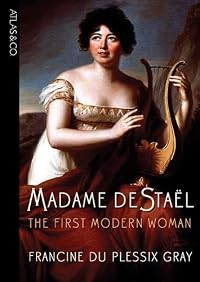
Madame de Stael: The First Modern Woman
by Francine du Plessix Gray
On This Page
Description
"One of the great literary forces of her age or any age, Germaine de Stael was born into the political and intellectual aristocracy of her time. The daughter of Jacques Necker, Louis XVI's finance minister; she married Sweden's ambassador to the French court and for two decades held the limelight as a political figure and prolific writer. Admittedly not a beauty, she was nonetheless notoriously seductive and enjoyed whirlwind affairs with some of the most influential men of her time. She was show more demonized by Napoleon for her forthrightness, her powerful intellect, and her prestigious salon, a hothouse of subversive ideas and sexual intrigue. The Emperor exiled her, on and off, for the last two decades of her life." "Madame de Stael - force of nature, exuberant idealist, and ultimate enthusiast - waged a lifelong struggle against all that was tyrannical, cynical, or passionless in her time; and left a legacy of enlightened liberalism that radiated throughout Europe during the nineteenth century."--Jacket. show lessTags
Recommendations























Member Reviews
I believe my first encounter with Madame de Staël was in Dorothy Parker’s “Song of One of the Girls”, where she appears as one of “the glamorous ladies at whose beckoning history shook”. As Francine du Plessix Gray’s biography describes her, she wouldn’t meet modern definitions of “glamorous”; her kinder contemporaries described her as “leonine” or “sturdy” and she had no physical grace, being famous for falling flat on her face while attempting to curtsey to Marie Antoinette. Daughter of the millionaire financier Jaques Necker, she had the 18th century equivalent of a “Tiger Mom”; she was tutored in mathematics, geography, science, and languages starting at age three, wasn’t allowed contact with other show more children, and couldn’t leave the house alone until she was 12. This regimen did produce considerable intellectual attainment – even her enemies agreed she was a brilliant conversationalist – and, perhaps surprisingly, a kindly and generous temperament. If there was any moral education included – and there probably was, since the Neckers were strict Calvinists – it didn’t take; after her marriage to the accommodating Swedish diplomat Erik Magnus Staël, she became notorious for seducing just about every famous Frenchman of her time (describing her attempts as a political peacemaker, a critic commented “She entertains the Royalists at breakfast, the Girondins at lunch, the Jacobins at supper, and everybody at night”). Intellectual and independent women have always been subject to accusations of sexual excess; but in her case they seem to be justified – none of her four children who reached adulthood was of certain paternity.
Mentally she seems to have been at least a quarter bubble off level; Gray speculates a modern diagnosis might be bipolar disorder with emphasis on the manic part. Both she and several of her lovers developed the habit of staging “suicide attempts” with not-quite-overdoses of laudanum every time the relationship progressed poorly, to the extent that a “Coppet dose” of opium (her home in Switzerland was at Coppet) actually became a slang term for the action.
Despite all this she became a popular and successful author, and also somehow retained her seductiveness even into her 50s – though her always ample figure now ballooned, she still managed one last lover, a handsome (but stupid) war hero twenty years her junior.
Gray’s biography is straightforward and readable – she engages in a little speculation on de Staël’s psychological problems and the possible fathers of her children, but resists the temptation to go overboard. It helps to know a little about the French revolutionary and Napoleonic periods. Madame de Staël is buried with her mother and father in the family crypt in Switzerland. I’ll have to track down her books. show less
Mentally she seems to have been at least a quarter bubble off level; Gray speculates a modern diagnosis might be bipolar disorder with emphasis on the manic part. Both she and several of her lovers developed the habit of staging “suicide attempts” with not-quite-overdoses of laudanum every time the relationship progressed poorly, to the extent that a “Coppet dose” of opium (her home in Switzerland was at Coppet) actually became a slang term for the action.
Despite all this she became a popular and successful author, and also somehow retained her seductiveness even into her 50s – though her always ample figure now ballooned, she still managed one last lover, a handsome (but stupid) war hero twenty years her junior.
Gray’s biography is straightforward and readable – she engages in a little speculation on de Staël’s psychological problems and the possible fathers of her children, but resists the temptation to go overboard. It helps to know a little about the French revolutionary and Napoleonic periods. Madame de Staël is buried with her mother and father in the family crypt in Switzerland. I’ll have to track down her books. show less
Madame de Stael may indeed have been, as the subtitle to this biography claims, The First Modern Woman. She wasn't quite beautiful, but she was intelligent and masterful in conversation, which in the salons of 18th century France was equally important. (Of course, her chattiness was probably well-tolerated in part because she inherited one of the largest fortunes in Europe...)
To me, Madame de Stael seems like a female Voltaire: less-than-handsome, full of restless intellectual energy, author of many books on diverse subjects, forever entangled in ridiculous amours, always in trouble with the authorities. In the lady's case, the main authority was Napoleon, an authoritarian boor who found it doubly maddening to be opposed by not only a show more rich person, but a rich person with breasts. He was forever banishing her and trying to shut her up, but Madame de Stael actually had the last laugh, using her social connections to help forge the alliances that eventually brought the emperor down.
Francine du Plessix Gray (author of the excellent memoir Them) writes fluidly and concisely, cramming the plentiful action of Madame de Stael's life into a compulsively readable little book. She does not gloss over the lady's faults -- Gray diagnoses de Stael as a manic-depressive and sighs in relief while relating the tale of her last doomed romance -- but the author clearly admires her subject, and makes a good case that the reader should, as well. show less
To me, Madame de Stael seems like a female Voltaire: less-than-handsome, full of restless intellectual energy, author of many books on diverse subjects, forever entangled in ridiculous amours, always in trouble with the authorities. In the lady's case, the main authority was Napoleon, an authoritarian boor who found it doubly maddening to be opposed by not only a show more rich person, but a rich person with breasts. He was forever banishing her and trying to shut her up, but Madame de Stael actually had the last laugh, using her social connections to help forge the alliances that eventually brought the emperor down.
Francine du Plessix Gray (author of the excellent memoir Them) writes fluidly and concisely, cramming the plentiful action of Madame de Stael's life into a compulsively readable little book. She does not gloss over the lady's faults -- Gray diagnoses de Stael as a manic-depressive and sighs in relief while relating the tale of her last doomed romance -- but the author clearly admires her subject, and makes a good case that the reader should, as well. show less
This short biography was a lively and well written introduction to a woman who is perhaps best known for her romances but who was remarkable for her intellect and her commitment to independence for women. du Plessix Gray provides some fascinating insights into her childhood and psychology. This was particularly interesting to me since I recently read "A Place of Greater Safety," Hilary Mantel's historical novel about the French revolution, and de Staël's father was an important person in the lead-up to the revolution.
This is a great short introduction to the life of a woman who was a cultural icon in France during the Napoleonic era.For two decades she was a central political and literary figure. Her support of subversive ideas led to exile by Napoleon. Nevertheless she continued to be a champion of enlightenment thinking and thinkers throughout her life.
This is an extremely readable biography that provides general information on the life of Madame de Stael in addition to a good overview of information regarding the the French Revolution. This biography does not delve into specifics but gives an overall portrait of the Madame De Stael's life; it retells her actions and explores some of her motivations. It is told in a style that is very enjoyable to read.
This is an extremely readable biography that provides general information on the life of Madame de Stael in addition to a good overview of information regarding the the French Revolution. This biography does not delve into specifics but gives an overall portrait of the Madame De Stael's life; it retells her actions and explores some of her motivations. It is told in a style that is very enjoyable to read.
This is an extremely readable biography that provides general information on the life of Madame de Stael in addition to a good overview of information regarding the the French Revolution. This biography does not delve into specifics but gives an overall portrait of the Madame De Stael's life; it retells her actions and explores some of her motivations. It is told in a style that is very enjoyable to read.
Members
- Recently Added By
Lists

Club Read's Recommended Nonfiction Written by Women
618 works; 30 members

Works Cited in The History of White People by Nell Irvin Painter
321 works; 2 members
Author Information

18+ Works 1,697 Members
Francine du Plessix was born in Warsaw, Poland on September 25, 1930. She received a bachelor's degree in philosophy from Barnard College in 1952. For two summers she studied at the Black Mountain College in North Carolina. After writing radio reports at the United Press for two years, she moved to Paris to report on fashion for the French show more magazine Réalités. She returned to the United States and married the painter Cleve Gray in 1957. She wrote both fiction and nonfiction. Her novels included Lovers and Tyrants, World Without End, October Blood, and The Queen's Lover. Her nonfiction works included Divine Disobedience: Profiles in Catholic Radicalism, Hawaii: The Sugar-Coated Fortress, Soviet Women: Walking the Tightrope, and biographies of the poet Louise Colet, the Marquis de Sade, Simone Weil, and Madame de Staël. Them: A Memoir of Parents won the National Book Critics Circle Award in 2006. She died from complications of congestive heart failure on January 13, 2018 at the age of 88. (Bowker Author Biography) show less
Common Knowledge
- People/Characters
- Germaine de Staël
Classifications
- Genres
- History, Nonfiction, Biography & Memoir, General Nonfiction, Literature Studies and Criticism, Sexuality and Gender Studies
- DDC/MDS
- 944.04092 — History & geography History of Europe France and Monaco France Revolution 1789-1804
- LCC
- DC146 .S7 .G73 — History of Europe, Asia, Africa and Oceania France – Andorra – Monaco History of France Modern, 1515- Revolutionary and Napoleonic period, 1789-1815
- BISAC
Statistics
- Members
- 93
- Popularity
- 343,517
- Reviews
- 9
- Rating
- (3.50)
- Languages
- English
- Media
- Paper
- ISBNs
- 2