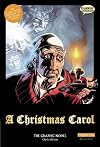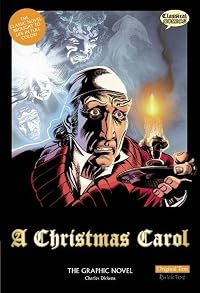
A Christmas Carol: The Graphic Novel
by Charles Dickens, Mike Collins (Illustrator), David A Roach (Illustrator), Sean Michael Wilson (Script)
On This Page
Description
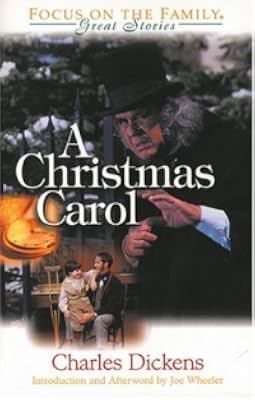
Presents in graphic novel format an adaptation of Dickens' story of a miser named Ebenezer Scrooge who learns the true meaning of Christmas when three ghostly visitors review his past and foretell his future.Tags
Recommendations
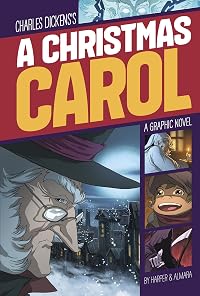





Member Reviews
Classical Comics' graphic novel adaptation of Dickens' classic story of the transformation of Ebeneezer Scrooge following a Christmas Eve visit by the ghosts of Christmas Past, Present, and Yet to Come, comes in two versions: original text and quick text. Both have the same illustrations, both cut out the much of the description of what is happening , but the original text version cuts keeps the original dialogue, this one – the quick text version – has “reduced dialogue for easier reading” in more modern English.
The graphic novel follows the story line well, and will appeal to graphic novel fans. However, the text is too abridged for my taste (although it may appeal more to younger readers). The original text version is a show more better adaptation, and will be a better choice for those who love the original. The book also includes supplementary material such as a Dickens timeline, information about Victorian England, and character descriptions. show less
The graphic novel follows the story line well, and will appeal to graphic novel fans. However, the text is too abridged for my taste (although it may appeal more to younger readers). The original text version is a show more better adaptation, and will be a better choice for those who love the original. The book also includes supplementary material such as a Dickens timeline, information about Victorian England, and character descriptions. show less
Anytime a new company takes on the difficult task of re-imagining our beloved classics in a graphic novel mode, is time to hold our breath and hope they can pull it off. Classical Comics has answered the call. Dickens' A Christmas Carol has been handsomely given a new reading using the original text and illustrated compellingly over 140 pages of story followed by short essays on the life of Dickens and 19th century England.
This isn't the first time A Christmas Carol has been turned into a comic book. The original Classics Illustrated version was published in 1948, a book I used to own and love, but certainly, unlike the current version, with a greatly truncated text.
In 1990 a new series of Classics Illustrated books was published show more using the talents of some of the world's top artists. That effort didn't last more than a year, but it created some incredible versions (and visions) of the classics. My one quibble with this new edition of A Christmas Carol is that the art, while certainly competent and at times quite striking, nevertheless could have been so much more if rendered by a more visionary graphic artist.
Nevertheless, the book provided a satisfying evening's read. It probably didn't hurt that it was snowing outside my window, and I was in need of some Christmas cheer! show less
This isn't the first time A Christmas Carol has been turned into a comic book. The original Classics Illustrated version was published in 1948, a book I used to own and love, but certainly, unlike the current version, with a greatly truncated text.
In 1990 a new series of Classics Illustrated books was published show more using the talents of some of the world's top artists. That effort didn't last more than a year, but it created some incredible versions (and visions) of the classics. My one quibble with this new edition of A Christmas Carol is that the art, while certainly competent and at times quite striking, nevertheless could have been so much more if rendered by a more visionary graphic artist.
Nevertheless, the book provided a satisfying evening's read. It probably didn't hurt that it was snowing outside my window, and I was in need of some Christmas cheer! show less
 This review was written for LibraryThing Early Reviewers.
.
Classical Comics is creating a collection of classic novels turned into graphic novels. This idea isn't new of course and has generally been done rather lousily. It was with a mix of trepidation and anticipation that I read this book and overall I was quite happy with it, starting with the cover: shiny black lines on a matte black background: very cool.
Christmas Carol comes in two formats, both with identical pictures, Original Text and Quick Text. The version I read was Original Text (it's the one with the cool cover and the one they sent me). The Big O (if you don't know me already from Thmusings, he's my five-year-old son) and I are rereading the original novel in a copiously illustrated version; I had considered reading this show more instead, but it hadn't arrived by the time I told him we'd start reading.
Anyway, reading both simultaneously means I am hyperaware of the alterations in the text. Even though this is "Original Text", it obviously won't be identical. All the tags are gone, for instance. In fact, it wasn't until Marley's ghost appeared that I remembered something from the opening paragraphs that had been cut.
What I'm getting at is that the excisions are made so smoothly that if you weren't reading the original simultaneously, you would likely never know the difference.
(I can't say the same for the Quick Text, but based on the sample panels in the back of the book, I think it's been simplified into awkwardness.)
My main beef with the book is the art. The art is of high quality, make no mistake, but (and here comes the snob in me) it's just so typical. It looks like anything you might see from a major superhero publisher. It's "dynamic" but boring. The colors and inking look straight off the shelf. And I think the book deserves more.
Given the (single ) sample panels from other Classical Comics books shown in the backpages, I think Jane Eyre and Frankenstein fared much better in the art department while Henry V and Macbeth got the shaft.
(Incidentally, Shakespeare, in addition to Original Text and Quick Text, comes in Plain Text --- as long as Original, but modernized. The two panels I have to judge on suggest above average competence in the modernization, but, naturally, less poetic than the original. It also reminded me how bleeding much I hate Henry V.)
So! The adaptation is borderline excellent --- one of the finest novel adaptations into comic form I've ever read. Not nearly as good as the (as yet) untouchable City of Glass, but far above every other example I can think of at the moment.
Speaking as a teacher, I would love to have some class sets of a title or two from Classical Comics. It would be an interesting experiment to teach, say, Great Expectation as a comic. Most of the brainy stuff can be done with the Original Text version and the chance to look at the artistic nuts-N-bolts of the comic form would be mahvelous.
Knowing I might think that, Classical Comics offers teachers' guides for five of their titles.
Speaking of teaching, these books have some handy essays and other miscellany tucked away in the back to supplement a teaching of the novel. A Christmas Carol comes with the following: a brief Dickens bio, a brief Dickens geneology, a Dickens-themed timeline, a primer on the Vicotrian era, an essay on Christmas in the Victorian era and a making-of for the comic (as well as ads for the books I've been mentioning).
All in all, a good read and, potentially, a nice tool. I'ld love to taste others and see if the quality remains high.
----------
http://fobcomics.blogspot.com/2008/12...
http://thmazing.blogspot.com/2008/12/23rd-five-of-twothousandeight.html
http://thmazing.blogspot.com/2008/12/24th-five.html show less
Classical Comics is creating a collection of classic novels turned into graphic novels. This idea isn't new of course and has generally been done rather lousily. It was with a mix of trepidation and anticipation that I read this book and overall I was quite happy with it, starting with the cover: shiny black lines on a matte black background: very cool.
Christmas Carol comes in two formats, both with identical pictures, Original Text and Quick Text. The version I read was Original Text (it's the one with the cool cover and the one they sent me). The Big O (if you don't know me already from Thmusings, he's my five-year-old son) and I are rereading the original novel in a copiously illustrated version; I had considered reading this show more instead, but it hadn't arrived by the time I told him we'd start reading.
Anyway, reading both simultaneously means I am hyperaware of the alterations in the text. Even though this is "Original Text", it obviously won't be identical. All the tags are gone, for instance. In fact, it wasn't until Marley's ghost appeared that I remembered something from the opening paragraphs that had been cut.
What I'm getting at is that the excisions are made so smoothly that if you weren't reading the original simultaneously, you would likely never know the difference.
(I can't say the same for the Quick Text, but based on the sample panels in the back of the book, I think it's been simplified into awkwardness.)
My main beef with the book is the art. The art is of high quality, make no mistake, but (and here comes the snob in me) it's just so typical. It looks like anything you might see from a major superhero publisher. It's "dynamic" but boring. The colors and inking look straight off the shelf. And I think the book deserves more.
Given the (single ) sample panels from other Classical Comics books shown in the backpages, I think Jane Eyre and Frankenstein fared much better in the art department while Henry V and Macbeth got the shaft.
(Incidentally, Shakespeare, in addition to Original Text and Quick Text, comes in Plain Text --- as long as Original, but modernized. The two panels I have to judge on suggest above average competence in the modernization, but, naturally, less poetic than the original. It also reminded me how bleeding much I hate Henry V.)
So! The adaptation is borderline excellent --- one of the finest novel adaptations into comic form I've ever read. Not nearly as good as the (as yet) untouchable City of Glass, but far above every other example I can think of at the moment.
Speaking as a teacher, I would love to have some class sets of a title or two from Classical Comics. It would be an interesting experiment to teach, say, Great Expectation as a comic. Most of the brainy stuff can be done with the Original Text version and the chance to look at the artistic nuts-N-bolts of the comic form would be mahvelous.
Knowing I might think that, Classical Comics offers teachers' guides for five of their titles.
Speaking of teaching, these books have some handy essays and other miscellany tucked away in the back to supplement a teaching of the novel. A Christmas Carol comes with the following: a brief Dickens bio, a brief Dickens geneology, a Dickens-themed timeline, a primer on the Vicotrian era, an essay on Christmas in the Victorian era and a making-of for the comic (as well as ads for the books I've been mentioning).
All in all, a good read and, potentially, a nice tool. I'ld love to taste others and see if the quality remains high.
----------
http://fobcomics.blogspot.com/2008/12...
http://thmazing.blogspot.com/2008/12/23rd-five-of-twothousandeight.html
http://thmazing.blogspot.com/2008/12/24th-five.html show less
This review was written for LibraryThing Early Reviewers.Owning 5 different versions ( at least ) including both the audio and movie version presented by Patrick Stewart makes me a self-proclaimed expert and I can say that this graphic version is excellent. The images have a dream-like quality that stay with the reader well after finishing this story. The dream image is important because this entire story is presented as a dream that Scrooge has and wakes up the next morning with a chance to change his miserly ways. Enjoy this great addition to the CCC (Christmas Carol Canon)
This review was written for LibraryThing Early Reviewers.[A Christmas Carol] is a favourite of mine, and I was interested to see how a graphic artist would approach it. This is the 'original text' version from Classical Comics, and it includes all of the original dialogue and such parts of the narrative as are essential to the plot. The result is that the story is reduced to action, and some of the subtlety is lost. From my point of view, this is a shame, as Dickens is arguably at his best when describing or commenting on his characters and their surroundings. But these books are intended to introduce classic works to new, mostly young, readers, and the more direct storytelling could maintain an interest that might otherwise wander.
The artwork is dramatic, drawing on Dickens' hidden show more descriptions, and cleverly marking the change of Scrooge's character from darkness to light, but it does not appeal to me. I'm not the target audience, but I wonder if such a lack of beauty really appeals to anyone?
There are notes for schools at the back of the book about Dickens, a Victorian Christmas and (most interestingly) the creation of the graphic novel.
I would recommend it as an introduction to Dickens, but I'll be sticking to my Arthur Rackham illustrated version myself. show less
The artwork is dramatic, drawing on Dickens' hidden show more descriptions, and cleverly marking the change of Scrooge's character from darkness to light, but it does not appeal to me. I'm not the target audience, but I wonder if such a lack of beauty really appeals to anyone?
There are notes for schools at the back of the book about Dickens, a Victorian Christmas and (most interestingly) the creation of the graphic novel.
I would recommend it as an introduction to Dickens, but I'll be sticking to my Arthur Rackham illustrated version myself. show less
This review was written for LibraryThing Early Reviewers.Rather than a retelling, this graphic novel takes the classic A CHRISTMAS CAROL and adapts it using "quick text," so that the reader still gets the effect of Dickens' novel, but can be read in one sitting rather than trudging through the original. The colors used to show the moods of the story are beautiful as they change from dark and dreary, to bleek during the ghost of Christmas past, to eerie with the ghost of Christmases to come and then to bright and cheerful as Scrooge changes his demeanour and decides to be a joyful, giving person.
I'll admit right off that I was skeptical of a Chirstmas Carol "comic book." I was wrong. This "Original Text" version of A Christmas Carol the Graphic Novel retains all of Dickens' rich text. The illustrations are colorful and compelling, and the paper is a very high quality.
I especially liked the character gallery at the front, so the reader can keep track of the characters depicted. The back matter contains lots of information about Dickens and his times.
My two boys, ages 10 an 4, devoured this together in one afternoon. The images were essential for holding the attention of the younger one.
I definitely recommend this Dickens graphic novel, and look forward to more from the publisher.
I especially liked the character gallery at the front, so the reader can keep track of the characters depicted. The back matter contains lots of information about Dickens and his times.
My two boys, ages 10 an 4, devoured this together in one afternoon. The images were essential for holding the attention of the younger one.
I definitely recommend this Dickens graphic novel, and look forward to more from the publisher.
This review was written for LibraryThing Early Reviewers.Members
- Recently Added By
Author Information

2,578+ Works 313,139 Members
Charles Dickens, perhaps the best British novelist of the Victorian era, was born in Portsmouth, Hampshire, England on February 7, 1812. His happy early childhood was interrupted when his father was sent to debtors' prison, and young Dickens had to go to work in a factory at age twelve. Later, he took jobs as an office boy and journalist before show more publishing essays and stories in the 1830s. His first novel, The Pickwick Papers, made him a famous and popular author at the age of twenty-five. Subsequent works were published serially in periodicals and cemented his reputation as a master of colorful characterization, and as a harsh critic of social evils and corrupt institutions. His many books include Oliver Twist, David Copperfield, Bleak House, Great Expectations, Little Dorrit, A Christmas Carol, and A Tale of Two Cities. Dickens married Catherine Hogarth in 1836, and the couple had nine children before separating in 1858 when he began a long affair with Ellen Ternan, a young actress. Despite the scandal, Dickens remained a public figure, appearing often to read his fiction. He died in 1870, leaving his final novel, The Mystery of Edwin Drood, unfinished. (Bowker Author Biography) show less

Work Relationships
Is an adaptation of
Common Knowledge
- Canonical title*
- A Christmas Carol [The Graphic Novel] (original text) (original text)
- Important places
- London, England, UK
*Some information comes from Common Knowledge in other languages. Click "Edit" for more information.
Classifications
- Genres
- Graphic Novels & Comics, Tween, Kids
- DDC/MDS
- 741.5 — Arts & recreation Drawing & decorative arts Drawing Comic books, graphic novels, fotonovelas, cartoons, caricatures, comic strips
- LCC
- PZ7.7 .W56 — Language and Literature Fiction and juvenile belles lettres Fiction and juvenile belles lettres Juvenile belles lettres
- BISAC
Statistics
- Members
- 102
- Popularity
- 316,741
- Reviews
- 14
- Rating
- (3.76)
- Languages
- Dutch, English
- Media
- Paper
- ISBNs
- 3