On This Page
Description
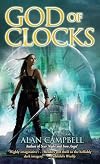
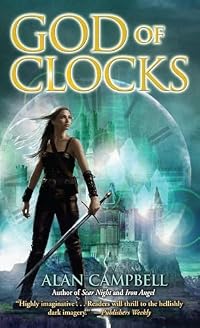
Former assassin Rachel Hael has rejoined the blood-magician Mina Greene and her devious little dog, Basilis, on one last desperate mission to save the world from the grip of Hell. Carried in the jaws of a debased angel, they rush to the final defensive stronghold of the god of time--pursued all the while by the twelve arconites.Tags
Recommendations


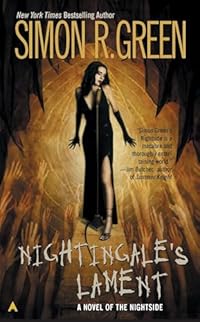
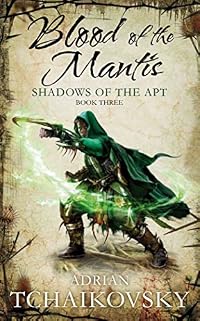
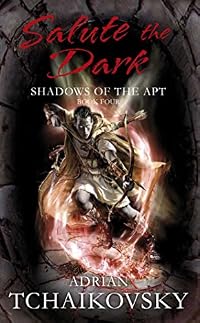
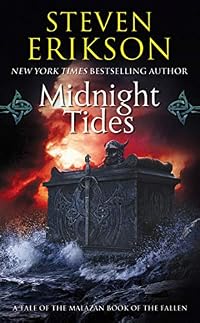

Member Reviews
First things first, if this is your first Alan Campbell book, please put it down, step away, and find the first book in the series. God of Clocks is nominally book three in the so-called Deepgate Codex (the first two are Scar Night and Iron Angel). I say it's "nominally" book three because there's also a prequel novella entitled Lye Street (published by the truly wonderful folks at Subterranean Press). God of Clocks is not a book that you can jump into without understanding the world building of the previous books, so my strong recommendation is to start with Scar Night and go from there.
Before I go further, let me say this: Scar Night is one of the better new fantasy novels out there. It's a fantastically original world with a wide show more range of interesting characters and one of the most compelling urban fantasy landscapes you're likely to run across. I recommend Scar Night without reservation or hesitation.
Now, if you've come this far, I'm assuming you've read the other two books in the Deepgate Codex, so I will forego the summary of what has come before. God of Clocks begin immediately after the end of Iron Angel. The battle of Larnaig is over, and the City of Coreollis has fallen to King Menoa's arconites. Now, the remaining protagonists from Iron Angel must divide into two groups and embark upon a risky two-front strategy involving simultaneous invasions of heaven and hell (this also allows Campbell to engage in the multi-narrator structure apparently mandatory in epic fantasy). Along the way, one group will seek to enter the castle of the angel Sabor, god of clocks, resulting in a threat to Time itself.
Time travel and paradoxes. I must confess that I tend to be skeptical about time travel in a novel. There's something vaguely deus ex machina about it. It also can easily lead an author into self indulgent literary legerdemain. To be blunt: the author stops telling a story and begins showing off, which pushes the writing out in front of the narrative. That being said, Campbell handles this all quite nicely and I think is able to avoid the pitfalls into which a lesser writer would stray.
I enjoyed the book. The characters have their moments, although I don't think they generate an inordinate amount of sympathy. The landscape is very creative; one thing that Campbell does not lack is creativity, the book positively brims with inventive ideas and interesting detail. And yet, I miss Deepgate. One of my favorite characters is John Anchor and that's ironic, really, because I feel that an anchor is what the books lacks. Scar Night had Deepgate as its anchor, and it became the beating heart of the book. Without that anchor, I feel like Campbell has drifted a little in both Iron Angels and God of Clocks. I don't regret the read, but I don't know that he has fulfilled the promise contained in Scar Night. show less
Before I go further, let me say this: Scar Night is one of the better new fantasy novels out there. It's a fantastically original world with a wide show more range of interesting characters and one of the most compelling urban fantasy landscapes you're likely to run across. I recommend Scar Night without reservation or hesitation.
Now, if you've come this far, I'm assuming you've read the other two books in the Deepgate Codex, so I will forego the summary of what has come before. God of Clocks begin immediately after the end of Iron Angel. The battle of Larnaig is over, and the City of Coreollis has fallen to King Menoa's arconites. Now, the remaining protagonists from Iron Angel must divide into two groups and embark upon a risky two-front strategy involving simultaneous invasions of heaven and hell (this also allows Campbell to engage in the multi-narrator structure apparently mandatory in epic fantasy). Along the way, one group will seek to enter the castle of the angel Sabor, god of clocks, resulting in a threat to Time itself.
Time travel and paradoxes. I must confess that I tend to be skeptical about time travel in a novel. There's something vaguely deus ex machina about it. It also can easily lead an author into self indulgent literary legerdemain. To be blunt: the author stops telling a story and begins showing off, which pushes the writing out in front of the narrative. That being said, Campbell handles this all quite nicely and I think is able to avoid the pitfalls into which a lesser writer would stray.
I enjoyed the book. The characters have their moments, although I don't think they generate an inordinate amount of sympathy. The landscape is very creative; one thing that Campbell does not lack is creativity, the book positively brims with inventive ideas and interesting detail. And yet, I miss Deepgate. One of my favorite characters is John Anchor and that's ironic, really, because I feel that an anchor is what the books lacks. Scar Night had Deepgate as its anchor, and it became the beating heart of the book. Without that anchor, I feel like Campbell has drifted a little in both Iron Angels and God of Clocks. I don't regret the read, but I don't know that he has fulfilled the promise contained in Scar Night. show less
Interesting series as a whole. Campbell is really good at imagining and describing these fantastic worlds, but I think that it's also his weakness. He seems to be more interested in developing the world and his vivid descriptions at the expense of the plot. As things start to get interesting, he pauses to describe everything around the characters, and it causes the story to slow down and break up.
Still, it's a worthwhile and interesting read, but you do need have some patience to get through the whole thing.
Still, it's a worthwhile and interesting read, but you do need have some patience to get through the whole thing.
Alan Cambell’s Deepgate Codex is a dark, grimy, Gothic fantasy with elements of dark humor and horror. This thrilling saga is consistently anything but predictable or mundane. It is a madcap tumble through bizarre, lunatic landscapes. Just when you think you know what is coming, guess again!
God of Clocks picks up where Iron Angel left off and sets off at a madcap pace into what should have been a brilliant conclusion to an incredible trilogy. The ending, unfortunately, felt very rushed. It was building to this amazing climax and then it was…over. It just ended. More questions were left unanswered than answered. Plus a whole new set of questions came up! I truly hope that Alan Campbell is not through with these characters and this show more world.
Despite the disappointing, befuddling ending, Alan Campbell’s Deepgate Codex is still a strange and brilliant trilogy. I’ve left so much out of my reviews for fear of saying too much. Read it!
I highly recommend this trilogy for fans of Scott Lynch, Patrick Rothfuss and George R.R. Martin. Like Martin and Lynch, Campbell is not afraid to kill off main characters… although they do not always stay dead… show less
God of Clocks picks up where Iron Angel left off and sets off at a madcap pace into what should have been a brilliant conclusion to an incredible trilogy. The ending, unfortunately, felt very rushed. It was building to this amazing climax and then it was…over. It just ended. More questions were left unanswered than answered. Plus a whole new set of questions came up! I truly hope that Alan Campbell is not through with these characters and this show more world.
Despite the disappointing, befuddling ending, Alan Campbell’s Deepgate Codex is still a strange and brilliant trilogy. I’ve left so much out of my reviews for fear of saying too much. Read it!
I highly recommend this trilogy for fans of Scott Lynch, Patrick Rothfuss and George R.R. Martin. Like Martin and Lynch, Campbell is not afraid to kill off main characters… although they do not always stay dead… show less
God of Clocks picks up soon after [b:Iron Angel|2598001|Iron Angel (Deepgate Codex #2)|Alan Campbell|http://d.gr-assets.com/books/1266953288s/2598001.jpg|2895252] leaves off. It doesn't really add much that's new, though the battle continues, and some of the mysteries are revealed. I'm sorry to say that it's only some.
Campbell wove in a number of intriguing threads in books 1 and 2. He leaves quite a lot of them loose in this third volume. There are two other books in this universe, [b:Lye Street|957379|Lye Street|Alan Campbell|http://d.gr-assets.com/books/1266682207s/957379.jpg|942289] and [b:Damnation for Beginners|14478265|Damnation for Beginners|Alan Campbell|http://d.gr-assets.com/books/1337982084s/14478265.jpg|20120798], but they show more appear to be relatively free standing. With that, I'd have to count this closing book of the trilogy as a disappointment. Where Iron Angel fulfilled its promise in unexpected ways, this book does not. It moves the story forward, but deteriorates at the end into a not very satisfying dead end.
Towards the end of the book, Campbell inserts a time travel segment. (God of Clocks, after all.) As most time travel efforts do, even in defter hands, this ends with a whimper. Campbell pulls of a slight variation of the time travel standards, but only a slight one. And it ends poorly - more a colorful plot mechanism than credible narrative.
As noted, there are two other books in the universe, but I don't expect to buy either of them. I'd sum up this trilogy as interesting and innovative, but hampered by occasionally inadequate description, and brought down by a substandard ending. I can recommend the first book, [b:Scar Night|627204|Scar Night (Deepgate Codex, #1)|Alan Campbell|http://d.gr-assets.com/books/1320430003s/627204.jpg|2128357] as a interesting read, but I'd stop there. You could even stop after book 2, Iron Angel. But in my view, this third book will frustrate and disappoint you. show less
Campbell wove in a number of intriguing threads in books 1 and 2. He leaves quite a lot of them loose in this third volume. There are two other books in this universe, [b:Lye Street|957379|Lye Street|Alan Campbell|http://d.gr-assets.com/books/1266682207s/957379.jpg|942289] and [b:Damnation for Beginners|14478265|Damnation for Beginners|Alan Campbell|http://d.gr-assets.com/books/1337982084s/14478265.jpg|20120798], but they show more appear to be relatively free standing. With that, I'd have to count this closing book of the trilogy as a disappointment. Where Iron Angel fulfilled its promise in unexpected ways, this book does not. It moves the story forward, but deteriorates at the end into a not very satisfying dead end.
As noted, there are two other books in the universe, but I don't expect to buy either of them. I'd sum up this trilogy as interesting and innovative, but hampered by occasionally inadequate description, and brought down by a substandard ending. I can recommend the first book, [b:Scar Night|627204|Scar Night (Deepgate Codex, #1)|Alan Campbell|http://d.gr-assets.com/books/1320430003s/627204.jpg|2128357] as a interesting read, but I'd stop there. You could even stop after book 2, Iron Angel. But in my view, this third book will frustrate and disappoint you. show less
Barely makes four stars because of he poor ending which seemed very rushed and didn't really tie everything up like I had hoped. Still a fantastic read especially with all the time travelling stuff but disappointing as you get into the last 10 or 20 pages and realise it's all going to just end rather abruptly.
God of Clocks (Deepgate Codex)
by Alan Campbell
I like to give a short little spoiler-less review before I really dig into my thoughts.
These aren't bad books. But they aren't great books either. If you're a fan of the fantasy genre, if you like Mieville and Gaiman especially, and if you're in between other books, I'd give these a try. I wouldn't put aside anything you're reading right not to pick them up though.
These books are ripe with imagination and truly original ideas. Played out strongly enough that you'll find yourself thinking about this world for a long time to come. Probably longer than you'll remember the story or the characters themselves. And there's the weakness. And there's the summary, wonderfully imagined world, but show more forgettable characters and story.
And now, details and spoilers.
I didn't mind the time travel at the end. I didn't even really mind the ambiguous ending where things were just "better" all of the sudden.
Well I didn't mind the mechanics of the time travel. That was kinda a fun little experiment in chronology even.
It was the suddenness. I mean that's the thing about time travel, right? If they are there at the end of the book travelling backwards through time, then shouldn't we have seen hints in books one and two? Or even the first half of book three?
I mean they go all the way back to the very very beginning of the history of this world for petes sake. I know you could explain it away with in story mechanics. But it feels forced. Like the mechanics are there to plug a plot hole.
And the characters.... really the only one I found interesting was Carnival. And I guess i found her more fun than interesting. There wasn't much depth to her. just rage. But it was fun to see how deep that rage went. Everyone else just felt like shadows really. I finished the book last night and I'm already forgetting the characters.
I will remember the arconites. The giant metal angels powered by will and indestructible as long as they believe they are.
I'll remember hell, and the moving homes and the trapped souls.
And I'll especially remember Deepgate. The city suspended by chains over a bottomless abyss. show less
by Alan Campbell
I like to give a short little spoiler-less review before I really dig into my thoughts.
These aren't bad books. But they aren't great books either. If you're a fan of the fantasy genre, if you like Mieville and Gaiman especially, and if you're in between other books, I'd give these a try. I wouldn't put aside anything you're reading right not to pick them up though.
These books are ripe with imagination and truly original ideas. Played out strongly enough that you'll find yourself thinking about this world for a long time to come. Probably longer than you'll remember the story or the characters themselves. And there's the weakness. And there's the summary, wonderfully imagined world, but show more forgettable characters and story.
And now, details and spoilers.
I didn't mind the time travel at the end. I didn't even really mind the ambiguous ending where things were just "better" all of the sudden.
Well I didn't mind the mechanics of the time travel. That was kinda a fun little experiment in chronology even.
It was the suddenness. I mean that's the thing about time travel, right? If they are there at the end of the book travelling backwards through time, then shouldn't we have seen hints in books one and two? Or even the first half of book three?
I mean they go all the way back to the very very beginning of the history of this world for petes sake. I know you could explain it away with in story mechanics. But it feels forced. Like the mechanics are there to plug a plot hole.
And the characters.... really the only one I found interesting was Carnival. And I guess i found her more fun than interesting. There wasn't much depth to her. just rage. But it was fun to see how deep that rage went. Everyone else just felt like shadows really. I finished the book last night and I'm already forgetting the characters.
I will remember the arconites. The giant metal angels powered by will and indestructible as long as they believe they are.
I'll remember hell, and the moving homes and the trapped souls.
And I'll especially remember Deepgate. The city suspended by chains over a bottomless abyss. show less
I think the first half was great. But I HATE time travel, unless it's just used simply like to go back in time and solve a mystery. This book dove right into all the paradoxes and other goobley gook that makes time travel so annoying. So minus a star for that and minus a star for that piece of crap Mr. Campbell called an ending. I have NO IDEA how the story ended. I guess everything worked out fine? He might as well have just ended it with "... and they all lived happily ever after."
If you loved the 2nd book (and I did) and you're looking for closure (and I was) - just stop there. You'll get no closure with this book. It is fun but in the end it's like someone ripped out the last chapter.
If you loved the 2nd book (and I did) and you're looking for closure (and I was) - just stop there. You'll get no closure with this book. It is fun but in the end it's like someone ripped out the last chapter.
Members
- Recently Added By
Published Reviews
ThingScore 75
This is an unusual one. It is nominally a fantasy yet about two thirds of the way through we suddenly encounter time travel and temporal paradoxes, which was in retrospect quite elegantly foreshadowed, and it begins to resemble more a work of SF. That was the point that the book, for me, sparked to life. Up to then it had been a (I hesitate to say typical, as Campbell’s skill as a writer show more elevates it above the norm) fantasy and consequently I found it difficult to engage with. And the solution one of the characters adopts to the deleterious consequences of her previous choices on the timeline she has thereby created is well out of the ordinary, not to say drastic.
Far from it merely happening there is also a rationale - a mechanism, no less - given for the ability to travel in time. The God of Clocks for whom the book is named inhabits a building where clocks abound and rooms with portals to other times open and close on their unwinding.
Certain characters from the two previous Deepgate Codex books reappear - Dill, Rachel Hael, John Anchor and also the angel, Carnival. The vision which illuminated the first, Scar Night, though, of the city Deepgate suspended on huge chains over a chasm, has been missing in the latter books, which suffer as a consequence since the setting lies closer to the default mediaeval of the general run of fantasy. There is also too much murder and mayhem for my tastes but this is evidently what aficionados of the form appreciate.
In God Of Clocks there is a quest, of sorts. So far, so fantasy. Yet at its end the status quo ante is not restored - or only in (small) part. This too is more characteristic of SF than of the standard fantasy novel. Is it possible that Campbell secretly yearns to be a writer of SF? Whatever, he is certainly twisting the tropes of fantasy in new directions.
(The book blurb states he lives in south Lancashire. I think that, just perhaps, might be south Lanarkshire.) show less
Far from it merely happening there is also a rationale - a mechanism, no less - given for the ability to travel in time. The God of Clocks for whom the book is named inhabits a building where clocks abound and rooms with portals to other times open and close on their unwinding.
Certain characters from the two previous Deepgate Codex books reappear - Dill, Rachel Hael, John Anchor and also the angel, Carnival. The vision which illuminated the first, Scar Night, though, of the city Deepgate suspended on huge chains over a chasm, has been missing in the latter books, which suffer as a consequence since the setting lies closer to the default mediaeval of the general run of fantasy. There is also too much murder and mayhem for my tastes but this is evidently what aficionados of the form appreciate.
In God Of Clocks there is a quest, of sorts. So far, so fantasy. Yet at its end the status quo ante is not restored - or only in (small) part. This too is more characteristic of SF than of the standard fantasy novel. Is it possible that Campbell secretly yearns to be a writer of SF? Whatever, he is certainly twisting the tropes of fantasy in new directions.
(The book blurb states he lives in south Lancashire. I think that, just perhaps, might be south Lanarkshire.) show less
added by jackdeighton
Lists

New Weird Fiction
69 works; 12 members
Author Information

8 Works 2,130 Members
Some Editions
Series

Common Knowledge
- Canonical title
- God of Clocks
- Original publication date
- 2009-04-14
- Dedication
- For my brothers, Neil and Alex
Thanks to Simon, Peter, Juliet, David and Euan - First words
- In the dark heart of Cosnipol's great wooden skyship they boiled a demigod.
- Last words
- (Click to show. Warning: May contain spoilers.)"That's the good stuff."
- Publisher's editor
- Ulman, Juliet
- Blurbers
- Hal Duncan; Greg Keyes; Sharon Shinn; Sarah Ash; Scott Lynch
Classifications
Statistics
- Members
- 261
- Popularity
- 123,013
- Reviews
- 15
- Rating
- (3.52)
- Languages
- English, German, Italian, Polish
- Media
- Paper, Ebook
- ISBNs
- 11
- ASINs
- 3