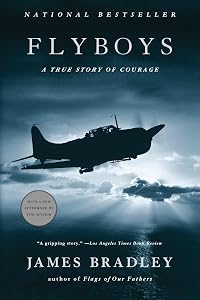
Flyboys: A True Story of Courage
by James Bradley
On This Page
Description
Over the remote Pacific island of Chichi Jima, nine American flyers-Navy and Marine pilots sent to bomb Japanese communications towers there-were shot down. Flyboys, a story of war and horror but also of friendship and honor, tells the story of those men.Over the remote Pacific island of Chichi Jima, nine American flyers-Navy and Marine pilots sent to bomb Japanese communications towers there-were shot down. One of those nine was miraculously rescued by a U.S. Navy submarine. The others show more were captured by Japanese soldiers on Chichi Jima and held prisoner. Then they disappeared. When the war was over, the American government, along with the Japanese, covered up everything that had happened on Chichi Jima. The records of a top-secret military tribunal were sealed, the lives of the eight Flyboys were erased, and the parents, brothers, sisters, and sweethearts they left behind were left to wonder.
Flyboys reveals for the first time ever the extraordinary story of those men. Bradley's quest for the truth took him from dusty attics in American small towns, to untapped government archives containing classified documents, to the heart of Japan, and finally to Chichi Jima itself. What he discovered was a mystery that dated back far before World War II-back 150 years, to America's westward expansion and Japan's first confrontation with the western world. Bradley brings into vivid focus these brave young men who went to war for their country, and through their lives he also tells the larger story of two nations in a hellish war.
With no easy moralizing, Bradley presents history in all its savage complexity, including the Japanese warrior mentality that fostered inhuman brutality and the U.S. military strategy that justified attacks on millions of civilians. And, after almost sixty years of mystery, Bradley finally reveals the fate of the eight American Flyboys, all of whom would ultimately face a moment and a decision that few of us can even imagine.
Flyboys is a story of war and horror but also of friendship and honor. It is about how we die, and how we live-including the tale of the Flyboy who escaped capture, a young Navy pilot named George H. W. Bush who would one day become president of the United States. A masterpiece of historical narrative, Flyboys will change forever our understanding of the Pacific war and the very things we fight for. show less
Tags
Recommendations











Member Recommendations
whymaggiemay both examine prisoners of the Pacific islands
20
Member Reviews
This is a most amazing, heart-breaking and heartfelt telling of what happened to some of our heroic airmen in the Pacific theater during World War II. I was interested in learning about this part of our U.S. military history because, as a child of Holocaust survivors, I mostly learned about WWII from the point of view of Nazi Europe. This book took me in depth to another, even more horrendous, part of this lengthy world conflict.
The more I read about man's inhumanity to man in this narrative, the more in disbelief I remained, yet the more I realized that the evil inclination is just as present in man as the good inclination. This is also part of the Jewish teaching I was given when growing up.
I was horrified by this book. Yet, I really show more appreciate the author's even-handedness in presenting both sides of the conflict by the end of the book. It is now with relief that I can wish my son a pleasant trip to Japan this year and look forward to his stories about that country on his return home.
A line from the end of this book read, "Nations tend to see the other side's war atrocities as systemic and indicative of their culture and their own atrocities as justified or the acts of stressed combatants." This statement is pretty telling about war. I hope that the future brings us all towards better understanding of each other's cultures. show less
The more I read about man's inhumanity to man in this narrative, the more in disbelief I remained, yet the more I realized that the evil inclination is just as present in man as the good inclination. This is also part of the Jewish teaching I was given when growing up.
I was horrified by this book. Yet, I really show more appreciate the author's even-handedness in presenting both sides of the conflict by the end of the book. It is now with relief that I can wish my son a pleasant trip to Japan this year and look forward to his stories about that country on his return home.
A line from the end of this book read, "Nations tend to see the other side's war atrocities as systemic and indicative of their culture and their own atrocities as justified or the acts of stressed combatants." This statement is pretty telling about war. I hope that the future brings us all towards better understanding of each other's cultures. show less
Absolutely Brutal. An incredibly powerful reminder of why almost all countries have a version of Memorial Day and why successful diplomacy beats "winning" a war. It is rare for such a balanced account of gruesome battles, but Bradley does a very admirable job of presenting honest accounts from both the Japanese and American perspectives. The representative photos of the Flyboys before they entered the Pacific greatly personalized the narrative as well. A horrifyingly necessary read in a time when the world is once again headed to massive international conflict. .
This is a hard book to read, but worth the pain. So much of history (all?) is slanted to present the best look at the author's chauvinism. This book seems to be pretty even-handed is showing the gruesome barbarity of war as waged by any nation. Not all nations practice all the possible atrocities, all the time, and the notion that one death is better, or more fair, than another becomes questionable by the end of the book.
I have heard from the children of Pacific War vets that they can never forgive the Japanese, but this book gives several first-hand accounts of just that forgiveness. It is that grace that in the end makes this book readable.
I have heard from the children of Pacific War vets that they can never forgive the Japanese, but this book gives several first-hand accounts of just that forgiveness. It is that grace that in the end makes this book readable.
I bought this book but wasn't very eager to begin reading it. I had read several reviews from people who thought James Bradley was a bit unfair in his characterization of US servicemen. Some people called the book treason in light of the things mentioned in regards to atrocities committed by the United States. I began reading this book and did not want to stop. It was that good. It was not a feel good read. This book does not glorify war as other historians tend to do. You don't get any picture of war other than pure madness. Bradley gives you the reality of war from the individual's point of view. He makes it personal.
I have found that many American history authors write their books from the standpoint of the US having the moral show more superiority. The US always takes the high road and the enemy, whoever it is, is of a lower moral standard. I don't necessarily disagree with that point of view many times. After all, I am an American and I firmly believe that the US has fought in most wars for just reasons. However, history is about more than just one side. It's about more than just one point of view. It is an aggregate of facts and perceptions taken from both sides. The truth is usually somewhere in between.
In light of that, James Bradley lays it all out there when it comes to the actions of the Japanese and the US military. Bad things happened on both sides. I would say that the Japanese committed far more atrocities on an individual level. Cannibalism and beheadings were not common on the US side. The Japanese military seemed to embrace these acts wholeheartedly. Bradley spends a great deal of time talking about the cannibalism and the beheadings. You come to loathe the Japanese military as an institution and yet you find yourself feeling sorry for some of their soldiers who followed orders or risked losing their own lives.
The US does not escape criticism either. Firebombing major cities across Japan was not exactly civil. Thousands of innocent women and children were killed. I consider that a tragedy, and yet I also factor in the mindset of Japan at the time. The author does a good job of explaining that. There was nothing that could have been done diplomatically to bring the war to an end. When looking at the number of US servicemen that would have died conquering the Japanese islands, what choice was there?
War is not pretty. Once you get beyond Hollywood and the romantic image that people have in regards to combat, you will see something that should give everyone pause before they start beating the drums of war. Innocent people will die. Tragedies will occur. Families will be shattered by the deaths of fathers, brothers, and sons. That suffering will occur on both sides. That is the point I believe James Bradley is trying to make in this book. show less
I have found that many American history authors write their books from the standpoint of the US having the moral show more superiority. The US always takes the high road and the enemy, whoever it is, is of a lower moral standard. I don't necessarily disagree with that point of view many times. After all, I am an American and I firmly believe that the US has fought in most wars for just reasons. However, history is about more than just one side. It's about more than just one point of view. It is an aggregate of facts and perceptions taken from both sides. The truth is usually somewhere in between.
In light of that, James Bradley lays it all out there when it comes to the actions of the Japanese and the US military. Bad things happened on both sides. I would say that the Japanese committed far more atrocities on an individual level. Cannibalism and beheadings were not common on the US side. The Japanese military seemed to embrace these acts wholeheartedly. Bradley spends a great deal of time talking about the cannibalism and the beheadings. You come to loathe the Japanese military as an institution and yet you find yourself feeling sorry for some of their soldiers who followed orders or risked losing their own lives.
The US does not escape criticism either. Firebombing major cities across Japan was not exactly civil. Thousands of innocent women and children were killed. I consider that a tragedy, and yet I also factor in the mindset of Japan at the time. The author does a good job of explaining that. There was nothing that could have been done diplomatically to bring the war to an end. When looking at the number of US servicemen that would have died conquering the Japanese islands, what choice was there?
War is not pretty. Once you get beyond Hollywood and the romantic image that people have in regards to combat, you will see something that should give everyone pause before they start beating the drums of war. Innocent people will die. Tragedies will occur. Families will be shattered by the deaths of fathers, brothers, and sons. That suffering will occur on both sides. That is the point I believe James Bradley is trying to make in this book. show less
I really enjoyed this book, but be warned that it is not a feel-good story, as you might think from the title. The basic story of the 5 downed US pilots is just a vehicle for a very well written look at the atrocities of war and how they came to be. It illustrates very well the moral ambiguity of war, and how ethnic, political, social, and military development of a society can propel individuals who may be either good or evil at baseline to perform horrible acts. I agree with another reviewer that it should be read by mature readers only - I wouldn't want my son to read it until he was in (or already out of) college. I think a person needs to be well secure in the belief that humans are basically good before they read something like show more this that will severely challenge that belief. show less
This is the story of the brutal, sadistic, and demonic treatment of our airmen who had the misfortune to end up on Chichi Jima and their courageous fortitude under pressure. It is a well-told story.
Reverent account of the fates of several Navy and Marine Corps airmen who fell into enemy hands on the island of Chichi-Jima during the last months of World War Two. The book attempts at times to tell the whole story of the Pacific air war - that's too big a tale for this short book, but it succeeds when relating the personal stories of a few American POW's and their captors.
Members
- Recently Added By
Lists

Top Five Books of 2014
1,064 works; 397 members

Books Read in 2014
2,344 works; 89 members

Blue Pyramid 1,276 Best Books of All Time
1,248 works; 32 members
Author Information

5+ Works 9,516 Members
Author James Bradley is the son of Doc Bradley, one of the flagraisers. He is a writer and speaker living in Westchester County, New York. (Publisher Provided) James Bradley was born in Wisconsin in 1954. He received a degree in East Asian history from the University of Wisconsin at Madison. He worked in the corporate communications industry in show more the United States, Japan, England and South Africa over the next twenty years. His father, John Bradley, was one of the six men who became famous for being photographed raising the American flag on Mt. Suribachi. He wrote about the six men in his first book Flags of Our Fathers, which was adapted into a movie. His other books include Flyboys and The Imperial Cruise. (Bowker Author Biography) show less
Awards and Honors
Awards
Distinctions
Common Knowledge
- Canonical title
- Flyboys: A True Story of Courage
- Original publication date
- 2003 (1st edition) (1st edition)
- Important places
- Chichi Jima
- Important events
- World War II (1939 | 1945); World War II, Pacific Theater (1941-12-07 | 1945-09-02); Tokyo Fire Raids (1945)
- Dedication
- Jimmy Dye, Glenn Frazier, Floyd Hall, Marve Mershon, Warren Earl Vaughn, Dick Woellhof, Grady York, and the Unidentified Airman, and to all Others
- First words
- The e-mail was from Iris Chang, author of the groundbreaking bestseller The Rape of Nanking.
- Quotations
- Nations tend to see the other side's war atrocities as systemic and indicative of their culture and their own atrocities as justified or the acts of stressed combatants.
"I believe any culture can be indoctrinated into any attitude that the leaders want to teach them." (Glen Berry) - Last words
- (Click to show. Warning: May contain spoilers.)"Hello," he said, "this is Warren."
- Original language
- English
- Disambiguation notice
- Full title (2003): Flyboys : a true story of courage / James Bradley
Classifications
Statistics
- Members
- 3,022
- Popularity
- 5,918
- Reviews
- 45
- Rating
- (3.99)
- Languages
- Czech, English
- Media
- Paper, Audiobook, Ebook
- ISBNs
- 27
- UPCs
- 3
- ASINs
- 10