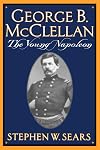
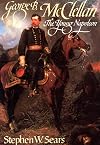
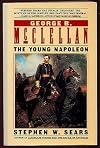
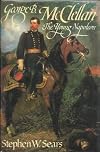
George B. McClellan: The Young Napoleon
by Stephen W. Sears
On This Page
Description
"Sears has finally unraveled the mystique of this complex, brilliant Civil War general... A fascinating story" (James M. McPherson, author of Battle Cry of Freedom ). "Commander of the Northern army in the Civil War, Gen. George McClellan saw himself as God's chosen instrument for saving the Union. Self-aggrandizing, with a streak of arrogant stubbornness, he set himself above President Lincoln, whom he privately called 'the Gorilla.' To 'the young Napoleon, ' as McClellan's troops dubbed show more him, abolition was an 'accursed doctrine.' Fond of conspiracy plots, he insisted that the Lincoln administration had traitorously conspired to set him up for military defeat. Although he constantly anticipated one big, decisive battle that would crush the South, he squandered one military opportunity after another, and, if Sears is correct, he was the worst strategist the Army of the Potomac ever had. Based on primary sources, letters, dispatch books, diaries, newspapers, this masterly biography is an astonishing portrait of an egotistical crank who could snatch defeat from the jaws of victory." - Publishers Weekly "Engagingly written and thoroughly researched, Sears's persuasive critique is the best and most complete biography of this controversial general." - Library Journal "The best biography of McClellan ever published. Sears uses intensive research, including new material, to document the tormented, wasted military career of a talented man... The enigma of McClellan has never been explained so well... Historians should be grateful." - The Washington Post Book World show lessTags
Recommendations















Member Reviews
There are few generals of the Civil War as controversial as George Brinton McClellan. His command of the Army of the Potomac during the early years of the Civil War generated a storm of criticism and sparked debates still being waged by historians today. Drawing heavily on McClellan’s letters and other documents, Stephen Sears offers a convincing assessment of McClellan and his military career, one that places him squarely in the ranks of McClellan’s critics. His biography of the general reveals McClellan to have been a man with many gifts, of which he was perhaps too well aware. His outsized self-regard generated constant disputes with his superiors, as he saw what was often reasonable arguments as driven by implacable opponents show more determined to destroy him.
These tendencies were only magnified by the pressures of the command. Had McClellan been as successful as his prewar reputation promised little may have come of this, but his Peninsula campaign was hobbled by "Little Mac"'s insistence on caution, one magnified by a continual fear that he faced an enemy superior in numbers. As a result, he was continually outfoxed by his opponents, making his "Young Napoleon" label (the source of the book's subtitle) ironic rather than accurate. Such was his stature, though, that even after his dismissal he was well-regarded enough to be selected as the Democratic Party's presidential candidate in their losing 1864 campaign.
Sears's focus in this book is on McClellan's Civil War service, as he spends only four of the book’s seventeen chapters on McClellan's life before and after the conflict that defined his historical legacy. Though regrettable in some respects, it is an understandable decision to focus on the years in which he made his greatest historical impact and which continues to generate debate even today. In the end, though, it makes for a sad tale of a man who, for all of his gifts, ultimately came to be defined by his limitations. show less
These tendencies were only magnified by the pressures of the command. Had McClellan been as successful as his prewar reputation promised little may have come of this, but his Peninsula campaign was hobbled by "Little Mac"'s insistence on caution, one magnified by a continual fear that he faced an enemy superior in numbers. As a result, he was continually outfoxed by his opponents, making his "Young Napoleon" label (the source of the book's subtitle) ironic rather than accurate. Such was his stature, though, that even after his dismissal he was well-regarded enough to be selected as the Democratic Party's presidential candidate in their losing 1864 campaign.
Sears's focus in this book is on McClellan's Civil War service, as he spends only four of the book’s seventeen chapters on McClellan's life before and after the conflict that defined his historical legacy. Though regrettable in some respects, it is an understandable decision to focus on the years in which he made his greatest historical impact and which continues to generate debate even today. In the end, though, it makes for a sad tale of a man who, for all of his gifts, ultimately came to be defined by his limitations. show less
This is a difficult book for me to evaluate. I was prejudiced when I picked it up. My only purpose in reading it was out of a sense of duty.
The sub-title, "The Young Napoleon" is one of the greater misnomers of all time. He might have seen himself this way but he was far from it. It is inarguable that he was a superb organizer and even trainer but there any comparison with Napoleon ceases. Was McClellan afraid to fight his army? Clearly, he was nearly utterly unwilling to utter the command "GO." He always saw his opponent as vastly outnumbering his forces and he spent a lot of time demanding re-enforcements. He did fight one of the bloodiest battles of the Civil War at Antietam but he does not seem to have been hugely troubled by the show more loss of life so he could take the view of a general who realized battles cannot be fought without loss of life. Some historians believe that he could have ended the war at Antietam had he been bolder. We'll never know.
As a person, McClellan seems to have been an incredible dunderhead believing himself to be better than any with whom he had to do business. show less
The sub-title, "The Young Napoleon" is one of the greater misnomers of all time. He might have seen himself this way but he was far from it. It is inarguable that he was a superb organizer and even trainer but there any comparison with Napoleon ceases. Was McClellan afraid to fight his army? Clearly, he was nearly utterly unwilling to utter the command "GO." He always saw his opponent as vastly outnumbering his forces and he spent a lot of time demanding re-enforcements. He did fight one of the bloodiest battles of the Civil War at Antietam but he does not seem to have been hugely troubled by the show more loss of life so he could take the view of a general who realized battles cannot be fought without loss of life. Some historians believe that he could have ended the war at Antietam had he been bolder. We'll never know.
As a person, McClellan seems to have been an incredible dunderhead believing himself to be better than any with whom he had to do business. show less
George B. McClellan by all accounts should have been the definitive war hero during the Civil War given his military record yet he failed to accomplish what so many were relying on him to do … crush the Confederacy. He was obsessively cautious and always had an excuse of why it was impossible to advance on the enemy. He was delusional when it came to the enemy, exaggerating claims over their numbers. He was overly cautious about the well being of his soldiers, never wanting to risk losing them for what he deemed a lost cause. He saw himself as God’s chosen instrument for saving the Union and figured all would play out in his favor. Eventually he was relieved of his command somewhat bitter and arrogant as to why it had happened never show more taking responsibility for his actions. He always said I never signed up to be in charge I was assigned to do so and out of loyalty I did what was expected. He later said the same about politics when running for president of the United States and being nominated and elected as governor to New Jersey. McClellan’s innermost thoughts are expressed through his letters to his wife and family revealing his true self which was one of loyalty and patriotism to his country. show less
Ratings
Members
- Recently Added By
Published Reviews
ThingScore 100
Sears, former editor with American Heritage magazine and author of the definitive history of the Battle of Antietam (Landscape Turned Red, 1983), now turns his full attention on one Civil War figure, Major General George Brinton McClellan. McClellan is remembered as a man whose grasp exceeded his talent. He was the soldier who earned command of the Army of the Potomac early in the Civil War, show more made it one of the best-disciplined forces in the world, and then found himself credited with only one Pyrrhic victory, Antietam. In the wartime election of 1864, he was the one public figure self-confident enough to run against Lincoln; in the years after the Civil War, he was also one of the few men in America who failed to realize that George McClellan had never possessed the potential to be either an American President or an American Caesar. Sears deftly compresses the general's very full prewar life and pursuits into a few chapters. At age 34, with outbreak of civil war, McClellan became the second-highest ranking general in the North....(click on link for more review) show less
added by MsMixte
Author Information

41+ Works 5,765 Members
Stephen W. Sears is the author of many award-winning books on the Civil War, including Gettysburg, Landscape Turned Red, and Chancellorsville, all winners of the Fletcher Pratt Award. He lives in Connecticut.
Common Knowledge
- People/Characters
- George B. McClellan; Brooks Adams; Alexander II, Emperor of Russia; Edward Porter Alexander; Joseph W. Alsop; Richard Heron Anderson (as General R. H. Anderson) (show all 22); John A. Andrew; William H. Aspinwall; John Jacob Astor; Edward Dickinson Baker (as Colonel Edward D. Baker); George Bancroft; Nathaniel P. Banks; Francis Channing Barlow (as Francis C. Barlow); Samuel Barlow (as Samuel L. M. Barlow); John G. Barnard; T. J. Barnett; Edward Bates; John Beatty (Lieutenant Colonel); P. G. T. Beauregard; Henry W. Bellows; August Belmont; James Gordon Bennett
- Important places
- USA; Antietam Creek, Pennsylvania-Maryland, USA; Atlanta, Georgia, USA
- Important events
- American Civil War (1861 | 1865)
- Dedication
- In memory of Robert S. Fletcher
- Blurbers
- McPherson, James M.; Keneally, Thomas
Classifications
Statistics
- Members
- 415
- Popularity
- 75,070
- Reviews
- 3
- Rating
- (3.97)
- Languages
- English
- Media
- Paper, Ebook
- ISBNs
- 5
- ASINs
- 9