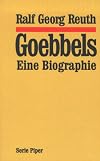
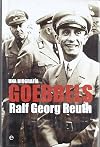
Goebbels
by Ralf Georg Reuth
On This Page
Description
The story of the THird Reich as seen through the life of Hitler's propaganda minister, Joseph Goebbels.Tags
Recommendations


















Member Reviews
Rather lacking in the sense of a central thesis that takes a specific approach to Goebbels' life, despite, at the time, Reuth getting access to heretofore restricted archival material from the DDR. Instead, Reuth gives us an unending timeline, where one even never seems to outweigh another in terms of historical importance or personal development of the subject. What insight the biography gives is through implication. For example, the hesitation, paranoia, and fear that comes through Goebbels' writing--even though it was composed with an eye to future generations reading it as a "great man's" thoughts--actually works to distance the propaganda minister from the responsibility (and guilt) traditionally ascribed to him. At least until show more 1943-44, when his role as an architect of the Holocaust becomes predominant. But for earlier years, Reuth's narrative makes it seem as if Goebbels is somewhat fearful of being out of the loop and thus always on the second or even third rung of Nazi decision making. Bormann, Goering, Himmler, Hess, and even Ribbentrop, Rosenberg, and Lammers are depicted often as more powerful and influential than Goebbels. But none of this is actually stated as such by Reuth. As I say, it is done more through the implication of what the reader is made to feel and understand through the narrative Reuth constructs out of Goebbels' journals and diaries.
Another thing implied is a picture of Goebbels as a complete non-entity without Hitler. The early part of his life is undistinguished and, in fact, boring. Only when he attaches himself to the NSDAP, first through Gregor Strasser and, later, Hitler, does he become a more animated being. I am willing to buy into this notion more firmly than the relatively power dependent figure discussed above. For without Hitler, it is clear that Goebbels was nothing. The "poison dwarf" only found purpose through anger and revenge at the bourgeois representatives of capital or the reactionary aristocratic class all of whom he felt conspired against people such as himself to keep them from their proper place in society. Only the arrival of Hitler into his life allowed Goebbels to focus his disappointments and anger in a way that gave value to the Nazis.
Lastly, there is an emphasis on Goebbels' commitment to socialism and a volkisch socialist revolution. He never let that notion go. It was the mechanism through which he wanted to overthrow the old aristocratic order when he was younger. And towards the end of the war it fed his fantasies about making a separate peace with the Soviets in order to fight the Allies on one front.
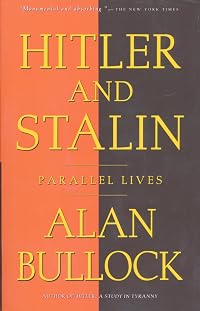
The tone of this biography, meanwhile, tends towards reflecting an objective attitude. On that score Reuth is much more akin to earlier biographers of the Nazis, such as Alan Bullock, although even Bullock was much more eager to assess and place blame on the likes of Goebbels for their actions than is Reuth. show less
Another thing implied is a picture of Goebbels as a complete non-entity without Hitler. The early part of his life is undistinguished and, in fact, boring. Only when he attaches himself to the NSDAP, first through Gregor Strasser and, later, Hitler, does he become a more animated being. I am willing to buy into this notion more firmly than the relatively power dependent figure discussed above. For without Hitler, it is clear that Goebbels was nothing. The "poison dwarf" only found purpose through anger and revenge at the bourgeois representatives of capital or the reactionary aristocratic class all of whom he felt conspired against people such as himself to keep them from their proper place in society. Only the arrival of Hitler into his life allowed Goebbels to focus his disappointments and anger in a way that gave value to the Nazis.
Lastly, there is an emphasis on Goebbels' commitment to socialism and a volkisch socialist revolution. He never let that notion go. It was the mechanism through which he wanted to overthrow the old aristocratic order when he was younger. And towards the end of the war it fed his fantasies about making a separate peace with the Soviets in order to fight the Allies on one front.
The tone of this biography, meanwhile, tends towards reflecting an objective attitude. On that score Reuth is much more akin to earlier biographers of the Nazis, such as Alan Bullock, although even Bullock was much more eager to assess and place blame on the likes of Goebbels for their actions than is Reuth. show less
Chilling story of one of Hitler's most infamous followers. He had a fairly interesting life, and I picked up a lot of details from the book (his reading tastes, personality, religious faith, what drove him to follow Hitler). A bit dry in style, but still good.
It is twenty yea-s since a serious biography of Goebbels was published. Ralf Georg Reuth here draws on a wealth of new source material to produce a brilliant account of Goebbels' life which will stand as the definitive biography for years to come. Some of this source material was held by the East Germans and Russians and has only been available since the fall of the Berlin wall. Goebbels was a small, spindly, highly intelligent man with a clubfoot and an inferiority complex who rose to power with Hitler and was, of all the Nazis, the strongest advocate of the extermination of the Jews. Reuth describes Goebbels' childhood in a strict, Catholic, lower-middle-class family; his poverty; his many affairs with women above his station; his show more political activity and intrigues in Berlin for Hitler; his career in the Third Reich; his wife and children; his suicide.
The use of previously unavailable archival information and diaries, and carefully excavated eyewitness accounts, makes this not only an important social document, but a fascinating and gripping study of a monster. show less
The use of previously unavailable archival information and diaries, and carefully excavated eyewitness accounts, makes this not only an important social document, but a fascinating and gripping study of a monster. show less
Nov 11, 2014 (Edited)Italian
Ratings
Members
- Recently Added By
Author Information

21+ Works 264 Members
Some Editions
Awards and Honors
Awards
Common Knowledge
- Canonical title
- Goebbels
- Original title
- Goebbels : eine Biographie
- People/Characters
- Joseph Goebbels
- Original language
- German
Classifications
- Genres
- History, Nonfiction, Biography & Memoir, General Nonfiction
- DDC/MDS
- 943.086092 — History & geography History of Europe Central Europe: Germany, Austria, Switzerland, Czech, Poland, Hungary Historical periods of Germany Germany 1866- Third Reich 1933-1945 History, geographic treatment, biography Biographies, Diaries And Journals
- LCC
- DD247 .G6 .R4913 — History of Europe, Asia, Africa and Oceania Germany History of Germany History By period Modern, 1519- 19th-20th centuries Revolution and Republic, 1918-
- BISAC
Statistics
- Members
- 150
- Popularity
- 219,168
- Reviews
- 3
- Rating
- (3.25)
- Languages
- English, German, Polish, Spanish
- Media
- Paper, Ebook
- ISBNs
- 12
- ASINs
- 3