
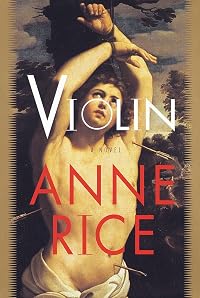
Violin
by Anne Rice
On This Page
Description
A woman from New Orleans steals a violin from a ghost and becomes the musician she always wanted, finding herself acclaimed on two continents. Part fantasy, part reality.Tags
Recommendations


Member Reviews
I received this book as a gift when the mass market paperback first came out since my aunt knew I liked Anne Rice. I was rather excited, and the start is good. However, the book quickly became plodding. There's a wholoe bunch of characters which really add nothing to the story or plot. Ms. Rice wrote some beautiful sentences and paragraphs and this book did have some good parts. I found the story of the Violin (the instrument in the book) and its origins to be interesting and the best part of the book. However, this book fell flat overall. The premise was interesting enough, but this book simply was not as good as her earlier works.
If you're a die-hard Anne Rice fan/completist, you will want to read this book, but otherwise, it's simply show more not worth your time if you're looking for something worthwhile and enjoyable to read. Without Ms. Rice's name, this book just wouldn't stand on its own. show less
If you're a die-hard Anne Rice fan/completist, you will want to read this book, but otherwise, it's simply show more not worth your time if you're looking for something worthwhile and enjoyable to read. Without Ms. Rice's name, this book just wouldn't stand on its own. show less
Now I really get the fascination and sensuality of Anne Rice's novels. The novel opens with the protagonist, Triana, absorbing herself in the music of the masters after her husband, Karl's, death in their home in New Orleans. Serenading her outside her window as the relatives come into her cave of loneliness is a long-haired, sensuous musician, Stefan. Stefan's story begins to come out in bits and pieces and forms the second third of the novel. We learn about the many deaths in Triana's life and her guilt about them (probably shades of the author's own life), including the horror of a child growing up in an alcoholic household. We then journey to mid-19th century Austria, to the home of Russian aristocrats, and enter Stefan's journey show more with all its passion and horror. A step into another world that is still quite absorbing, and the first Anne Rice book I've ever read. show less
In reading the reviews I didn't know what to expect as they were all over the place. For an Anne Rice book, there were far more unhappy or disappointed ratings. Well after forcing myself to finish this book I fully understand. Only Anne Rice could write such a so well written story and basically have it feel almost like gibberish! The writing was very good, great descriptions and very interesting thoughts. Sounds absolute delightful, doesn't it!? Well it wasn't delightful, it was brutal. I did enjoy what I think was the premises, hate to say it this way, but I'm guessing. This book, to be effective, should have been told in half the pages. At points in the book, especially in the first part, the descriptions were so very very very very show more detailed and over done that I was sick of the story before it ever started, if it did actually every start.
It reminded me of the first James Bond book I ever tried to read, it took Ian Fleming an entire page to describe how Bond wanted a martini made. Prior to that it was already a bit verbose, for me as a young teenager, and I simply could not take any more. My best friend loved James Bond and thought they were great books BUT I never picked up another one after that. I was horrified of what I felt was drivel.
Im much older now and more tolerant and understanding of writers quirks and Anne Rice has more than her fair share of quirks. In this instance, in my opinion, this is a book the puts all of Anne Rice's quirks on display and foregoes any real story, overwhelming the reader with the primary characters emotions ad nauseam. Admitted the principle character appeared to have some significant emotional issues. Unfortunately Anne's presentation of these issues, and how they seemingly controlled her life, simply lost whatever story there was within them. Yes there was a story. Emotions detracted from the story rather than made the story, as that is my assessment of the intent.
The one comment that might be redeeming is that maybe Anne was trying to translate dark poetry into a novel. For all her quirks, I enjoy most of her works and quite disappointed in this one. Even for those who love Anne Rice I would have a difficult time recommending this book. show less
It reminded me of the first James Bond book I ever tried to read, it took Ian Fleming an entire page to describe how Bond wanted a martini made. Prior to that it was already a bit verbose, for me as a young teenager, and I simply could not take any more. My best friend loved James Bond and thought they were great books BUT I never picked up another one after that. I was horrified of what I felt was drivel.
Im much older now and more tolerant and understanding of writers quirks and Anne Rice has more than her fair share of quirks. In this instance, in my opinion, this is a book the puts all of Anne Rice's quirks on display and foregoes any real story, overwhelming the reader with the primary characters emotions ad nauseam. Admitted the principle character appeared to have some significant emotional issues. Unfortunately Anne's presentation of these issues, and how they seemingly controlled her life, simply lost whatever story there was within them. Yes there was a story. Emotions detracted from the story rather than made the story, as that is my assessment of the intent.
The one comment that might be redeeming is that maybe Anne was trying to translate dark poetry into a novel. For all her quirks, I enjoy most of her works and quite disappointed in this one. Even for those who love Anne Rice I would have a difficult time recommending this book. show less
Anne Rice's Violin tells the story of two charismatic figures bound to each other by a passionate commitment to music as a means of rapture, seduction, and liberation. At the novel's center: a uniquely fascinating woman, Triana, and the demonic fiddler Stefan, a tormented ghost who begins to prey upon her, using his magic violin to draw her into a state of madness. But Triana sets out to resist Stefan, and the struggle thrusts them both into a terrifying supernatural realm. Violin flows abundant with the history, the drama, and the romantic intensity that have become synonymous with Anne Rice at her incomparable best.
The beginning to middle was sparse and unnecessarily so, making the whole book more of a chore to read than anything else. Nevertheless, trudging through it one is (slightly) rewarded with a cameo appearance from Stefan's teacher and one of the world's greatest composers. As a personal preference, the very last chapters were in my opinion the best (and not because the book would soon be over, either). Overall, unlikeable book, because Triana is a dull character who doesn't even whine complainingly.
Considering the level of all Anne Rice's books that I have already read, this one was a complete let down. Perhaps I was expecting something different, as sexy as the books from her vampires series. How upset I was when I found that this book actually tells the story of a woman in such a depression level that it get actually annoying. Amidst her sorrow, this woman meets the ghost of a violinist.
You hopefully suppose that the story is going to improve now that the woman met the subject of the book, but this is actually where the book gets awfully tedious. During the 400 pages of the book, the only thing that they do is argue and scream at each other. As you go through the story you get to the conclusion that, in spite of the bonds that show more tight them together in the story, whatever still keeps them together is not clear. It's not the violin. Seriously, it CAN'T be the violin because Triana barely played violin. Stephan's attitudes can be justified. Not Triana's.
As for the main character, she tells her weird, non-violin related, stupid story about her bizarre past.
The only part of the book that I effectively liked (and, in my opinion, should've been the core of the book since the first page) was Stephan's story, which could have been better explored but only lasted 10 or 20 pages. show less
You hopefully suppose that the story is going to improve now that the woman met the subject of the book, but this is actually where the book gets awfully tedious. During the 400 pages of the book, the only thing that they do is argue and scream at each other. As you go through the story you get to the conclusion that, in spite of the bonds that show more tight them together in the story, whatever still keeps them together is not clear. It's not the violin. Seriously, it CAN'T be the violin because Triana barely played violin. Stephan's attitudes can be justified. Not Triana's.
As for the main character, she tells her weird, non-violin related, stupid story about her bizarre past.
The only part of the book that I effectively liked (and, in my opinion, should've been the core of the book since the first page) was Stephan's story, which could have been better explored but only lasted 10 or 20 pages. show less
If you've never read a book of Anne Rice don't start with this! The first few volumes of the Vampire Chronicles are classic... but unfortunately this book never will. The most of the book is simply boring (except the past sequences) written in a way too sentimental baroquesqe periods. Just for fans!
Members
- Recently Added By
Lists

Ghost Stories That Thrill Us
256 works; 115 members
Author Information

132+ Works 189,697 Members
Anne Rice was born Howard Allen O'Brien on October 4, 1941 in New Orleans, Louisiana. She received a bachelor's degree in political science in 1964 and master's degree in English and creative writing in 1972 from San Francisco State University. She published her first short story in 1965 called October 4, 1948. Her first book, Interview with the show more Vampire, was published in 1976. It was made into a film starring Brad Pitt, Kirsten Dunst, and Tom Cruise in 1994. She wrote various series in the same genre including the rest of the Vampire Chronicles, the Mayfair Witches books, and The Wolf Gift Chronicles. Her novel, Feast of All Saints, became a Showtime mini-series in 2001. Her other works include Cry to Heaven, Servant of the Bones, and Violin. In 1998, Rice returned to the Catholic Church and for some time only wrote for Christ or about Christ. These works include Christ the Lord: Out of Egypt, Christ the Lord: The Road to Cana, and Called Out of Darkness. Anne Rice died on December 11, 2021 at the age of 80. (Bowker Author Biography) show less
Awards and Honors
Distinctions
Work Relationships
Common Knowledge
- Canonical title
- Violin
- Original publication date
- 1997
- People/Characters
- Triana; Stefan; Ludwig van Beethoven; Niccolo Paganini; Karl
- Important places
- Louisiana, USA; New Orleans, Louisiana, USA; Rio de Janeiro, Rio de Janeiro, Brasil; Vienna, Austria
- Epigraph
- And the Angel of the lord declared unto Mary, and she conceived of the Holy Ghost.
- Dedication
- For Annelle Blanchard, M.D. For Rosario Tafaro For Karen and as always and forever For Stan and Christopher and Michele Rice, John Preston, and Victoria Wilson and in tribute to the talent of Isaac Stern and Leila Josefowicz.
- First words
- What I seek to do here perhaps cannot be done in words.
- Last words*
- (Click to show. Warning: May contain spoilers.)I played for them - with surety and ease, without fear and with no anger - I played for them a sorrowful song, a glorious song, a joyful one.
*Some information comes from Common Knowledge in other languages. Click "Edit" for more information.
Classifications
Statistics
- Members
- 3,680
- Popularity
- 4,378
- Reviews
- 24
- Rating
- (3.05)
- Languages
- 5 — English, French, Hungarian, Portuguese, Spanish
- Media
- Paper, Audiobook, Ebook
- ISBNs
- 39
- ASINs
- 22