Panegyric, Volumes 1 and 2
by Guy Debord
On This Page
Description
Guy Debord's silver-tongue-in-cheek autobiography mixes precision and pastiche in a whirlwind account of philosophy, exploit, and inebriation. From the stark professions of Volume I to the illustrated sequences of Volume 2, Panegyric confronts us with a figure who strategically, demonically tried to wrest life from the disabling modern 'spectacle.'Tags
Recommendations

































Member Reviews
This is something of a biography, though not perhaps in an entirely conventional sense. I hadn't heard of Guy Debord before coming across this in a book shop, so I will briefly describe why he might be of interest.
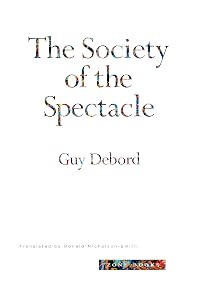
He is best known for his activities in the 50s to 70s, where he generally acted as something between a revolutionary, avant-garde intellectual, and drunk. For example, he set up a quasi-political group called the Situationist International, and was involved in leading the Paris uprising in 1968, occupying the Sorbonne and encouraging the strikes and civil unrest. However he also came up with influential concepts such as the "Society of the Spectacle", in his book of the same name, which is a diagnosis of an illness of society show more affected by mass media, consumer culture, cultural homogenisation, and marketing. These are some of the same issues noted ten years before in Hoggart's Uses of Literacy, but in this case exposed not in an academic, politically neutral manner, but with the intention to encourage revolution against this state of affairs. Debord was a keen observer of these issues when they were only a fraction as bad as they are today, so his thoughts on these matters are now of even greater importance. Debord was also among the first to be involved with the concept of "psycho-geography", which is having a bit of a resurgance in some circles at the moment. It's not worth describing what exactly "psycho-geography" is here, but it was initially a method influenced by the Surrealists, and partly involved wandering around cities at random using a map from another city, then describing the locales that were found.
However, neither of these things are the main topic of this book here, which is more of a justification or view into Debord's life. He writes in a slightly unusual way, and there was the odd phrase here and there where he conspicuously lacks modesty, which reminded of Nietzsche's strange biography, Ecce Homo. Generally his style of writing and its content are interesting though, and there are a lot of quotes.
While the first half of the book is written in chapters, the second half is more of a picture scrapbook. This won't be of interest to everyone, but might be of interest to those who have read some of Debord or are interested in related thinkers. show less
He is best known for his activities in the 50s to 70s, where he generally acted as something between a revolutionary, avant-garde intellectual, and drunk. For example, he set up a quasi-political group called the Situationist International, and was involved in leading the Paris uprising in 1968, occupying the Sorbonne and encouraging the strikes and civil unrest. However he also came up with influential concepts such as the "Society of the Spectacle", in his book of the same name, which is a diagnosis of an illness of society show more affected by mass media, consumer culture, cultural homogenisation, and marketing. These are some of the same issues noted ten years before in Hoggart's Uses of Literacy, but in this case exposed not in an academic, politically neutral manner, but with the intention to encourage revolution against this state of affairs. Debord was a keen observer of these issues when they were only a fraction as bad as they are today, so his thoughts on these matters are now of even greater importance. Debord was also among the first to be involved with the concept of "psycho-geography", which is having a bit of a resurgance in some circles at the moment. It's not worth describing what exactly "psycho-geography" is here, but it was initially a method influenced by the Surrealists, and partly involved wandering around cities at random using a map from another city, then describing the locales that were found.
However, neither of these things are the main topic of this book here, which is more of a justification or view into Debord's life. He writes in a slightly unusual way, and there was the odd phrase here and there where he conspicuously lacks modesty, which reminded of Nietzsche's strange biography, Ecce Homo. Generally his style of writing and its content are interesting though, and there are a lot of quotes.
While the first half of the book is written in chapters, the second half is more of a picture scrapbook. This won't be of interest to everyone, but might be of interest to those who have read some of Debord or are interested in related thinkers. show less
I'm a little bit wary of reviewing these volumes. Guy Debord gave very precise instructions about its translation from French into other languages. I read it in English without the certainty that those instructions have been met. On the one hand it is a short, eclectic collections of musings by the author about himself, his place in society and society itself. On the other it is a memoir of an influential radical. And on yet another it is an enigmatic puzzle. It is something that can be skimmed through and enjoyed or taken word by word to provoke thought and ideas. Well worth the read any way you care to take it.
Feels a bit slight. Or perhaps in the years since I studied this stuff, I've lost the context.
Quite enjoyed the chapter on drinking, though.
Quite enjoyed the chapter on drinking, though.
Guy Debord writes:
Never to have given more than very slight attention to questions of money, and absolutely none to the ambition of holding some brilliant post in society, is a trait so rare among my contemporaries that some will no doubt consider it incredible, even in my case. It is, however, true, and it has been so constantly and abidingly verifiable that the public will just have to get used to it.
Our only public activities, which remained rare and brief in the early years, were meant to be completely unacceptable: at first, primarily due to their form; later, as they acquired depth, primarily due to their content. They were not accepted.
This time, what was an absolutely new phenomenon, which naturally left few traces, was that the show more sole principle accepted by all was precisely that there could be no more poetry or art – and that something better had to be found. show less
Never to have given more than very slight attention to questions of money, and absolutely none to the ambition of holding some brilliant post in society, is a trait so rare among my contemporaries that some will no doubt consider it incredible, even in my case. It is, however, true, and it has been so constantly and abidingly verifiable that the public will just have to get used to it.
Our only public activities, which remained rare and brief in the early years, were meant to be completely unacceptable: at first, primarily due to their form; later, as they acquired depth, primarily due to their content. They were not accepted.
This time, what was an absolutely new phenomenon, which naturally left few traces, was that the show more sole principle accepted by all was precisely that there could be no more poetry or art – and that something better had to be found. show less
Facturas de Mas Crisaran en el interior
May 22, 2023Spanish
Ratings
Members
- Recently Added By
Author Information

78+ Works 4,888 Members
Series
Belongs to Publisher Series
Radical Thinkers (42 - Set 4(6))
Common Knowledge
- Canonical title*
- Panegirico
- Original title
- Panégyrique, Tome Premier & Tome Second
- Original publication date
- 1989 - 1997
*Some information comes from Common Knowledge in other languages. Click "Edit" for more information.
Classifications
- Genres
- Biography & Memoir, Nonfiction, Philosophy, General Nonfiction
- DDC/MDS
- 303.484 — Society, government, & culture Social sciences, sociology & anthropology Social processes Social change Causes of change Purposefully induced change
- LCC
- HN440 .R3 .D43413 — Social sciences Social history and conditions. Social problems. Social reform Social history and conditions. Social problems. By region or country
- BISAC
Statistics
- Members
- 223
- Popularity
- 146,575
- Reviews
- 5
- Rating
- (3.76)
- Languages
- English, Italian, Portuguese, Spanish
- Media
- Paper, Ebook
- ISBNs
- 12
- ASINs
- 5