On This Page
Description
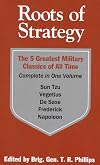
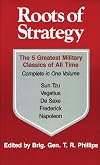
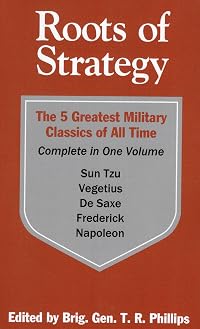
Writings of Sun Tzu, Vegetius, Marshal Maurice de Saxe, Frederick the Great, and Napoleon.Tags
Recommendations

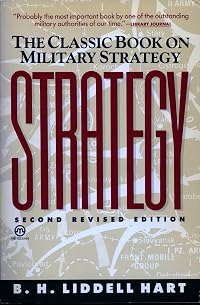










Member Reviews
Reprinted in 1985 as "Roots of Strategy: The 5 Greatest Military Classics of All Time". Seems to overlook Scipio and Clausewitz.
Frederick is considered the founder of modern Germany, although during his life he only ruled a small state, in two geographically disconnected parts which he little expanded--Silesia excepting. All other soldiers came to imitate him, to this day.
Frederick was a liberal. He allowed freedom of the press and speech. He conducted his personal affairs and those of the State with economy and discipline--not understood by the peerages of useless royalty. Public flogging was abolished. (Not abolished in America until 1813.) At the end of the Seven Years War, he devoted his energies to rebuilding the countryside show more and cities which had suffered. TACTICS: by conditioning his troops, he moved his army and charged more rapidly; by drill, Prussian foot could load and fire muskets twice as rapidly, and would not fire during the attack when it was useless to do so. Use of flank marches, oblique order, smaller columns, mobile horse artillery, increased howitzers in play, and lighter horse. Influenced by Saxe, Frederick was a great influence on Napoleon, who was not fooled by the uniforms, and the polish of the drill. show less
Frederick is considered the founder of modern Germany, although during his life he only ruled a small state, in two geographically disconnected parts which he little expanded--Silesia excepting. All other soldiers came to imitate him, to this day.
Frederick was a liberal. He allowed freedom of the press and speech. He conducted his personal affairs and those of the State with economy and discipline--not understood by the peerages of useless royalty. Public flogging was abolished. (Not abolished in America until 1813.) At the end of the Seven Years War, he devoted his energies to rebuilding the countryside show more and cities which had suffered. TACTICS: by conditioning his troops, he moved his army and charged more rapidly; by drill, Prussian foot could load and fire muskets twice as rapidly, and would not fire during the attack when it was useless to do so. Use of flank marches, oblique order, smaller columns, mobile horse artillery, increased howitzers in play, and lighter horse. Influenced by Saxe, Frederick was a great influence on Napoleon, who was not fooled by the uniforms, and the polish of the drill. show less
kann man immer wieder gebrauchen, wenn man männliches Denken verstehen will
Dec 8, 2006German
Ratings
Members
- Recently Added By
Author Information
All Editions
Series

Work Relationships
Common Knowledge
- Canonical title
- Roots of Strategy
- Alternate titles
- Roots of Strategy: The 5 Greatest Military Classics of All Time
- People/Characters
- Sun Tzu, General; Vegetius, Publius (or Flavius) Renatus (or Flavius); de Saxe, Maréchal Count Maurice; Frederick the Great, King of Prussia; Napoleon Bonaparte
- First words
- Foreward This collection contains the most influential military classics written prior to the nineteenth century.
- Last words
- (Click to show. Warning: May contain spoilers.)It is thus of all professions that in which subalterns should use the largest initiative.
Classifications
Statistics
- Members
- 292
- Popularity
- 110,364
- Reviews
- 3
- Rating
- (4.22)
- Languages
- English
- Media
- Paper, Ebook
- ISBNs
- 4
- UPCs
- 1
- ASINs
- 6