
Up Front
by Bill Mauldin
On This Page
Description
A collection of the work of cartoonist Bill Mauldin reflects his experiences as an enlisted man, in cartoons that capture the humor, boredom, and horror of the common soldier's daily life.Tags
Recommendations
























Member Reviews
FIRST READING 2014
"I feel like a fugitive from th' law of averages" (Willy to Joe, hunkered down in rubble with tracers mapping a spiderweb above their heads.) [39]
Mauldin's essay a plaintive defense of the dogface infantryman, seemingly prompted by his observation of their treatment at home, and perhaps some criticism directed at his own work. Mauldin's focus in his comics is on infantry over other soldiers; he was an infantry sergeant, but apart from that chose to describe the wartime life of the everyday soldier.
Mauldin notes he's a cartoonist not a writer, and the essay is by way of background for the comics. It serves that purpose quite well, skillfully introducing individual comics on nearby pages without stopping to say so, but show more Mauldin's a better writer than this implies. He wrote for the Stars and Stripes for years during the war, and who knows what other roles besides.
The result is a war mosaic built from micro-history tiles, a view of WWII from the perspective of soldiers: not strategy, campaigns, or even specific battles, but life for soldiers participating in same. Mud, a guarded optimism, a persistence if not dedication, the closest thing to family until they get back home. Wonder if this perspective influenced others celebrated for it: John Keegan for The Face of Battle, or indirectly, Howard Zinn. On the other hand, none of these writers invented the idea of telling history from the standpoint of the masses rather than the rulers.
SECOND READING 2024
Having read The Thin Red Line in the interval between my two readings of Up Front, Mauldin's implicitly agreeable outlook on U.S. military leadership during WWII (whether the officer class or civilian) is suddenly very evident. James Jones's view of military ineptitude is far more caustic and deep-lying. Part of this, I realise, is Mauldin's intent to capture the experience of the doggies he portrays, and portray them such his readers look on sympathetically, rather than critique the military per se. The contrast is striking, nevertheless. show less
"I feel like a fugitive from th' law of averages" (Willy to Joe, hunkered down in rubble with tracers mapping a spiderweb above their heads.) [39]
Mauldin's essay a plaintive defense of the dogface infantryman, seemingly prompted by his observation of their treatment at home, and perhaps some criticism directed at his own work. Mauldin's focus in his comics is on infantry over other soldiers; he was an infantry sergeant, but apart from that chose to describe the wartime life of the everyday soldier.
Mauldin notes he's a cartoonist not a writer, and the essay is by way of background for the comics. It serves that purpose quite well, skillfully introducing individual comics on nearby pages without stopping to say so, but show more Mauldin's a better writer than this implies. He wrote for the Stars and Stripes for years during the war, and who knows what other roles besides.
The result is a war mosaic built from micro-history tiles, a view of WWII from the perspective of soldiers: not strategy, campaigns, or even specific battles, but life for soldiers participating in same. Mud, a guarded optimism, a persistence if not dedication, the closest thing to family until they get back home. Wonder if this perspective influenced others celebrated for it: John Keegan for The Face of Battle, or indirectly, Howard Zinn. On the other hand, none of these writers invented the idea of telling history from the standpoint of the masses rather than the rulers.
SECOND READING 2024
Having read The Thin Red Line in the interval between my two readings of Up Front, Mauldin's implicitly agreeable outlook on U.S. military leadership during WWII (whether the officer class or civilian) is suddenly very evident. James Jones's view of military ineptitude is far more caustic and deep-lying. Part of this, I realise, is Mauldin's intent to capture the experience of the doggies he portrays, and portray them such his readers look on sympathetically, rather than critique the military per se. The contrast is striking, nevertheless. show less
The essays and cartoons in this book are an American treasure.
I've read a lot of books about war, but this is the truest one. Bill Mauldin was a soldier in WW2 who saw action in North Africa, Italy, and France. An infantryman with a talent for drawing, he was selected for the 45th Division paper and then Stars & Stripes, where his "Willie and Joe" cartoons became instant classics, depicting the truth of life on the front lines, where ordinary men struggled through mud, bad food, long marches, and the all too present threat of random death. There heroism is in their endurance, their ability to deal with the absurdity of war while remaining human, and never letting their buddies down.
I've read a lot of books about war, but this is the truest one. Bill Mauldin was a soldier in WW2 who saw action in North Africa, Italy, and France. An infantryman with a talent for drawing, he was selected for the 45th Division paper and then Stars & Stripes, where his "Willie and Joe" cartoons became instant classics, depicting the truth of life on the front lines, where ordinary men struggled through mud, bad food, long marches, and the all too present threat of random death. There heroism is in their endurance, their ability to deal with the absurdity of war while remaining human, and never letting their buddies down.
I really enjoyed this one and the text helped clarify a lot of the cartoons which I didn’t get at first pass. I got this book via the death of a family friend from her hoarded family home. It still reeks of mildew even after cleaning and deodorizing and many of the pages are scribbled on with pencil and crayon by an anonymous toddler. It’s in rough shape, but this is going to sit on the shelves of my library as long as I’m around. The cartoons were well-rendered imho and the text was clear, concise, and very informative. Here’s a particularly powerful passage early on in the book:
Many celebrities and self-appointed authorities have returned from quick tours of war zones […] and have put out their personal theories to show more photographers and reporters. Some say the American soldier is the same clean-cut young man who left his home; others say morale is sky-high at the front because everybody’s face is shining for a great cause.
They are wrong. The combat man isn’t the same clean-cut lad because you don’t fight a kraut by Marquis of Queensbury rules. You shoot him in the back. You blow him apart with mines, you kill or maim him the quickest and most effective way you can with the least danger to yourself. He does the same to you. He tricks you and cheats you, and if you don’t beat him at his own game you don’t live to appreciate your own nobleness.
But you don’t become a killer. No normal man who has smelled and associated with death ever wants to see any more of it. In fact, only men who are even going to want bloody noses in a fist fight after this war will be those who want people to think they were tough combat men, when they weren’t. The surest way to become a pacifist is to join the infantry. [pgs.12-14, emphasis mine]
I really don’t have much to say about this one, other than more people need to take some time and read this one. I have another six quotes I noted and would have included them here if I had more to say but instead, I’ll leave you with this one:
I’ve lost friends who were ordinary people and just wanted to live and raise a family and pay their taxes and cuss the politicians. I’ve also lost friends who had brilliant futures. Gregor Duncan, one of the finest and most promising artists I’ve ever known, was killed at Anzio while making sketches for Stars and Stripes. It’s a pretty tough kick in the stomach when you realize what people like Greg could have done if they had lived. It’s one of the costs of war we don’t often remember. [pg.57] show less
Many celebrities and self-appointed authorities have returned from quick tours of war zones […] and have put out their personal theories to show more photographers and reporters. Some say the American soldier is the same clean-cut young man who left his home; others say morale is sky-high at the front because everybody’s face is shining for a great cause.
They are wrong. The combat man isn’t the same clean-cut lad because you don’t fight a kraut by Marquis of Queensbury rules. You shoot him in the back. You blow him apart with mines, you kill or maim him the quickest and most effective way you can with the least danger to yourself. He does the same to you. He tricks you and cheats you, and if you don’t beat him at his own game you don’t live to appreciate your own nobleness.
But you don’t become a killer. No normal man who has smelled and associated with death ever wants to see any more of it. In fact, only men who are even going to want bloody noses in a fist fight after this war will be those who want people to think they were tough combat men, when they weren’t. The surest way to become a pacifist is to join the infantry. [pgs.12-14, emphasis mine]
I really don’t have much to say about this one, other than more people need to take some time and read this one. I have another six quotes I noted and would have included them here if I had more to say but instead, I’ll leave you with this one:
I’ve lost friends who were ordinary people and just wanted to live and raise a family and pay their taxes and cuss the politicians. I’ve also lost friends who had brilliant futures. Gregor Duncan, one of the finest and most promising artists I’ve ever known, was killed at Anzio while making sketches for Stars and Stripes. It’s a pretty tough kick in the stomach when you realize what people like Greg could have done if they had lived. It’s one of the costs of war we don’t often remember. [pg.57] show less
The quintessential collection of WWII soldier cartoons. Funny and touching, and filled with the difference between dust and mud. They can both be horrible, and bring one close to suicide. The text, also by Mauldin is fresh and immediate. If America had been as receptive to his later book, "Back Home", it would have found a compassionate voice for the 1950's. As it is, do read "Up Front", but not at a single sitting. This kind of art requires savouring. Then find a copy of "Back Home"!
This is a gritty, absolutely real account of life up front during World War II, written, cartooned and published during the war. The version I read was especially wonderful because the paper was extremely thin,cheap material, showing the era when it was printed.
I've seen Mauldin's cartoons before, but didn't understand many of them until he explained them here. His is the rawest, most straight-forward description of life as a U.S. "dogface" (infantry soldier) during WWII that I've ever read, but is of course prejudiced, since he too was a doggie and sufffered alongside them in the wet foxholes.
If it had just been the writing, without the cartoons to illustrate them or to discuss, it wouldn't have been as enjoyable or special, but show more together it was fascinating. show less
I've seen Mauldin's cartoons before, but didn't understand many of them until he explained them here. His is the rawest, most straight-forward description of life as a U.S. "dogface" (infantry soldier) during WWII that I've ever read, but is of course prejudiced, since he too was a doggie and sufffered alongside them in the wet foxholes.
If it had just been the writing, without the cartoons to illustrate them or to discuss, it wouldn't have been as enjoyable or special, but show more together it was fascinating. show less
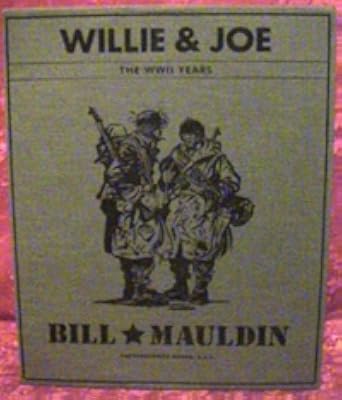
General Patton was not a fan of Bill Mauldin's, but War Correspondent Ernie Pyle, General Eisenhower, the Pulitzer Prize committee of 1945, readers who made this book a bestseller in 1945 and, not least, many if not most of the combat infantrymen, affectionately known as "dogfaces", who were the subjects of Bill Mauldin's cartoons for Stars and Stripes, were big fans and now, after reading Up Front, so am I. Up Front is a great introduction to Mr. Mauldin's editorial cartoons written during his time in Italy during World War II, including not only the cartoons themselves, but also text explaining the ideas and incidents leading up to the cartoons. The "stars" of the cartoon series are two enlisted "dogfaces", Willie and Joe and most of show more the cartoons show bits and pieces of their daily lives in the infantry on the front lines. Willie and Joe grew to be symbols of the enlisted infantrymen of World War II and in 2010, ended up on a postage stamp, along with their creator, Bill Mauldin. I was glad to be given this insight into the life of the everyday enlisted World War II soldier and recommend this work contributed by someone who was there. show less
I first read this book in the late 1970's having checked it out from the public library. I've probably read it twenty times or more since (having bought my own copies). I think it is a down-to-earth description of warfare from those most intimately familiar with it. Mauldin's text goes along with the cartoons and helps explain them which, with the passage of time, "understanding" likely fades.
Members
- Recently Added By
Lists

Publisher's Weekly NON-Fiction list - 1912 - 1975
486 works; 4 members
Author Information

26+ Works 2,270 Members
Some Editions
Awards and Honors
Distinctions
Common Knowledge
- Canonical title
- Up Front
- Original publication date
- 1944
- People/Characters
- Willie [Willie & Joe]; Joe [Willie & Joe]
- Important events
- World War II
- Dedication
- To Jean
- First words
- My business is drawing, not writing, and this text is pretty much background for the drawings.
- Last words
- (Click to show. Warning: May contain spoilers.)Until the doc can go back to his chrome office and gallstones and the dogface can go back to his farm and I can go back to my wife and son, that is the closest to home we can ever get.
Classifications
Statistics
- Members
- 1,050
- Popularity
- 24,631
- Reviews
- 18
- Rating
- (4.26)
- Languages
- English, German
- Media
- Paper
- ISBNs
- 9
- ASINs
- 44