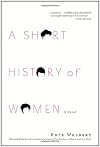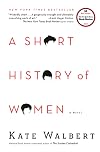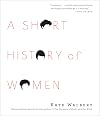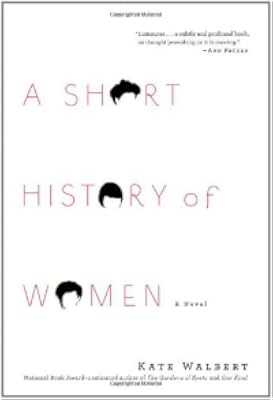
A Short History of Women
by Kate Walbert
On This Page
Description
Inspired by a suffragist ancestor who starved herself to promote the integration of Cambridge University, Evie refuses to marry and Dorothy defies a ban on photographing the bodies of her dead Iraq War soldier sons, a choice that embarrasses Dorothy's daughters.Tags
Recommendations







Member Recommendations
Member Reviews
A complicated tapestry tracking generations of women, each trying to discover themselves and what each believes worth fighting for. I really enjoy the story, but having listened to the audiobook there were moments when the changing narrators were hard to follow. I'd recommend reading rather than listening.
Keeping track of the relationships was sometimes difficult but I loved the writing. It was a very personal read, Walbert gave voice to experiences I'd thought were singular and named without limiting experiences and feelings that seemed nameless.
This is a superb piece of writing. A book to be savored. Contained within a mere 237 pages is a family saga that jumps back and forth through time like the work of Proust, with a style that recalls Virginia Woolf's "To the Lighthouse". The family springs from Dorothy Trevor Townsend, who starves herself to death to call attention to women's suffrage in 1914. The story is told through her eyes, and through those of her descendants, restless, questing women all, up to the present day. The book raises a lot of questions regarding the place of women in society, using Florence Nightingale as a touchstone. These women seem to feel like outsiders in a society in which they comprise a slight majority. They rebel, as Nightingale did, against show more being "a continuation", but nevertheless continue in the rebellious path of their matriarch, Dorothy. I have to say though, that these restless, disconnected feelings aren't the province of women alone. Anyone who's lived the human condition should be able to relate. show less
Kate Walbert’s slender novel is just what the title says it is: a short history of American women in the 20th century, told through five generations of a single family. The absent matriarch is Dorothy Trevor Townsend: a determined and troubled suffragette who dies on a hunger strike, leaving behind a daughter and a son. As the generations pass, her legacy echoes through the lives of her female descendents. These women all share Dorothy’s thirst for agency and justice, for companionship and security. But the times that surround them are ever changing, affecting them every bit as much as their heritage. From Evelyn, Dorothy’s brilliant and controlled daughter blazing trails in the American education system to teach chemistry at show more Barnard College, to Dora, Dorothy’s great-great-granddaughter, whose Facebook profile declares her political views “State of Terror” and religious views “Animist”, each of these women is remarkable in her own right, and at the same time could be any woman of her time.
Walbert’s great triumph in A Short History of Women is her perfectly clear, concise prose. Each chapter, narrated by a different character, is brief and breathtaking: a single moment suspended in time. While she can hardly avoid making a political statement with such a book as this, her empathy lies squarely with her characters, exactly as it should. show less
Walbert’s great triumph in A Short History of Women is her perfectly clear, concise prose. Each chapter, narrated by a different character, is brief and breathtaking: a single moment suspended in time. While she can hardly avoid making a political statement with such a book as this, her empathy lies squarely with her characters, exactly as it should. show less
This should be required reading for anyone with an interest in women’s history/studies/literature. A Short History of Women follows five generations of women, the descendants of a fictional suffragette, Dorothy Townsend who starved herself to death for her cause. The novel traces how her legacy echoes in the lives of the future generations of women in her family despite their wide range of personal choices and experiences. Walbert is a master of powerful restraint. She is simultaneously subtle and direct, wry and heartbreaking, brave and tender. This allows her to reflect on topics that people have been discussing for ages (i.e. “The Woman Question”, women’s rights, women’s voices, etc.) while avoiding the pitfalls of common show more clichés. I don’t necessarily see Walbert bringing new ideas to the table, but she has touchingly shown that while (most) women’s rights have been won and the women’s movement has withered, women are still asking themselves – and each other – the same questions. “They were always waiting, waiting to hear, respectfully listening. Who are we? they wanted to know. Tell us, who? And what should we do next?”I found one review by a man who read the book based on his wife’s recommendation. He said he simply couldn’t connect with the characters, didn’t understand their experiences, and his wife said he just couldn’t understand women’s experience in a male-dominated society. I think that’s a load of crap. Walbert expertly demonstrates that the collective experience of women that has transcended time and various realities is the search to fill some common void. These women are all trying to become this person they’ve never met and couldn’t possibly know, they have something to say but can’t find the words, they just want to do something, but what? “What we want is something to do, something to live for.” Who can’t relate to that?My favorite character was Dorothy’s niece, who in her mid-70’s rediscovers Florence Nightingale, creates a personal rebellion and starts searching for her own voice. And when she finds it, she speaks loudly: “Why Florence Nightingale? Because she was, first and foremost, BRAVE. She made a different life. She got blood on her hands. She did not accept what she could not abide. When she finally understood that her bonds were made of straw, she broke them, or bent them, or whatever you'd do to straw.” … “And we have such a road ahead! It is only at the brink of death that we are truly present for our life. And isn't that an outrage?” show less
I really liked some of the characters in this book, but I felt there was not enough time with any of them. Great first line: "Mum starved herself for suffrage." But the reasons never really became clear. I couldn't decide if it was a true political stand, because Dorothy's motives were only alluded to, or if it was really an act of selfishness to leave her young children as orphans. Subsequent generations take their own "stand" or try to find their own ways, but the story didn't hang together enough for me. However, I would read more from this author as I liked her descriptive style.
A Short History of Women was one of the ten best books of the year, according to The New York Times. It’s easy to see how this story of five generations of women, all dealing with quintessential “women’s issues” through five generations of the same family, might impress with its postmodern techniques of jumping through time from 1914 to 2003 to 1898 back to 1914; changing viewpoint and even voice with each section; and reproducing blogs and Facebook pages. I, however, found the book cold and uninvolving, with characters about whom I cared not at all and no real plot. As a fictional treatise on the history of women, it has some merit, but as a novel I found it wanting.
The book begins with the death of Dorothy Trevor Townsend, an show more Englishwoman who starves herself to promote the cause of women’s suffrage. She leaves behind two young children, a girl and a boy, who are split up between relatives and never see one another again. Why this first Dorothy – there are a few others as the years go by – takes it into her head to abandon her family is never adequately explored, though we are told that she gave her body because she had nothing else to give. But no one seems to pay much attention to her sacrifice, and there is no evidence that it had any effect on Parliament’s decision, finally, to grant women the right to vote.
It certainly had an effect on her children, however – and her grandchildren, it seems, and down through the ages. Her daughter, Evelyn, is the only character who is in the least likeable, and that is probably because she tells her story in the first person, the only character in the book to do so. Evelyn lives a life different in almost every way from what was expected of women in her era, probably another reason she is at all appealing. But she is the type of woman who holds others at arm’s length, and her lack of close emotional attachments makes her life seem to pass too lightly. In fact, under the circumstances described in the book, she would have been a truly revolutionary figure, but we see little of that.
The women in later generations are stereotypes of contemporary women of different ages. Dorothy Townsend Barrett is a member of the generation that gave rise to the Baby Boom, a woman who married just after the end of World War II and promptly had two children, just as she was supposed to according to the mores of the time. Somewhat later, a third child comes along unexpectedly, and Walbert writes of this woman in 2007 taking her daughter on a play date and winding up having a play date of her own with the other girl’s mother. Walbert presents a picture of modern women as anxious, helicopter parents who have little emotional attachment to their children, but are eager to see that those children get the proper type of everything, from the right schools to the proper toys.
A Short History of Women appears intended to hold up a mirror to who we are and where we came from. But if modern women are really as emotionally bereft as the women in this book, we are missing out on a great deal of life. Ultimately, I found this book to be deadening in its portrayal of women supposedly attempting to find their own voices and to make sense of their lives; nothing at all seems to make sense to them, or fundamentally to matter to them. There is no emotion expressed in any way except obliquely, impliedly, no love of mother for child or woman for man. Walbert seems to be saying that women cannot know who they are unless they abjure all connections to anyone but themselves. It makes for a grim, cold and depressing reading experience. show less
The book begins with the death of Dorothy Trevor Townsend, an show more Englishwoman who starves herself to promote the cause of women’s suffrage. She leaves behind two young children, a girl and a boy, who are split up between relatives and never see one another again. Why this first Dorothy – there are a few others as the years go by – takes it into her head to abandon her family is never adequately explored, though we are told that she gave her body because she had nothing else to give. But no one seems to pay much attention to her sacrifice, and there is no evidence that it had any effect on Parliament’s decision, finally, to grant women the right to vote.
It certainly had an effect on her children, however – and her grandchildren, it seems, and down through the ages. Her daughter, Evelyn, is the only character who is in the least likeable, and that is probably because she tells her story in the first person, the only character in the book to do so. Evelyn lives a life different in almost every way from what was expected of women in her era, probably another reason she is at all appealing. But she is the type of woman who holds others at arm’s length, and her lack of close emotional attachments makes her life seem to pass too lightly. In fact, under the circumstances described in the book, she would have been a truly revolutionary figure, but we see little of that.
The women in later generations are stereotypes of contemporary women of different ages. Dorothy Townsend Barrett is a member of the generation that gave rise to the Baby Boom, a woman who married just after the end of World War II and promptly had two children, just as she was supposed to according to the mores of the time. Somewhat later, a third child comes along unexpectedly, and Walbert writes of this woman in 2007 taking her daughter on a play date and winding up having a play date of her own with the other girl’s mother. Walbert presents a picture of modern women as anxious, helicopter parents who have little emotional attachment to their children, but are eager to see that those children get the proper type of everything, from the right schools to the proper toys.
A Short History of Women appears intended to hold up a mirror to who we are and where we came from. But if modern women are really as emotionally bereft as the women in this book, we are missing out on a great deal of life. Ultimately, I found this book to be deadening in its portrayal of women supposedly attempting to find their own voices and to make sense of their lives; nothing at all seems to make sense to them, or fundamentally to matter to them. There is no emotion expressed in any way except obliquely, impliedly, no love of mother for child or woman for man. Walbert seems to be saying that women cannot know who they are unless they abjure all connections to anyone but themselves. It makes for a grim, cold and depressing reading experience. show less
Members
- Recently Added By
Lists

Biggest Disappointments
606 works; 168 members

Simon & Schuster
136 works; 4 members

Books That Changed Our Perspective
423 works; 168 members
Author Information

12+ Works 1,693 Members
Kate Walbert has published fiction and articles in the Paris Review, DoubleTake, The New York Times, and numerous other publications. The recipient of fellowships from Yaddo, MacDowell, and the National Endowment for the Arts, as well as a grant from the Connecticut Commission on the Arts, she is the author of "Where She Went," a short story show more collection. Her most recent novel is called A Short History of Women. Walbert teaches writing at Yale University and lives in New York City and Branford, Connecticut. (Publisher Provided) show less
Awards and Honors
Awards
Common Knowledge
- Canonical title
- A Short History of Women
- Original publication date
- 2009-06-16
- Dedication
- THis book is for Delia, and for Iris
- First words
- Mum starved herself for suffrage, Grandmother claiming it was just like Mum to take a cause too far.
- Last words
- (Click to show. Warning: May contain spoilers.)I climb into bed with her, into that place where she is and if I get caught, if I am found here, I am sorry, I will tell them: There is nowhere else to be.
- Blurbers
- Packer, Ann
Classifications
Statistics
- Members
- 655
- Popularity
- 44,308
- Reviews
- 46
- Rating
- (3.18)
- Languages
- Dutch, English, German
- Media
- Paper, Audiobook, Ebook
- ISBNs
- 10
- ASINs
- 4