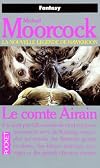
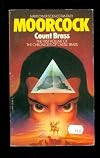
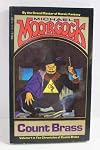
Count Brass
by Michael Moorcock
Chronicles of Count Brass (1), Hawkmoon (5), The Eternal Champion (Hawkmoon novel 5)
On This Page
Description
'War, albeit with the Dark Empire, was clean compared to this...' Years after the defeat of the evil empire of Granbretan, Duke Dorian Hawkmoon and his beloved Yisselda have rebuilt the Kamarg, the land once ruled by Yisselda's father, the late Count Brass. But their lives are turned upside down when the spectre of the dead count returns, possessed of the belief that he can return to life if he slays the one who led him to his death in the Battle of Londra: his former ally - and now show more son-in-law - Dorian Hawkmoon. show lessTags
Recommendations















Member Recommendations

KevinRubin "The Jewel in the Skull" is the first book of the History of the Runestaff series, to which the "Chronicle of Castle Brass" is a sequel series.
Member Reviews
This is the first in the Count Brass series, but follows the previous series about the Runestaff. I read that many years ago and no longer have it, so it's just as well that this begins with a summary and drops in various other aspects of the back story as the book goes on.
Duke Dorian Hawkmoon is enjoying a quiet life ruling the Kamarg, a marshy area with its own unique wildlife such as horned horses (and based on the real-life area of France, known as the Camargue). The setting is an alternative Europe, seemingly in the far future after a period where a technological society - possibly ours - collapsed. Five years before the story begins, Hawkmoon and his friends were instrumental in overthrowing a tyrannical regime known as the Dark show more Empire, based on a reborn technology and operating from their version of Great Britain. The rulers of the regime supposedly all perished at the Battle of Londra (London) or just before, yet Dorian's tranquil existence, married to the daughter of Count Brass (who also died in the battle), and enjoying family life with her and their son and daughter, begins to be blighted when local people start to eye him with disapproval.
He discovers that rumour is rife that the ghost of Count Brass is out in the marshes at night telling passersby that Dorian betrayed him and led him to his death. Determined to quash this, he rides out to meet the apparent imposter, but discovers things are not that simple. This man is a younger version of the Count, and soon he brings younger versions of Dorian's other close friends to meet him, who also died in the struggle against Granbretan. They have been brought there by someone they term the oracle, who has told them they are in a netherworld - for them, it is endless night - but that they will be restored to their former lives if they kill Dorian who otherwise will lead them all to their deaths. Luckily, he persuades them to doubt the oracle, and when the creature reappears in a strange pyramidal device which can appear and disappear, it transpires he is one of the supposedly deceased ex-rulers of the former Dark Empire. Dorian and the others set out on an epic journey to find out what is going on and why this man is having to work through intermediaries to kill him. The answers when they come lead to heartbreak for Dorian.
This is a short page-turning read, not a profound story, but colourful and with a zany cast of characters including a villain who wears a mask with a working and chiming clock in it. The ending is the best part, as Dorian truly pays a terrible price and yet is left wondering whether the past he remembers is real or imaginary. show less
Duke Dorian Hawkmoon is enjoying a quiet life ruling the Kamarg, a marshy area with its own unique wildlife such as horned horses (and based on the real-life area of France, known as the Camargue). The setting is an alternative Europe, seemingly in the far future after a period where a technological society - possibly ours - collapsed. Five years before the story begins, Hawkmoon and his friends were instrumental in overthrowing a tyrannical regime known as the Dark show more Empire, based on a reborn technology and operating from their version of Great Britain. The rulers of the regime supposedly all perished at the Battle of Londra (London) or just before, yet Dorian's tranquil existence, married to the daughter of Count Brass (who also died in the battle), and enjoying family life with her and their son and daughter, begins to be blighted when local people start to eye him with disapproval.
He discovers that rumour is rife that the ghost of Count Brass is out in the marshes at night telling passersby that Dorian betrayed him and led him to his death. Determined to quash this, he rides out to meet the apparent imposter, but discovers things are not that simple. This man is a younger version of the Count, and soon he brings younger versions of Dorian's other close friends to meet him, who also died in the struggle against Granbretan. They have been brought there by someone they term the oracle, who has told them they are in a netherworld - for them, it is endless night - but that they will be restored to their former lives if they kill Dorian who otherwise will lead them all to their deaths. Luckily, he persuades them to doubt the oracle, and when the creature reappears in a strange pyramidal device which can appear and disappear, it transpires he is one of the supposedly deceased ex-rulers of the former Dark Empire. Dorian and the others set out on an epic journey to find out what is going on and why this man is having to work through intermediaries to kill him. The answers when they come lead to heartbreak for Dorian.
This is a short page-turning read, not a profound story, but colourful and with a zany cast of characters including a villain who wears a mask with a working and chiming clock in it. The ending is the best part, as Dorian truly pays a terrible price and yet is left wondering whether the past he remembers is real or imaginary. show less
“Count Brass” by Michael Moorcock was better reading this time around than the first time. I was a big Michael Moorcock fan as a teenager in the 80’s, reading and rereading most of his books numerous times, but the Castle Brass series was one I just couldn’t get into. But shopping for used books I thought I’d give it another try, now that I’m several decades older.
It picks up with Hawkmoon five years after the events of the Runestaff series of books, after Hawkmoon and his companions, not all of whom survived, brought down the evil Granbretan empire. In this Hawkmoon is living his life, enjoying peace and calm with his wife and children, when there are rumors that his dead companions are out in the marshes outside town, show more calling him a traitor and blaming him for their deaths, turning his fellow living citizens against him.
He heads out to investigate and begins an adventure with his five years’ dead companions, or their doppelgängers. They find out that at least one of the evil scientists from Granbretan survived the last battle and is manipulating time and space for revenge.
They’re successful but the story concludes with a bittersweet ending, and an opening to continue the series.
Overall it was enjoyable to escape and read this again. I definitely enjoyed it more now some decades after the first time I tried reading it. But it was also harder to suspend disbelief about some of Moorcock’s descriptions, like two guys in full plate armor, not making any noise as they bound out of a chariot. I didn’t feel like I was “in the story” the way his other books made me feel when I was a teenager.
I’d definitely recommend to a Moorcock fantasy fan, but not as an introduction to Moorcock’s work. This series is very much a sequel to his “History of the Runestaff” series. show less
It picks up with Hawkmoon five years after the events of the Runestaff series of books, after Hawkmoon and his companions, not all of whom survived, brought down the evil Granbretan empire. In this Hawkmoon is living his life, enjoying peace and calm with his wife and children, when there are rumors that his dead companions are out in the marshes outside town, show more calling him a traitor and blaming him for their deaths, turning his fellow living citizens against him.
He heads out to investigate and begins an adventure with his five years’ dead companions, or their doppelgängers. They find out that at least one of the evil scientists from Granbretan survived the last battle and is manipulating time and space for revenge.
They’re successful but the story concludes with a bittersweet ending, and an opening to continue the series.
Overall it was enjoyable to escape and read this again. I definitely enjoyed it more now some decades after the first time I tried reading it. But it was also harder to suspend disbelief about some of Moorcock’s descriptions, like two guys in full plate armor, not making any noise as they bound out of a chariot. I didn’t feel like I was “in the story” the way his other books made me feel when I was a teenager.
I’d definitely recommend to a Moorcock fantasy fan, but not as an introduction to Moorcock’s work. This series is very much a sequel to his “History of the Runestaff” series. show less
Even though the Empire of Granbretan had fallen. Even though he and his wife had survived the bloody battle. Even though he had two wonderful children. Even though all this, Dorian Hawkmoon had regrets. And somehow, those regrets began to manifest themselves in the people of Kamarg. They no longer showed his respect and love - openly questioning his right to rule Kamarg; suggesting that he led the beloved Count Brass to his death for purely personal reasons; hinting that he was a murderer. Of course, there was a great deal of truth to this - and Hawkmoon wanted nothing more than to return his dead friend to life. Unbeknownst to him, his deepest desire was about to be granted - but the price may be more than he ever considered.
A very, show more very cool story with an interesting take on regret and what might happen if you could turn back the hands of time and undo something. In the end, would you really want to? How much would you be willing to give up? show less
A very, show more very cool story with an interesting take on regret and what might happen if you could turn back the hands of time and undo something. In the end, would you really want to? How much would you be willing to give up? show less
The first in the Count Brass trilogy. This series again features both Dorian Hawkmoon and Count Brass, but mostly Dorian Hawkmoon, so the title is a bit confusing. This trilogy occurs after the Runestaff series, also featuring Dorian Hawkmoon. While Dorian is not as famous as Elric or Corum, he is my 2nd favorite incarnation of the Eternal Champion. The strange world of Dorian Hawkmoon, set in some half-fantasy, half-technology future/alternate Earth is an interesting world, though mostly confined to what we would call Europe. Standard Moorcock, a very short, fascinating fantasy, but I liked the premise and the writing is better than some of his others.
The continuing story of Hawkmoon, with a twist at the end I never saw coming.
Ratings
Members
- Recently Added By
Author Information

659+ Works 65,135 Members
Michael Moorcock, 1939 - Writer Michael Moorcock was born December 18, 1939 in Mitcham, Surrey, England. Moorcock was the editor of the juvenile magazine Tarzan Adventures from 1956-58, an editor and writer for the Sexton Blake Library and for comic strips and children's annuals from 1959-61, an editor and pamphleteer for Liberal Party in 1962, show more and became editor and publisher for the science fiction magazine New Worlds in 1964. He has worked as a singer-guitarist, has worked with the rock bands Hawkwind and Blue Oyster Cult and is a member of the rock band Michael Moorcock and the Deep Fix. Moorcock's writing covers a wide range of science fiction and fantasy genres. "The Chronicles of Castle Brass" was a sword and sorcery novel, and "Breakfast in the Ruins: A Novel of Inhumanity" uses the character Karl Glogauer as a different person in different times. Karl participates in the political violence of the French Revolution, the Paris Commune, and a Nazi concentration camp. Moorcock also wrote books and stories that featured the character Jerry Cornelius, who had no consistent character or appearance. "The Condition of Muzak" completed the initial Jerry Cornelius tetralogy and won Guardian Literary Prize in 1977. "Byzantium Endures" and "The Laughter of Carthage" are two autobiographical novels of the Russian emigre Colonel Pyat and were the closest Moorcock came to conventional literary fiction. "Byzantium Endures" focuses on the first twenty years of Pyat's life and tells of his role in the Russian revolution. Pyat survives the revolution and the subsequent civil war by working first for one side and then another. "The Laughter of Carthage" covers Pyat's life from 1920-1924 telling of his escape from Communist Russia and his travels in Europe and America. It's a sweeping picture of the world during the 1920's because it takes the character from living in Constantinople to Hollywood. Moorcock returned to the New Wave style in "Blood: A Southern Fantasy" (1994) and combined mainstream fiction with fantasy in "The Brothel of Rosenstrasse," which is set in the imaginary city of Mirenburg. MoorCock won the 1967 Nebula Award for Behold the Man and the 1979 World Fantasy Award for his novel, Gloriana. (Bowker Author Biography) show less
Some Editions
Series

Chronicles of Count Brass
3 works (1)

Hawkmoon
7 works (5)

The Eternal Champion
63 works (Hawkmoon novel 5)
Belongs to Publisher Series
Terra Fantasy (51)
Work Relationships
Is contained in
Common Knowledge
- Canonical title
- Count Brass
- Original title
- Count Brass
- Alternate titles*
- Graf Brass
- Original publication date
- 1973
- People/Characters
- Dorian Hawkmoon; Yisselda; Count Brass
- Important places
- Castle Brass, Kamarg; Kamarg
- Epigraph
- Then the Earth grew old, its landscapes mellowing and showing signs of age, its ways becoming whimsical and strange in the manner of a man in his last years. -- The High History of the Runestaff
And when this History was done there followed it another. A Romance involving the same participants in experiences perhaps even more bizarre and awesome than the last. And again the ancient Castle of Brass in the marshy Kam... (show all)arg was the centre for much of this action ... -- The Chronicles of Castle Brass - Dedication
- This book is for Bill Butler and Harrods of Knightsbridge for entirely opposite reasons.
- First words
- It had taken all these five years to restore the land of Kamarg, to repopulate its marshes with the giant scarlet flamingoes, the wild white bulls and the horned great horses which had once teemed here before the coming of th... (show all)e Dark Empire's bestial armies.
- Last words
- (Click to show. Warning: May contain spoilers.)Where Count Brass waited for him.
This ends the first of the Chronicles of Castle Brass - Original language
- English
- Disambiguation notice
- This book is the Count Brass novel, 1st in the Chronicles of Count Brass. It must not be combined with the omnibus 'Count Brass' book.
*Some information comes from Common Knowledge in other languages. Click "Edit" for more information.
Classifications
Statistics
- Members
- 677
- Popularity
- 42,432
- Reviews
- 6
- Rating
- (3.58)
- Languages
- English, French, German
- Media
- Paper, Ebook
- ISBNs
- 10
- ASINs
- 19