
On This Page
Description
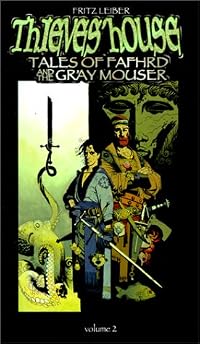
Fafhrd and the Gray Mouser search for treasure in book four of the genre-defining Sword and Sorcery series from the Grand Master of Science Fiction. Fafhrd and Mouse are not innocents; their world is no land of honor and righteousness. It is a world of human complexities and violent action, of discovery and mystery, of swords and sorcery. With Swords Against Wizardry, ,the story unfolds behind the curtain in the Witch's Tent. Fafhrd and Gray Mouser are there to consult a sorceress who show more holds the secret to their escape, but when would they ever need to escape? Would they need this knowledge when they journey to Stardock? Where is there to escape up there? No doubt the icy seduction of "the cruel one," with her greed for both gore and graciousness, could offer them several ways out. Their luck has been good so far; one way out should work. Their luck continues as thieves. They are the best thieves in Lankhmar until better positions arise: the Lords of Quarmall. Gray Mouser and Fafhrd steal a kingdom within a hill and declare themselves lords. Before The Lord of the Rings took the world by storm, Leiber's fantastic but thoroughly flawed antiheroes, Fafhrd and Gray Mouser, adventured deep within the caves of Inner Earth, albeit a different one. They wondered and wandered to the edges of the Outer Sea, across the Land of Nehwon and throughout every nook and cranny of gothic Lankhmar, Nehwon's grandest and most mystically corrupt city. Lankhmar is Leiber's fully realized, vivid incarnation of urban decay and civilization's corroding effect on the human psyche. Drawing on themes from Shakespeare, Edgar Allan Poe, and H. P. Lovecraft, master manipulator Fritz Leiber is a worldwide legend within the fantasy genre and actually coined the term Sword and Sorcery that describes the subgenre he helped create. show lessTags
Recommendations

























Member Reviews
Fritz Leiber began writing Fafhrd and Gray Mouser stories in 1939 and published his last one in 1988. Forty-nine years is an impressive run for a sword and sorcery series that began in the pulps. The barbarian Fafhrd and his diminutive thief companion, Gray Mouser, have inspired dozens of similar characters in fantasy and gaming. Leiber wanted a more hard-boiled brand of adventure than Tolkien provided. His language is both more Shakespearean and more American than Tolkien’s. Here is Gray Mouser complaining about the smell in a sorceress’s tent: “I don’t know which stinks worse, she or brazier,” he murmured. “Or maybe it’s the whole tent or this alley muck we must sit in. Or perchance her familiar is a skunk.” His show more characters have an eye for the girls, who are as libidinous as the heroines of an American thriller. His monsters are straight out of Lovecraft. In one review of Swords Against Wizardry, I was amused to find trigger warnings about body horror, torture, and sexism. Well, yes. Sure. What did you expect? show less
Swords and Wizardry is the fourth volume in Fritz Leiber’s Fafhrd and Gray Mouser series, which means that I’m past the halfway point in my re-reading now. It contains only four stories, two long novellas and two short tales serving as introductions to them. It maybe deserves some notice that the first story, “In the Witch’s Tent” was written especially for this volume, thus presumably being one of the bridge vignettes like those encountered in previous volumes which were intended to provide a consistent chronology for all the story. What is interesting about this particular one is that it does not even attempt to do any bridging, even fails to make any mention at all of Fafhrd’s and the Gray Mouser’s excursion into our show more world in “Adept’s Gambit” from Swords in the Mist. I can only assume that Leiber himself was embarrassed by this whole world-and-dimension-switching mess and chose to just conveniently forget all about it.
The two shorter stories are quite a bit of fun, especially “The Two Best Thieves in Lankhmar” (not the two you are probably thinking of), but the meat and substance of this volume are the two novellas, “Stardock” and “The Lords of Quarmall”. For some reason this novel had sunk somewhat deeper into the quagmire of the past then the other volumes and I was not sure what to expect from this particular volume, but as it turned out, I enjoyed it a lot – sufficiently so that I think it is part of the essential Fafhrd and Gray Mouser, if not for “Stardock”, then for “The Lords of Quarmall” which might just be my second-favourite Fafhrd and Gray Mouser story.
I strongly suspect that “Stardock” was at least partially inspired by the climbing of Zora Rach in E.R. Eddison’s The Worm Ouroboros (of which I happen to be a huge admirer). As good as Leiber’s writing is (when he is in top form, at least, and not just randomly turning nouns and verbs into adverbs and adjectives), it never comes anywhere near the resonant rhythms and mythopoetic imagery of Eddison’s prose. In consequence, you do not have mythic figures scaling the sublime heights of a region where man is not supposed to be, but just two guys climbing a rather oversized rock with a lot of snow and ice on it. Which does fit in with the irreverence and debunking that are generally characteristic for this series, but is not exactly suitable to make an extented mountain climb something interesting to read about. In other words. this novella drags a bit during its first half when it describes Fafhrd’s and the Gray Mouser’s ascent of Stardock in rather too much detail. Once they reach the summit, however, the story shakes off the ice it had been collecting during the climb and accelerates its glacial pacing to the fast-paced, hot-tempered words- and swordplay this series so excels at in its best moments.
“The Lords of Quarmall,” on the other hand, does not drag at all, and is in fact one of my favourite stories in the series. It is sheer brilliance from beginning to end - even though that beginning was not written by Leiber but hy one Harry Otto Fischer who apparently co-created Fafhrd and the Gray Mouser and the world of Nehwon as setting for a board game (anyone else thinking of Steven Erikson and Ian Esslemont here?). If you change the names and squint a bit, it almost reads like something written by Jack Vance, it has the bizarre setting and characters as well as the even bizarrer intrigues that are characteristic of many of that author’s works and would fit quite well into his Dying Earth setting. Those are just reminiscences however, and everything considered the novella is very much Fritz Leiber’s own (I never would have suspected that the beginning was not by him either, and in fact do suspect that he might have edited or even rewritten Fischer’s original). On a side note, “The Lords of Quarmall” demonstrates once again how the friendship between the Fafhrd and the Gray Mouser shows itself strongest when they are going their separate ways, or even working (unknowingly, in this case) against each other; it’s quite astonishing, looking back on this and previous volumes, how many of the series’ high points have its protagonists work apart from each other and one can’t help but wonder what that tells us about male friendship. In any case, this novella is pure delight, from its imaginative setting and Leiber’s sparkling prose to its twisting plot and the eerie, decadent atmosphere that pervades it. It might very well be the morst bizarre story in the series so far, bordering on the outright surreal in places, but still manages to keep it contained in a plot that for all its brisk speed still manages to take a few surprise turns along the way. show less
The two shorter stories are quite a bit of fun, especially “The Two Best Thieves in Lankhmar” (not the two you are probably thinking of), but the meat and substance of this volume are the two novellas, “Stardock” and “The Lords of Quarmall”. For some reason this novel had sunk somewhat deeper into the quagmire of the past then the other volumes and I was not sure what to expect from this particular volume, but as it turned out, I enjoyed it a lot – sufficiently so that I think it is part of the essential Fafhrd and Gray Mouser, if not for “Stardock”, then for “The Lords of Quarmall” which might just be my second-favourite Fafhrd and Gray Mouser story.
I strongly suspect that “Stardock” was at least partially inspired by the climbing of Zora Rach in E.R. Eddison’s The Worm Ouroboros (of which I happen to be a huge admirer). As good as Leiber’s writing is (when he is in top form, at least, and not just randomly turning nouns and verbs into adverbs and adjectives), it never comes anywhere near the resonant rhythms and mythopoetic imagery of Eddison’s prose. In consequence, you do not have mythic figures scaling the sublime heights of a region where man is not supposed to be, but just two guys climbing a rather oversized rock with a lot of snow and ice on it. Which does fit in with the irreverence and debunking that are generally characteristic for this series, but is not exactly suitable to make an extented mountain climb something interesting to read about. In other words. this novella drags a bit during its first half when it describes Fafhrd’s and the Gray Mouser’s ascent of Stardock in rather too much detail. Once they reach the summit, however, the story shakes off the ice it had been collecting during the climb and accelerates its glacial pacing to the fast-paced, hot-tempered words- and swordplay this series so excels at in its best moments.
“The Lords of Quarmall,” on the other hand, does not drag at all, and is in fact one of my favourite stories in the series. It is sheer brilliance from beginning to end - even though that beginning was not written by Leiber but hy one Harry Otto Fischer who apparently co-created Fafhrd and the Gray Mouser and the world of Nehwon as setting for a board game (anyone else thinking of Steven Erikson and Ian Esslemont here?). If you change the names and squint a bit, it almost reads like something written by Jack Vance, it has the bizarre setting and characters as well as the even bizarrer intrigues that are characteristic of many of that author’s works and would fit quite well into his Dying Earth setting. Those are just reminiscences however, and everything considered the novella is very much Fritz Leiber’s own (I never would have suspected that the beginning was not by him either, and in fact do suspect that he might have edited or even rewritten Fischer’s original). On a side note, “The Lords of Quarmall” demonstrates once again how the friendship between the Fafhrd and the Gray Mouser shows itself strongest when they are going their separate ways, or even working (unknowingly, in this case) against each other; it’s quite astonishing, looking back on this and previous volumes, how many of the series’ high points have its protagonists work apart from each other and one can’t help but wonder what that tells us about male friendship. In any case, this novella is pure delight, from its imaginative setting and Leiber’s sparkling prose to its twisting plot and the eerie, decadent atmosphere that pervades it. It might very well be the morst bizarre story in the series so far, bordering on the outright surreal in places, but still manages to keep it contained in a plot that for all its brisk speed still manages to take a few surprise turns along the way. show less
I thought this was an underwhelming entry in the Fafhrd and Gray Mouser saga. It's an interesting conceit - first climbing a tall mountain near Fafhrd's homeland, and then descending into a war fought in an underground kingdom - but the stories didn't grab my attention like earlier entries. I still appreciate his approach to S&S, and I'm hoping I'll enjoy the next volume.
ORIGINALLY POSTED AT Fantasy Literature.
The time has come for sorcery and swords.
After a somewhat disappointing third volume in the Lankhmar series, Fritz Leiber is back to form in Swords Against Wizardry. This book contains four stories about Fafhrd the big red-headed barbarian, and The Gray Mouser, the small wily magician-thief. Three of the stories come from the pulp magazine Fantastic and the first story was created for this volume as an introduction. The stories fit so well together that they almost feel like a novel.
“In the Witch’s Tent” is a very short introductory story in which Fafhrd and the Gray Mouser visit a witch who prophesies about the events to come in the next story.
In the novella “Stardock” (1965, show more Fantastic), our heroes and an ice-cat companion climb the forbidding mountain Stardock where they hope to find “a pouch of stars.” This story is slow in the beginning when the boys are climbing, but once they conquer Stardock, things get pretty exciting and, after leaving some incubating DNA behind, they leave the mountain with a bag of jewels that can only be seen at night. All of Fritz Leiber’s stories are gorgeously written, but “Stardock” has some of my favorite lines:
Fafhrd said dreamily, “They say the gods once dwelt and had their smithies on Stardock and from thence, amid jetting fire and showering sparks, launched all the stars; hence her name. They say diamonds, rubies, smaragds — all great gems — are the tiny pilot models the gods made of the stars... and then threw carelessly away across the world when their great work was done.”
I wish I could play those lines for you from the audio version read by Jonathan Davis. It’s beautiful.
“The Two Best Thieves in Lankhmar” (1968, Fantastic) is a fun short story that takes place after the boys return to the city after their conquest of Stardock. Apparently they got sick of each other on the way home (that happens occasionally and is a clue to the type of story that comes next), so they split up the jewels and went their separate ways. Both are trying to sell their share of the jewels, which is a problem because these gems can only be seen at night. When the story begins, the reader assumes that “The Two Best Thieves in Lankhmar” refers to Fafhrd and the Gray Mouser, but we all learn soon enough that what the Mouser says is true: Deal with a woman — surest route to disaster.
“The Lords of Quarmall" (1964, Fantastic) is one of my favorite Leiber novellas. Having split up for a time, Fafhrd and the Gray Mouser have, unbeknownst to them, each been hired to be the champion of two horrible brothers who hate each other and who want their father’s throne. The brother who hired the Mouser lives in subterranean caves underneath the brother who hired Fafhrd. Even though we can guess how the story will end, this is a creative tale with a grand setting. Fritz Leiber’s fantastic imagination is on full display in this story, and it beautifully highlights the sweet relationship these two rogues have with each other.
I can’t heap enough praise on the audio version of the Lankhmar books. Jonathan Davis is one of the best voice performers and these are some of his best performances. If you listen to audiobooks, don’t miss this series. If you don’t listen to audiobooks, listen to these and you’ll be converted. show less
The time has come for sorcery and swords.
After a somewhat disappointing third volume in the Lankhmar series, Fritz Leiber is back to form in Swords Against Wizardry. This book contains four stories about Fafhrd the big red-headed barbarian, and The Gray Mouser, the small wily magician-thief. Three of the stories come from the pulp magazine Fantastic and the first story was created for this volume as an introduction. The stories fit so well together that they almost feel like a novel.
“In the Witch’s Tent” is a very short introductory story in which Fafhrd and the Gray Mouser visit a witch who prophesies about the events to come in the next story.
In the novella “Stardock” (1965, show more Fantastic), our heroes and an ice-cat companion climb the forbidding mountain Stardock where they hope to find “a pouch of stars.” This story is slow in the beginning when the boys are climbing, but once they conquer Stardock, things get pretty exciting and, after leaving some incubating DNA behind, they leave the mountain with a bag of jewels that can only be seen at night. All of Fritz Leiber’s stories are gorgeously written, but “Stardock” has some of my favorite lines:
Fafhrd said dreamily, “They say the gods once dwelt and had their smithies on Stardock and from thence, amid jetting fire and showering sparks, launched all the stars; hence her name. They say diamonds, rubies, smaragds — all great gems — are the tiny pilot models the gods made of the stars... and then threw carelessly away across the world when their great work was done.”
I wish I could play those lines for you from the audio version read by Jonathan Davis. It’s beautiful.
“The Two Best Thieves in Lankhmar” (1968, Fantastic) is a fun short story that takes place after the boys return to the city after their conquest of Stardock. Apparently they got sick of each other on the way home (that happens occasionally and is a clue to the type of story that comes next), so they split up the jewels and went their separate ways. Both are trying to sell their share of the jewels, which is a problem because these gems can only be seen at night. When the story begins, the reader assumes that “The Two Best Thieves in Lankhmar” refers to Fafhrd and the Gray Mouser, but we all learn soon enough that what the Mouser says is true: Deal with a woman — surest route to disaster.
“The Lords of Quarmall" (1964, Fantastic) is one of my favorite Leiber novellas. Having split up for a time, Fafhrd and the Gray Mouser have, unbeknownst to them, each been hired to be the champion of two horrible brothers who hate each other and who want their father’s throne. The brother who hired the Mouser lives in subterranean caves underneath the brother who hired Fafhrd. Even though we can guess how the story will end, this is a creative tale with a grand setting. Fritz Leiber’s fantastic imagination is on full display in this story, and it beautifully highlights the sweet relationship these two rogues have with each other.
I can’t heap enough praise on the audio version of the Lankhmar books. Jonathan Davis is one of the best voice performers and these are some of his best performances. If you listen to audiobooks, don’t miss this series. If you don’t listen to audiobooks, listen to these and you’ll be converted. show less
Four stories in this one.
The first story is "In the Witch's Tent," and while it has some humorous aspects, it really just serves as a preamble to the next story.
And that story is "Stardock." Fafhrd and the Gray Mouser embark on an expedition to climb one of the highest mountain ranges in the world in search of a fabled treasure. It is said that the mountain range is so high that the gods used to dwell there and launched the stars into the night sky from the tallest peak. The gods used gems as models for the stars and then tossed them aside when they were finished.
This expedition is Fafhrd's idea, him being accustomed to cold laden lands and climbing icy peaks. Mouser is skeptical, but agrees to go anyway. Joining them is Hrissa the snow show more cat, who helps with the hunting and the fighting.
The journey makes up a good deal of the story. Leiber goes into so much detail describing climbing up the cliffs, dealing with the cold, and traversing the frozen wastes that I couldn't help but feel that he had firsthand knowledge mountain climbing, but I have no idea if he truly did.
The altitude, cold, and dwindling provisions lead Mouser to hallucinations which he dares not share with Fafhrd. But as they persist, he can't help but feel that they're real.
The third story is "The Two Best Thieves in Lankhmar." Our heroic pair have set out to sell their most recent haul, but each decides to outdo the other by selling their respective share to a jeweler or fence that each feels will give him the best price.
Women in the Fafhrd & Gray Mouser stories to this point are typically of the mother, maiden, crone variety, with maiden being the most common. But in this story, Leiber breaks out of the pattern that he's set and gives us female characters who can stand on their own.
The last story is "The Lords of Quarmall," a novella. Our heroes have had a bit of a spat and set off on their own for a while. Unbeknownst to them, each has been recruited by one of the sons of the Lord of Quarmall to serve as his champion. Both sons are adept sorcerers who despise one another. There's something of a "cold war" going on between them. Each has about a dozen sorcerers who cast spells attacking the other or defending their liege. Neither one is worth rooting for, and each of our heroes grows disillusioned with the job they've taken on. That leads to a bit of mischief. Ultimately, the cold war turns hot.
Besides the obvious familial intrigue, Lieber's Quarmall is a place where dread lurks in dark corners and forgotten rooms. The enslaved are not much more than zombies, forced to spend their lives (eternity perhaps) serving their master's needs, shambling on treadmills that turn fans that keep the air circulating in the forboding depths.
A solid collection of tales in the Fafhrd & Gray Mouser annals. show less
The first story is "In the Witch's Tent," and while it has some humorous aspects, it really just serves as a preamble to the next story.
And that story is "Stardock." Fafhrd and the Gray Mouser embark on an expedition to climb one of the highest mountain ranges in the world in search of a fabled treasure. It is said that the mountain range is so high that the gods used to dwell there and launched the stars into the night sky from the tallest peak. The gods used gems as models for the stars and then tossed them aside when they were finished.
This expedition is Fafhrd's idea, him being accustomed to cold laden lands and climbing icy peaks. Mouser is skeptical, but agrees to go anyway. Joining them is Hrissa the snow show more cat, who helps with the hunting and the fighting.
The journey makes up a good deal of the story. Leiber goes into so much detail describing climbing up the cliffs, dealing with the cold, and traversing the frozen wastes that I couldn't help but feel that he had firsthand knowledge mountain climbing, but I have no idea if he truly did.
The altitude, cold, and dwindling provisions lead Mouser to hallucinations which he dares not share with Fafhrd. But as they persist, he can't help but feel that they're real.
The third story is "The Two Best Thieves in Lankhmar." Our heroic pair have set out to sell their most recent haul, but each decides to outdo the other by selling their respective share to a jeweler or fence that each feels will give him the best price.
Women in the Fafhrd & Gray Mouser stories to this point are typically of the mother, maiden, crone variety, with maiden being the most common. But in this story, Leiber breaks out of the pattern that he's set and gives us female characters who can stand on their own.
The last story is "The Lords of Quarmall," a novella. Our heroes have had a bit of a spat and set off on their own for a while. Unbeknownst to them, each has been recruited by one of the sons of the Lord of Quarmall to serve as his champion. Both sons are adept sorcerers who despise one another. There's something of a "cold war" going on between them. Each has about a dozen sorcerers who cast spells attacking the other or defending their liege. Neither one is worth rooting for, and each of our heroes grows disillusioned with the job they've taken on. That leads to a bit of mischief. Ultimately, the cold war turns hot.
Besides the obvious familial intrigue, Lieber's Quarmall is a place where dread lurks in dark corners and forgotten rooms. The enslaved are not much more than zombies, forced to spend their lives (eternity perhaps) serving their master's needs, shambling on treadmills that turn fans that keep the air circulating in the forboding depths.
A solid collection of tales in the Fafhrd & Gray Mouser annals. show less
I was gravely disappointed, after the way Swords in the Mist ended with literally the last piece of dialog being one of my favorite characters in the whole series expressing interest in crossing realms with Fafhrd and the Grey Mouser, to see that Ahura was not even mentioned in this volume. Rating it as a stand-alone book, though, I must force myself to ignore that fact for this review, and interesting characters rarely survive the author's interest from one story within a volume to the next, let alone between books, so I wasn't surprised -- only deeply disappointed.
Overall, this book seems to show a maturing in Fritz Leiber's writing that I appreciated. For that, the book should rate slightly better than the three stars I gave it, but show more there were a couple of substantial negatives that dragged it back down. One was the way it becomes more difficult to sympathize with the "heroes" in this book than in some previous tales. They are increasingly presented as "heroes" while being less and less heroic and likable in some ways. Another is the fact that Stardock, mostly a well-written story, starts to fall apart toward the end in terms of its quality of storytelling. A third is that the story The Two Best Thieves in Lankhmar reads a bit like someone told Fritz he should portray more empowered women in his writing about Fafhrd and the Grey Mouser, but his heart wasn't in it, so he basically just phoned it in. A fourth is that the Quarmall story mixes some interesting world building with some I-don't-know-what that mostly turned me off the thing. I have mixed feelings about that tale.
I bought this whole series, up to book 5 (The Swords of Lankhmar), at a library's used book sale. It has been entertaining so far, but unless someone can tell me that Ahura reappears at some point, or gives me some other strong reason to continue reading about Fafhrd and the Grey Mouser, I'm unlikely to seek out the sixth book at all. I'll probably just consider Swords in the Mist the high point of the series and give the collection of books 1-5 to a thrift store. show less
Overall, this book seems to show a maturing in Fritz Leiber's writing that I appreciated. For that, the book should rate slightly better than the three stars I gave it, but show more there were a couple of substantial negatives that dragged it back down. One was the way it becomes more difficult to sympathize with the "heroes" in this book than in some previous tales. They are increasingly presented as "heroes" while being less and less heroic and likable in some ways. Another is the fact that Stardock, mostly a well-written story, starts to fall apart toward the end in terms of its quality of storytelling. A third is that the story The Two Best Thieves in Lankhmar reads a bit like someone told Fritz he should portray more empowered women in his writing about Fafhrd and the Grey Mouser, but his heart wasn't in it, so he basically just phoned it in. A fourth is that the Quarmall story mixes some interesting world building with some I-don't-know-what that mostly turned me off the thing. I have mixed feelings about that tale.
I bought this whole series, up to book 5 (The Swords of Lankhmar), at a library's used book sale. It has been entertaining so far, but unless someone can tell me that Ahura reappears at some point, or gives me some other strong reason to continue reading about Fafhrd and the Grey Mouser, I'm unlikely to seek out the sixth book at all. I'll probably just consider Swords in the Mist the high point of the series and give the collection of books 1-5 to a thrift store. show less
Didn't love it, and in particular the last story was a bit of a slog—some terrific moments, but overlong, with too many characters. My favourite stories so far seem to be the smallest (which surprises me, as a novel lover), perhaps only our two heroes against a mysterious force or bewildering circumstance ... but the larger the scope, the less enthused I am.
Have reason to believe book #5 is the best of the bunch, so looking forward to it—he didn't lose me, I just won't be re-reading this one.
(Note: 5 stars = amazing, wonderful, 4 = very good book, 3 = decent read, 2 = disappointing, 1 = awful, just awful. I'm fairly good at picking for myself so end up with a lot of 4s). I feel a lot of readers automatically render any book they show more enjoy 5, but I grade on a curve! show less
Have reason to believe book #5 is the best of the bunch, so looking forward to it—he didn't lose me, I just won't be re-reading this one.
(Note: 5 stars = amazing, wonderful, 4 = very good book, 3 = decent read, 2 = disappointing, 1 = awful, just awful. I'm fairly good at picking for myself so end up with a lot of 4s). I feel a lot of readers automatically render any book they show more enjoy 5, but I grade on a curve! show less
Members
- Recently Added By
Lists

Survey of Fantasy Classics
111 works; 23 members

The Seven-League Shelf
57 works; 3 members

Books Read in 2020
4,379 works; 123 members

Best Sellers / Popular 1968
237 works; 5 members
Author Information

335+ Works 26,593 Members
Some Editions
Awards and Honors
Distinctions
Series

Belongs to Publisher Series
Work Relationships
Is contained in
Common Knowledge
- Canonical title
- Swords Against Wizardry
- Original title
- Swords Against Wizardry
- Original publication date
- 1968
- People/Characters
- Fafhrd; Gray Mouser
- Important places
- Lankhmar, Nehwon; Quarmall, Nehwon; Nehwon
- Dedication
- Ce livre est dédié à Harry Otto Fischer qui fut le premier à explorer quarmall et qui, sur ce royaume souterrain, écrivit dix mille mots qui sont encore ici, dans ce récit, inchangés.
Additionnellement, la deuxième... (show all) nouvelle, Le quai des étoiles est dédié à deux alpinistes audacieux : Poul Andreson et Paul Turner.
F.L. - First words
- La vieille sorcière se pencha sur le brasier dont les volutes de fumée grise se mêlaient à ses mèches noires tombant en désordre.
- Last words
- (Click to show. Warning: May contain spoilers.)Friska, Ivivis ! Au travail, et vite ! Tous !
- Original language
- English
- Canonical DDC/MDS
- 813.087662
Classifications
- Genres
- Fantasy, Fiction and Literature
- DDC/MDS
- 813.087662 — Literature & rhetoric American literature in English American fiction in English By type Genre fiction Adventure fiction Speculative fiction Fantasy Sword and Sorcery
- LCC
- PS3523 .E458 — Language and Literature American literature American literature Individual authors 1900-1960
- BISAC
Statistics
- Members
- 1,254
- Popularity
- 19,497
- Reviews
- 27
- Rating
- (3.86)
- Languages
- 7 — Dutch, English, French, German, Polish, Spanish, Swedish
- Media
- Paper, Audiobook, Ebook
- ISBNs
- 30
- ASINs
- 21