The Wedding Procession of the Rag Doll and the Broom Handle and Who Was in It [short story]
by Carl Sandburg 
On This Page
Description
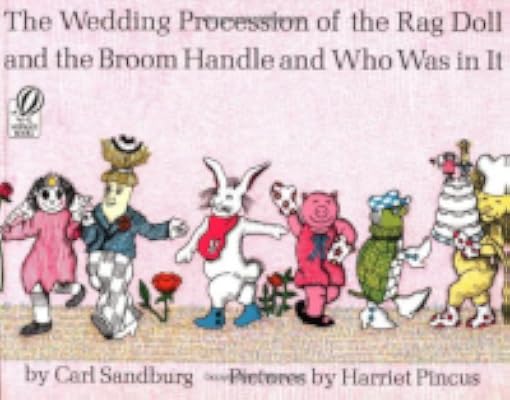
The rag doll and the broom handle marry and have a grand wedding procession that includes the Easy Ticklers, the Chubby Chubbs, and the Sleepyheads.Tags
Recommendations














Member Reviews
Carl Sandburg's Wedding Procession of the Rag Doll and the Broom Handle and Who Was In It is a fanciful tale of how the Rag Doll and the Broom Handle came to be husband and wife. Although some might consider this more of a fairy tale or fantasy book, I would argue it to be a good way to slowly introduce children to the idea of wedding ceremonies and marriage. I didn't care for this particular book due to it's garish illustrations. I still hold the belief that stories featuring personified objects, animals, or even made up creatures can be realistic. The little bit of fantasy just helps make some topics more approachable to younger audiences- and sometimes even adults!
A very strange book about the wedding of rag doll and broom handle. The book follows each set of people in the procession after retelling rag doll's and broom handle's romance. The book is filled with very strange people like spoon licker and clean ears. The illustrations perfectly match this strangeness to create a total surreal experience. Not much of a wedding book in terms of teaching about ceremonies and love.
For Rag Doll and the Broom Handles wedding, they had the best procession of all. They had a line of spoon lickers, music furnished by soup spoons, etc. The wedding was full of exciting surprises!
This one was a gift from a fellow bookcrosser.
Ratings
Members
- Recently Added By
Author Information

236+ Works 13,054 Members
The son of Swedish immigrants, Sandburg was born in Galesburg, Illinois. At age 13 he left school to roam the Midwest; he remained on the road for six years, working as a day laborer. Sandburg served in the Spanish-American War and then, from 1898 to 1902, attended Lombard College in Galesburg. After college, he went to Milwaukee, where he worked show more as a journalist; he also married Lillian Steichen there in 1908. During World War I, he served as a foreign correspondent in Stockholm; after the war he returned to Chicago and continued to write about America, especially the common people. Sandburg's first poems to gain wide recognition appeared in Poetry magazine in 1914. Two years later he published his Chicago Poems (1916), and Cornhuskers appeared in 1918. Meanwhile, Sandburg set out to become an authority on Abraham Lincoln (see Vol. 3). His exhaustive biography of the president, which took many years to complete, appeared as Abraham Lincoln: The Prairie Years (2 vols., 1926) and Abraham Lincoln: The War Years (4 vols., 1939), which won a Pulitzer Prize. Sandburg's poetry is untraditional in form. Drawing on Whitman as well as the imagists, its rhymeless and unmetered cadences reflect Midwestern speech, and its diction ranges from strong rhetoric to easygoing slang. Although he often wrote about the uncouth, the muscular, and the primitive, there was a pity and loving kindness that was a primary motive for his poetry. At Sandburg's death, Mark Van Doren, Archibald MacLeish, and President Lyndon Johnson delivered eulogies. In his tribute, President Johnson said that "Carl Sandburg was more than the voice of America, more than the poet of its strength and genius. He was America. . . . He gave us the truest and most enduring vision of our own greatness." The N.Y. Times described Sandburg as "poet, newspaper man, historian, wandering minstrel, collector of folk songs, spinner of tales for children, [whose] place in American letters is not easily categorized. But it is a niche that he has made uniquely his own." Sandburg was the labor laureate of the United States. Sandburg received the Pulitzer Prize for poetry in 1951 for his Complete Poems (1950). Among his many other awards were the gold medal for history and biography (1952) from the American Academy of Arts and Letters; the Poetry Society of America's gold medal (1953) for distinguished achievement; and the Boston Arts Festival Award (1955) in recognition of "continuous meritorious contribution to the art of American poetry." In 1959 he traveled under the auspices of the Department of State to the U.S. Trade Fair in Moscow, and to Stockholm, Paris, and London. In 1960 he received a citation from the U.S. Chamber of Commerce as a great living American for the "significant and lasting contribution which he has made to American literature." (Bowker Author Biography) show less
Carl Sandburg has a Legacy Library. Legacy libraries are the personal libraries of famous readers, entered by LibraryThing members from the Legacy Libraries group.
Awards and Honors
Work Relationships
Is contained in
Common Knowledge
- Canonical title
- The Wedding Procession of the Rag Doll and the Broom Handle and Who Was in It [short story]
Classifications
Statistics
- Members
- 89
- Popularity
- 361,383
- Reviews
- 4
- Rating
- (3.63)
- Languages
- English
- Media
- Paper, Ebook
- ISBNs
- 5
- UPCs
- 1
- ASINs
- 1