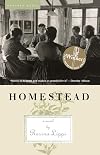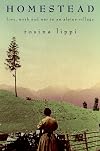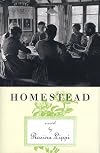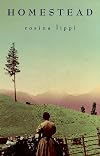
Homestead
by Rosina Lippi
On This Page
Description
Homestead, set in an Alpine village, spans the 20th century, and puts at the heart of each chapter a different woman, at a point in her life when her long-suppressed desire or anger or jealousy flares briefly into vivid life only to die back again.Tags
Recommendations











Member Recommendations
by gust

Member Reviews
There's a surprising amount of depth and meaning in this slim novel, that builds slowly and quietly through each of its 12 chapters. The story is set in a remote region of the Austrian alps, and told in the voices of women from 1909 to 1977, who managed life, love, and family on their rural homestead.
Life was hard: subsistence farming, few "modern conveniences," limited educational opportunities, and a clear but restrictive definition of a woman's role. Most women made do and were happy; some worked hard to escape. In the opening chapter, Anna, a young mother, receives a mysterious postcard which appears to be from a long lost lover. The post-mistress makes sure everyone knows about it, causing much gossip. Anna imagines the writer and show more his lifestyle and composes an elaborate reply, which she later abbreviated to a simple acknowledgement and apology, because his card has been misdirected. As this unfolds, the reader is also introduced to Anna's husband and children, characters who will figure prominently in later chapters.
In a rural area such as this, everyone seems to be related to everyone else. Thankfully Rosina Lippi included clan charts showing the genealogy of each homestead. While careful study of these while reading reveals small spoilers, I found them invaluable to keep track of generations and relationships.
Every one of these women was amazing, in their capacity for physical labor, and their commitment to families and to one another. Each chapter reveals details about those who came before, some of which were closely guarded family secrets. This provided the depth I mentioned before, and usually sent me off to re-read earlier chapters, taking new facts into account. When I reached the end, I felt like I had an incredibly rich tapestry in my hands, and I stood back to admire Lippi's achievement. show less
Life was hard: subsistence farming, few "modern conveniences," limited educational opportunities, and a clear but restrictive definition of a woman's role. Most women made do and were happy; some worked hard to escape. In the opening chapter, Anna, a young mother, receives a mysterious postcard which appears to be from a long lost lover. The post-mistress makes sure everyone knows about it, causing much gossip. Anna imagines the writer and show more his lifestyle and composes an elaborate reply, which she later abbreviated to a simple acknowledgement and apology, because his card has been misdirected. As this unfolds, the reader is also introduced to Anna's husband and children, characters who will figure prominently in later chapters.
In a rural area such as this, everyone seems to be related to everyone else. Thankfully Rosina Lippi included clan charts showing the genealogy of each homestead. While careful study of these while reading reveals small spoilers, I found them invaluable to keep track of generations and relationships.
Every one of these women was amazing, in their capacity for physical labor, and their commitment to families and to one another. Each chapter reveals details about those who came before, some of which were closely guarded family secrets. This provided the depth I mentioned before, and usually sent me off to re-read earlier chapters, taking new facts into account. When I reached the end, I felt like I had an incredibly rich tapestry in my hands, and I stood back to admire Lippi's achievement. show less
Have you ever selected a book with a good feeling you're going to love it? The story premise sounds interesting, other readers write glowing reviews - even the book cover grabs your interest. Then when you finish the book, you're so excited that you actually loved the book, just like you thought you would? That's exactly how it went for me with my latest book, Homestead by Rosina Lippi.
Homestead is a collection of tales told from the perspective of different women who live in a remote Austrian village from 1909-1977. To help tie their stories together, Lippi provides clan family trees at the beginning of the book. As you're introduced to each woman's chapter, you see her name and clan affiliation, which helps you understand her show more connection with the other characters in the story. While a woman may be featured in her chapter, she'll appear in other chapters as well. It was a great way to build up different perspectives on the same people.
The women's stories individually are moving, but when taken as a whole, create a fabulous book. Themes of love, loss, deception, greed, farming and raising family all permeate the narratives. The themes are universal, but it's the way Lippi fuses in the Austrian dialect and customs that make Homestead a unique historical read.
Shortlisted for the Orange Prize in 2001, Homestead is exactly why I advocate this award. Without its Orange Prize distinction, I may not have found Homestead, which would have been my loss. I hope other readers who enjoy provocative fiction will consider reading this exquisite book. I can't recommend it enough. show less
Homestead is a collection of tales told from the perspective of different women who live in a remote Austrian village from 1909-1977. To help tie their stories together, Lippi provides clan family trees at the beginning of the book. As you're introduced to each woman's chapter, you see her name and clan affiliation, which helps you understand her show more connection with the other characters in the story. While a woman may be featured in her chapter, she'll appear in other chapters as well. It was a great way to build up different perspectives on the same people.
The women's stories individually are moving, but when taken as a whole, create a fabulous book. Themes of love, loss, deception, greed, farming and raising family all permeate the narratives. The themes are universal, but it's the way Lippi fuses in the Austrian dialect and customs that make Homestead a unique historical read.
Shortlisted for the Orange Prize in 2001, Homestead is exactly why I advocate this award. Without its Orange Prize distinction, I may not have found Homestead, which would have been my loss. I hope other readers who enjoy provocative fiction will consider reading this exquisite book. I can't recommend it enough. show less
High in the Austrian Alps a postcard arrives in the remote village of Rosenau addressed to ‘Anna Fink’. Due to naming conventions there are nine potential recipients for the postcard. The mystery and discussion the missive elicits is our introduction to a close-knit community where the lives of Rosenau’s inhabitants are forever intertwined.
Beginning in 1909 with Anna’s story, for whom the arrival of the postcard is the start of a revealing personal journey, we follow the lives of Rosenau’s women and their families through the generations up until 1977. The story is structured as a series of 12 short chapters each from the point of view of a different woman. There are many inter-relationships between these women, which is show more emphasised by many of the characters having their stories concluded via another’s chapter later in the book.
Early in the 20th century Rosenau is secluded and rural with the villagers living in the traditional way. Over the course of the eight decades covered are two World Wars, rationing, occupation and the rise of industrialism, with the wars taking a terrible toll on the village clans and industrialisation changing their traditional lifestyle.
At some points I did find it a little hard to keep track of all the relationships, but there are three clan charts included at the beginning of my edition which were really helpful. There was also a glossary, pronunciation guide and information on naming conventions which highlighted important and interesting aspects of traditional Austrian clan life.
Lippi herself spent a number of years in Austria, and as a result this is a richly observed story, told with gentle compassion, of the universal wants and needs of women everywhere, and filled with details of village life in the Alps. As one reviewer put it “the women of this book are deeply and uniquely of their place”, and this is a great strength of Homestead, that Lippi can so deftly evoke a place and way of life that is quite foreign to most of us.
I devoured this book, and highly recommend it. show less
Beginning in 1909 with Anna’s story, for whom the arrival of the postcard is the start of a revealing personal journey, we follow the lives of Rosenau’s women and their families through the generations up until 1977. The story is structured as a series of 12 short chapters each from the point of view of a different woman. There are many inter-relationships between these women, which is show more emphasised by many of the characters having their stories concluded via another’s chapter later in the book.
Early in the 20th century Rosenau is secluded and rural with the villagers living in the traditional way. Over the course of the eight decades covered are two World Wars, rationing, occupation and the rise of industrialism, with the wars taking a terrible toll on the village clans and industrialisation changing their traditional lifestyle.
At some points I did find it a little hard to keep track of all the relationships, but there are three clan charts included at the beginning of my edition which were really helpful. There was also a glossary, pronunciation guide and information on naming conventions which highlighted important and interesting aspects of traditional Austrian clan life.
Lippi herself spent a number of years in Austria, and as a result this is a richly observed story, told with gentle compassion, of the universal wants and needs of women everywhere, and filled with details of village life in the Alps. As one reviewer put it “the women of this book are deeply and uniquely of their place”, and this is a great strength of Homestead, that Lippi can so deftly evoke a place and way of life that is quite foreign to most of us.
I devoured this book, and highly recommend it. show less
Loved this very much, though sometimes writing a little kitsch, what saves it is the underlying strength, the things that are mentioned briefly or left to you to conclude, I want to read it again, always a good sign. In short: the book covers 70 years in one isolated Austrian village during the 20th century. The first chapter takes place in 1901, the world as seen by one Anna Fink. We learn more and more each time viewing the world from a different angle as a different woman is given a voice, sometimes a very young one, sometimes an older one. Lippi is an intelligent, thoughtful writer. I look forward to more from her.
Some lovely scenes of the pastoral idyll of Austria earlier in the 20th century, but generally not much going on and fairly dull.
The story of women from an Austrian village that spans from the early 1900s to the 70s. Watching the town change through time was interesting and seeing how the peoples' lives were intertwined was equally as interesting. I don't often enjoy books where you have to keep so many people straight that you need a family tree, but the storytelling in this instance was just what I needed to become part of what I was reading. In a way, I felt as if I had visited the place and met the people.
There is much about humanity said in these pages, just as there is much about living in a small village and in a time when the sexes weren't exactly thought of as equal. There is somewhat of a surprise at the end, though I wouldn't want to give it away. I show more found certain aspects of the book predictable, though even then I enjoyed what I was reading. The book was a winner or nominee for several awards and I can easily see why. show less
There is much about humanity said in these pages, just as there is much about living in a small village and in a time when the sexes weren't exactly thought of as equal. There is somewhat of a surprise at the end, though I wouldn't want to give it away. I show more found certain aspects of the book predictable, though even then I enjoyed what I was reading. The book was a winner or nominee for several awards and I can easily see why. show less
'Homestead' is not the sort of book I usually read, but I found it interesting, as it was set in a remote community with a distinctive culture that I knew nothing about. It is a set of short stories about the lives of women living in an isolated village in the Austrian Alps between the 1900's and the 1970's.
Members
- Recently Added By
Published Reviews
ThingScore 88
This is a novel of great depth, compassion and tenderness.
added by rosinalippi
In a series of interconnected vignettes spanning 1909-77, Lippi breathes life into the village of Rosenau, an isolated dairy-farming community nestled in the Austrian Alps. Each chapter focuses on a segment of different women's lives, mainly: Anna, a young wife living in a household run by her mother-in-law, who receives a postcard from an outside man and sets the whole village talking; show more Johanna, a spinster living with her sister's family, who falls in love with an Italian deserter in her beloved alpine meadow and lives with the secret for the next 50 years; Angelika, Johanna's sister, who measures her own worth by the quality of the cheese she makes for her husband; and Katharina, who desperately wants to ride in one of the new automobiles of the Nazi soldiers. The simple lifestyle and Lippi's eloquent descriptions bring to life a world alien to the modern one yet brimming with emotions and events of universal understanding, evoking children's author Kate Seredy's Good Master and Singing Tree. An outstanding read. Melanie Duncan show less
added by rosinalippi
A debut collection of 12 linked stories portraying the life of a small Austrian village and its inhabitants over the course of the 20th century. Rosenau is not the sort of place that you can expect to find on a map, let alone in many novels. A remote hamlet in the Alpine foothills of western Austria, it is ancient but not especially picturesque and would probably disappoint any tourist who show more happened across it. Nearly all of its people are farmers, farmers wives, and farmers children, and the few civic officials who reside there the priest, the schoolteacher, the postmistress, and so on deal with farmers all day long and become inevitably agrarian themselves. Externally uneventful, its an intensely domestic environment and most of its dramas occur within one household or another. Lippi understands and makes good use of the stories there, which occur among people who know or are related to everyone else and become marvelously cyclical and haunting. A lovers postcard addressed only to Anna Fink arrives in 1909, for example, and causes confusion because there are at least three women of that name in town. A lonely spinster working her brothers farm in 1916 gives shelter to an Italian deserter and is plagued by him after he leaves, while other women somehow have to survive the deaths or mutilations of their sons or husbands. In 1938, a Nazi medical functionary arrives in search of two retarded brothers, soon to be transferred to an institution elsewhere; the brothers are turned over to their deaths by their loving but ignorant [aunt]. Years later, the inhabitants find themselves hauntedsometimes literallyby those who died or disappeared at the front. Many of the women, unable to find a man to marry after the war, become sharp-eyed but wistful observers of the town and its lifeand narrators of its stories. Delicate and a trifle introspective, but very fine and moving. Lippi has a clear eye and a sharp tongue. show less
added by rosinalippi
Lists

Favourite Women's Prize for Fiction, Orange & Bailey's Prize contenders
132 works; 52 members

I Could Live There
185 works; 12 members
Author Information

29+ Works 8,944 Members
Rosina Lippi was born in Chicago, Illinois on January 14, 1956. She received a PhD in linguistics from Princeton University. Before becoming a full-time writer, she worked as a professor. She writes the Wilderness series under the pen name Sara Donati. Her title The Gilded Hour is a New York Times bestseller. (Bowker Author Biography)

Sara Donati is a LibraryThing Author, an author who lists their personal library on LibraryThing.
Awards and Honors
Common Knowledge
- Canonical title
- Homestead
- Original publication date
- 1998
- People/Characters
- Mikatrin Sutterluty; Johanna Lang; Anna Fink; Marie Metzler (Grumpy Marie); The Wainwright (Ignaz Metzler); Katharina Metzler (show all 10); Olga Natter; Lillimarlene Natter; Angelika Feuerstein; Martha Feuerstein
- Important places
- Bregenzerwald, Vorarlberg, Austria; Bregenz Forest, Vorarlberg, Austria; Rosenau, Austria
- Important events
- World War I; World War II; Nazi annexation of Austria
- Dedication
- For Marlies, who shows me how to be a mother
For Elisabeth, who makes a mother of me - First words
- "Man Proposes GOD Disposes" read the faded proclamation painted across the shingles above the Wainwright's door.r
- Last words
- (Click to show. Warning: May contain spoilers.)After a time, she knew that it could not, that he could not, and she shook herself, and went down to him.
- Blurbers
- Bloom, Amy; Allison, Dorothy; Baxter, Charles; Brown, Rosellen
Classifications
Statistics
- Members
- 493
- Popularity
- 61,565
- Reviews
- 16
- Rating
- (3.88)
- Languages
- 6 — Catalan, Chinese, Dutch, English, German, Spanish
- Media
- Paper, Ebook
- ISBNs
- 17
- UPCs
- 1
- ASINs
- 1